Hackberry
Celtis occidentalis
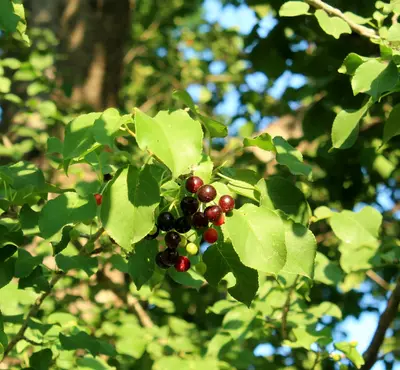
A tough, adaptable native tree that thrives where other shade trees struggle, making it perfect for challenging sites and urban environments. This undemanding tree grows quickly into a graceful, vase-shaped canopy that provides excellent filtered shade through its small, elm-like leaves. Wildlife enthusiasts love hackberry for its small berries that feed over 40 bird species throughout fall and winter.
Sun
Full sun to partial shade
Zones
3–9
USDA hardiness
Height
40-100 feet
Planting Timeline
Showing dates for Hackberry in USDA Zone 7
All Zone 7 shade-tree →Zone Map
Click a state to update dates
Hackberry · Zones 3–9
Growing Details
Complete Growing Guide
Light: Deep shade (Less than 2 hours to no direct sunlight), Full sun (6 or more hours of direct sunlight a day), Partial Shade (Direct sunlight only part of the day, 2-6 hours). Soil: Clay, High Organic Matter, Loam (Silt), Sand, Shallow Rocky. Soil pH: Acid (<6.0), Alkaline (>8.0), Neutral (6.0-8.0). Drainage: Good Drainage, Moist, Occasionally Dry. Height: 40 ft. 0 in. - 100 ft. 0 in.. Spread: 40 ft. 0 in. - 60 ft. 0 in.. Spacing: 24-60 feet, more than 60 feet. Growth rate: Rapid. Maintenance: Medium. Propagation: Seed. Regions: Coastal, Piedmont.
Harvesting
Female flowers give way to an often abundant fruit crop of round fleshy berry-like drupes maturing to deep purple. Each drupe has one round brown seed within. Birds consume the fruits and disperse the seeds. The globular fruit is borne singly on stems 1/2 to 3/4 of an inch long. It ripens in September, but often remains on the tree through the winter.
Color: Orange, Purple/Lavender, Red/Burgundy. Type: Berry, Drupe. Length: < 1 inch. Width: < 1 inch.
Garden value: Edible
Harvest time: Fall
Edibility: Fleshy parts of the fruit are edible and somewhat sweet. Can be eaten raw or used for making jellies and preserves.
Storage & Preservation
Hackberry berries are best stored fresh in the refrigerator at 32-40°F in a breathable container, where they'll keep for 1-2 weeks. For longer preservation, dry the berries by spreading them in a single layer in a warm, well-ventilated area for 2-3 weeks until brittle. Store dried berries in airtight containers in a cool, dark place for up to 6 months. Alternatively, freeze fresh berries on a tray before transferring to freezer bags for 8-12 months of storage. A third option is to ferment the berries with salt and herbs to create a traditional preserve.
History & Origin
Origin: Central & E. Canada to N. & E. U.S.A
Advantages
- +Attracts: Butterflies, Moths, Pollinators, Small Mammals, Songbirds
- +Edible: Fleshy parts of the fruit are edible and somewhat sweet. Can be eaten raw or used for making jellies and preserves.
- +Fast-growing
Companion Plants
Wild ginger and ferns belong under a hackberry because all three tolerate dry shade — once the canopy closes at 10-15 years, that ground layer gets little rain and heavy root competition, and most ornamentals just give up. Redbud (Cercis canadensis) pairs well at 15-20 feet out; it occupies a lower canopy layer and blooms in early spring before hackberry leafs out, so the two aren't fighting for the same light window. Keep Kentucky bluegrass out of a 40-foot radius — it's a high-water-demand turf that actively outcompetes hackberry's surface feeder roots and shuts out the native groundcovers that thrive in the leaf litter. Pine trees are a problem for a different reason: their needle drop pushes soil pH below hackberry's 6.0 tolerance floor over time.
Plant Together
Wild Ginger
Thrives in shade conditions under hackberry canopy, provides natural groundcover
Redbud
Compatible understory tree that tolerates hackberry's filtered shade
Spicebush
Native shrub that benefits from hackberry's wind protection and partial shade
Coral Bells
Shade-tolerant perennial that complements hackberry's root zone without competition
Wild Columbine
Adapts well to dappled shade and benefits from hackberry's leaf litter mulch
Ferns
Thrive in the moist, shaded environment created by hackberry's canopy
Virginia Creeper
Provides additional wildlife habitat while tolerating hackberry's shade
Hosta
Shade-loving perennial that benefits from hackberry's consistent canopy cover
Keep Apart
Black Walnut
Produces juglone which is toxic to hackberry and inhibits its growth
Pine Trees
Acidifies soil significantly, creating inhospitable conditions for hackberry
Kentucky Bluegrass
Competes aggressively for surface water and nutrients that hackberry needs
Pests & Disease Resistance
Resistance
Very disease resistant
Common Pests
Hackberry nipple gall, witches broom, psyllids
Diseases
Generally disease-free, occasional witches broom
Troubleshooting Hackberry
What you'll see, why it happens, and what to do about it.
Small, wart-like bumps (galls) clustered on leaf undersides, often causing leaf curl
Likely Causes
- Hackberry nipple gall psyllid (Pachypsylla celtidismamma) — tiny insects that inject tissue during bud break, triggering abnormal growth
- High psyllid populations from previous season overwintering in bark crevices
What to Do
- 1.No treatment is needed for tree health — galls are cosmetic and don't kill the tree
- 2.Rake and dispose of fallen leaves in autumn to reduce overwintering psyllid numbers
- 3.If infestation is severe on a young tree under 10 feet tall, a dormant oil spray in early spring before bud break can knock back psyllid populations
Dense, broom-like clusters of twigs sprouting from branches, looking like bird nests year-round
Likely Causes
- Witches broom — caused by a combination of the powdery mildew fungus Sphaerotheca phytoptophila and the eriophyid mite Eriophyes celtis acting together
- Common on Celtis occidentalis; considered a near-universal trait of the species at maturity
What to Do
- 1.Prune out affected branches 6-8 inches below the broom cluster if appearance matters on a specimen or street tree
- 2.Disinfect pruning tools between cuts with a 10% bleach solution to avoid spreading mite-borne material
- 3.No chemical control is reliably effective — accept it as a species characteristic or select a less susceptible cultivar
Young tree under 3 years showing wilted, scorched leaves in midsummer despite adequate rainfall
Likely Causes
- Transplant shock — hackberry has a coarse root system that resents disturbance and takes 1-2 full seasons to re-establish
- Planting too deep, burying the root flare below grade and cutting off oxygen to feeder roots
What to Do
- 1.Water deeply once a week (1-1.5 inches) during the first two summers; after that, hackberry genuinely doesn't need the help
- 2.Check the root flare — it should sit at or just above soil grade; backfill if it was planted too deep
- 3.Mulch a 3-4 foot ring around the base with 2-3 inches of wood chips, keeping mulch clear of the trunk
Stunted growth and pale yellow-green leaves on a tree planted near an established black walnut
Likely Causes
- Juglone toxicity — black walnut (Juglans nigra) releases juglone from its roots, toxic to many woody plants within roughly 50-60 feet of the trunk
- Young hackberries are more affected than established ones; trees under 4 feet are most vulnerable
What to Do
- 1.Move young trees at least 60 feet from the walnut's drip line before the taproot sets — once a hackberry passes 6 feet, transplanting gets very hard
- 2.If relocation isn't possible, improve drainage; juglone binds to soil particles and concentrates worse in waterlogged spots
- 3.No amendment neutralizes juglone in the ground — distance is the only fix that actually works
Frequently Asked Questions
How long does it take for a hackberry tree to produce berries?▼
Is hackberry a good shade tree for beginners?▼
Can hackberry trees grow in urban environments?▼
What do hackberry berries taste like?▼
How much sun does a hackberry tree need?▼
What pests affect hackberry trees?▼
Zone-by-Zone Planting Calendar
Growing Guides from Wind River Greens
Sources & References
External authority sources used in compiling this guide.
- ExtensionNC State Extension
See the Methodology page for how this data is sourced, what's AI-assisted, and known limitations.