Crimson King Maple
Acer platanoides 'Crimson King'
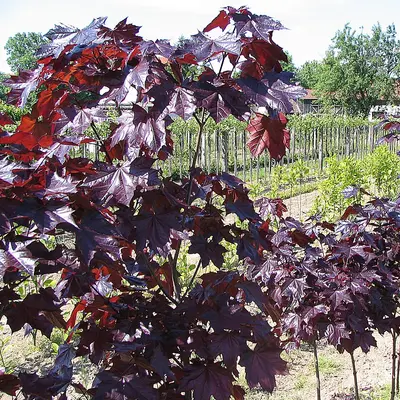
A stunning cultivar of Norway Maple that maintains deep burgundy-red foliage throughout the entire growing season. This fast-growing shade tree creates a dramatic focal point in any landscape with its rich purple-red leaves that seem to glow when backlit by sunlight. Perfect for homeowners wanting bold color without sacrificing the classic maple tree shape.
Sun
Full sun to partial shade
Zones
3–7
USDA hardiness
Height
40-50 feet
Planting Timeline
Showing dates for Crimson King Maple in USDA Zone 7
All Zone 7 shade-tree →Zone Map
Click a state to update dates
Crimson King Maple · Zones 3–7
Growing Details
Complete Growing Guide
Plant Crimson King Maple in spring or fall when soil moisture is consistent, as this cultivar is more sensitive to drought stress than standard Norway Maples. It thrives in full sun to partial shade, though at least six hours of direct sunlight daily intensifies its signature deep burgundy foliage—shade causes color to fade toward green. These trees prefer slightly acidic, well-drained soil and struggle in compacted clay. Watch closely for verticillium wilt, a fungal disease that affects this variety more readily than others, causing sudden wilting and branch dieback; there's no cure, so prevention through proper spacing for air circulation and avoiding soil-borne transmission is critical. One practical tip: apply 2-3 inches of organic mulch around the base to regulate soil temperature and moisture, reducing transplant shock and disease pressure during establishment.
Light: Full sun (6 or more hours of direct sunlight a day), Partial Shade (Direct sunlight only part of the day, 2-6 hours). Soil: Clay, Loam (Silt), Shallow Rocky. Drainage: Good Drainage, Moist, Occasionally Dry. Height: 40 ft. 0 in. - 50 ft. 0 in.. Spread: 30 ft. 0 in. - 50 ft. 0 in.. Growth rate: Medium. Maintenance: High. Propagation: Seed.
Harvesting
Since the Crimson King Maple is an ornamental shade tree rather than a fruit-bearing plant, traditional harvesting does not apply. However, if managing this tree for propagation, collect seeds when the winged samaras turn from green to tan or brown, typically in late summer to early fall. Visual readiness appears as the seed wings develop a papery texture and begin to lighten in color. Harvest occurs once during the season as seeds mature simultaneously, rather than in multiple pickings. Timing is critical—collect seeds shortly after they begin dropping naturally but before they disperse completely on the wind, usually between late August and September depending on your climate zone.
1.5"-2" long horizontally spreading wings mature September to October.
Color: Brown/Copper. Type: Samara. Length: 1-3 inches.
Harvest time: Fall
Storage & Preservation
Not applicable for shade trees. Crimson King Maple is a living ornamental plant maintained in the landscape, not harvested for storage. Tree care focuses on year-round maintenance: water regularly during establishment (first 1-2 years), mulch around the base to retain moisture and regulate soil temperature, and prune only to remove dead or crossing branches in late winter. No preservation methods apply, as the tree remains rooted in its growing location.
History & Origin
Originating as a cultivar of Norway Maple (Acer platanoides), the Crimson King was selected from seedling populations for its distinctive deep red foliage that persists throughout the growing season, a trait uncommon in most Norway Maple varieties. While specific breeder attribution and exact selection date remain poorly documented in readily available sources, the cultivar emerged through mid-twentieth-century horticultural breeding efforts focused on developing ornamental maples with enhanced color characteristics. The cultivar became widely propagated and commercialized through the nursery trade, establishing itself as a popular landscape tree. Its introduction likely occurred in Europe before gaining prominence in North American gardens, though comprehensive historical records of its origin point remain limited.
Origin: Northeastern Europe
Advantages
- +Maintains vibrant deep burgundy-red foliage throughout the entire growing season
- +Fast-growing shade tree that quickly establishes and fills landscape spaces
- +Stunning purple-red leaves create dramatic focal points with backlighting effects
- +Easy to grow with minimal care requirements for most gardeners
- +Classic maple tree shape provides elegant structure without unusual forms
Considerations
- -Highly susceptible to aphid infestations that can weaken tree vigor
- -Vulnerable to verticillium wilt and tar spot fungal diseases
- -Invasive root system can damage foundations, sidewalks, and underground utilities
- -Produces abundant winged seeds that create excessive seedling volunteers nearby
Companion Plants
The shade-tolerant plants that pair well with Crimson King — Hosta, Astilbe, Coral Bells (Heuchera), and Ferns — work for a straightforward reason: the tree is going to cast dense shade, and these plants are built for it. They stay low enough (most under 24 inches) that canopy light competition isn't a factor, and their shallow fibrous roots don't fight the maple's wide lateral root system at the 6-12 inch depth where most of the feeding happens. Wild Ginger is worth singling out as a ground cover directly under the drip line — it spreads slowly but fills in reliably where almost nothing else will bother.
Grass lawns fail here not because of any chemical antagonism, but because turfgrass and maples pull from the same top few inches of soil moisture — and the grass loses, leaving a patchy dead ring that looks worse than bare mulch. Roses need full sun and good airflow; next to a 40-50 foot maple they'll produce almost nothing and pick up black spot all season. Keep tomatoes clear too — they're confirmed Verticillium hosts, and repeated planting near the root zone builds up soil inoculum that a Norway maple cultivar like 'Crimson King' is already susceptible to.
Plant Together
Hosta
Thrives in the shade provided by the maple and complements its root system without competition
Astilbe
Flourishes in partial to full shade and adds colorful blooms under the maple canopy
Coral Bells
Tolerates shade well and provides attractive foliage contrast to the maple's deep red leaves
Ferns
Natural woodland companions that thrive in the cool, moist conditions under maple trees
Impatiens
Shade-loving annuals that provide continuous color throughout the growing season
Caladium
Colorful shade perennials that complement the maple's dramatic foliage
Wild Ginger
Native groundcover that naturalizes well under maples and helps retain soil moisture
Begonia
Shade-tolerant flowering plants that add brightness to the understory
Keep Apart
Tomatoes
Maple roots compete aggressively for nutrients and water, stunting tomato growth
Grass Lawn
Struggles to grow in deep shade and competes with shallow maple roots for resources
Roses
Require full sun and struggle in maple shade while competing for nutrients
Pests & Disease Resistance
Resistance
Generally healthy, some susceptibility to verticillium wilt
Common Pests
Aphids, scale insects, maple gall mites
Diseases
Verticillium wilt, tar spot, anthracnose
Troubleshooting Crimson King Maple
What you'll see, why it happens, and what to do about it.
Sticky residue on leaves and branches, often accompanied by black sooty mold coating the upper canopy
Likely Causes
- Aphid colonies (commonly Norway maple aphid, Periphyllus lyropictus) feeding on new growth and excreting honeydew
- Soft scale insects clustering along stems and leaf undersides
What to Do
- 1.Blast affected branches with a strong stream of water to knock aphids off — repeat every 3-4 days for two weeks
- 2.Apply insecticidal soap (2% solution) directly to infested areas in the evening to avoid leaf scorch
- 3.Encourage natural predators by avoiding broad-spectrum insecticides; lacewings and ladybugs will work the colony down on their own given time
Large, irregular black or tar-colored spots on upper leaf surfaces appearing mid-summer, leaves otherwise intact
Likely Causes
- Tar spot fungus (Rhytisma acerinum or R. punctatum) — cosmetic fungal infection that overwinters in fallen leaf litter
What to Do
- 1.Rake and bag every fallen leaf in autumn — don't compost them, as the fungal spores survive standard home compost piles
- 2.Don't panic: tar spot doesn't threaten the tree's health or longevity, just its looks
- 3.If it's severe two years running, a preventive copper-based fungicide applied at bud break in spring can reduce infection load
One or more branches wilting and dying back progressively, with olive-green or brown streaking visible in the sapwood when you cut into an affected branch
Likely Causes
- Verticillium wilt (Verticillium dahliae or V. albo-atrum) — soil-borne fungus that colonizes the vascular system
- Planting in a bed with a history of tomatoes, potatoes, or strawberries, which are known Verticillium hosts
What to Do
- 1.Prune out wilted branches at least 6 inches below any visible streaking; sterilize your saw with 70% isopropyl alcohol between cuts
- 2.Water consistently and fertilize lightly with a balanced 10-10-10 to reduce stress — a healthy tree can compartmentalize mild infections
- 3.If more than 30-40% of the canopy is affected, call a certified arborist; there is no chemical cure once the vascular system is involved
Irregular brown, papery patches on leaf edges and between veins appearing in spring shortly after leaf-out, sometimes with early leaf drop
Likely Causes
- Anthracnose (Discula sp.) — fungal disease that thrives in cool, wet spring weather around 50-60°F
- Poor air circulation from overhead structures or dense plantings within 10-15 feet
What to Do
- 1.Rake and remove fallen infected leaves promptly to break the disease cycle
- 2.Avoid overhead irrigation on the canopy; water at the root zone instead
- 3.A single application of chlorothalonil-based fungicide at bud break can help in years with consistently wet springs, but most established trees outgrow the damage without intervention