Sweet Pepper 'California Wonder'
Capsicum annuum 'California Wonder'
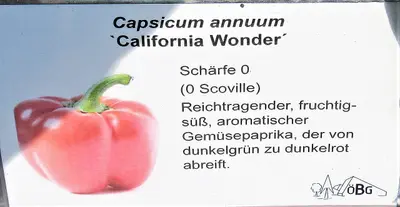
The gold standard for home garden bell peppers since 1928, this reliable heirloom produces thick-walled, blocky peppers that are perfect for stuffing, grilling, or eating fresh. Known for consistent production and excellent disease resistance, it's the variety that taught generations of gardeners how to grow peppers successfully. The classic choice that never goes out of style.
Harvest
70-75d
Days to harvest
Sun
Full sun
Zones
4–11
USDA hardiness
Height
1-3 feet
Planting Timeline
Showing dates for Sweet Pepper 'California Wonder' in USDA Zone 7
All Zone 7 pepper →Zone Map
Click a state to update dates
Sweet Pepper 'California Wonder' · Zones 4–11
Growing Details
Succession Planting
California Wonder keeps setting fruit on the same plant across the whole season, so you don't need to stagger multiple plantings the way you would with lettuce or cilantro. One good round of transplants is enough. Start seeds indoors 8–10 weeks before your last frost date; in zone 7, that's a February to early March sow, with transplants going out in late April to May once nighttime lows hold reliably above 55°F.
If you want peppers stretching into fall, start a second tray of seeds indoors in late June and set those transplants out in early August. California Wonder needs 70–75 days to first harvest, and fruit set stalls once nights drop below 55°F — so in zone 7 you have a narrow but workable window before the first frost shuts things down.
Complete Growing Guide
This heirloom variety rewards early starting indoors 8–10 weeks before your last frost, as its 70–75 day maturity counts from transplant, not seed. California Wonder thrives in warm soil (70–80°F) and full sun with consistent moisture; unlike modern hybrids, it's somewhat sensitive to drought stress during flowering, which can cause blossom-end rot if watering becomes irregular. The thick-walled fruits develop more slowly than thin-walled peppers, so patience is essential—premature picking reduces yields. This cultivar shows excellent disease resistance overall but occasionally struggles with spider mites in hot, dry climates; preventive overhead misting early in the day helps. One practical advantage: these peppers maintain their blocky shape and wall thickness even when mature, so you can harvest at green or full color without quality loss, giving you flexibility that speeds your picking schedule.
Light: Full sun (6 or more hours of direct sunlight a day). Soil: Clay, High Organic Matter, Loam (Silt), Sand. Soil pH: Acid (<6.0), Alkaline (>8.0), Neutral (6.0-8.0). Drainage: Good Drainage. Height: 1 ft. 0 in. - 3 ft. 8 in.. Spread: 0 ft. 6 in. - 1 ft. 0 in.. Spacing: 12 inches-3 feet. Growth rate: Medium. Maintenance: Low. Propagation: Seed. Regions: Coastal, Mountains, Piedmont.
Harvesting
Harvest California Wonder peppers when they reach full size—typically 3 to 4 inches long and wide—and develop their characteristic thick, blocky walls that feel firm and glossy to the touch. The peppers can be picked at the mature green stage, though waiting for color development to red, yellow, or orange intensifies sweetness and nutritional value. This variety produces continuously throughout the season, so regular harvesting every few days encourages more flowering and fruit set rather than allowing peppers to fully mature on the plant. For best results, cut peppers from the stem with pruners rather than pulling, which prevents damage to the brittle branches and keeps plants producing prolifically through fall.
Fruits are a non-pulpy berry and vary considerably across cultivars. Some are long, thin, bright red, and spicy; others are thick, large, and sweet-tasting; others still are small and in ornamental shapes and colors, grown as decoration.
Color: Black, Gold/Yellow, Green, Orange, Red/Burgundy. Type: Berry. Length: 1-3 inches. Width: < 1 inch.
Garden value: Edible, Good Dried, Showy
Harvest time: Summer
Edibility: Fruits edible, but spiciness is unpredictable in intensity.
Storage & Preservation
Fresh California Wonder peppers store best at 45-50°F with 90-95% humidity, ideally in perforated plastic bags within a refrigerator's crisper drawer. Under these conditions, expect a shelf life of two to three weeks before quality deteriorates. For longer preservation, freezing works exceptionally well—simply dice or slice the peppers, spread them on a baking sheet to freeze individually, then transfer to freezer bags for up to eight months. Roasting and freezing intensifies their natural sweetness and is ideal for winter stir-fries. Canning is another reliable option when pressure-canned with other ingredients for safety. These thick-walled peppers also dry admirably; slice into rings and dehydrate at 135°F until brittle for concentrated flavor in soups and sauces. Unlike hot peppers, the mild, crisp character of this variety shines brightest when preserved through freezing rather than fermentation.
History & Origin
Introduced in 1928, California Wonder emerged during the early twentieth-century expansion of pepper breeding in America, though the specific breeder's name remains undocumented in widely available horticultural records. The variety belongs to the broader lineage of blocky, thick-walled bell peppers developed during this era, likely drawing on earlier European and American landrace germplasm. California Wonder's commercial introduction coincided with increasing home gardening interest and the popularity of stuffed pepper recipes, positioning it as a practical choice for American gardeners. Its consistent performance and disease resistance made it a standard-bearer in seed catalogs for decades, cementing its status as an heirloom despite sparse documentation of its exact parentage or breeding origins.
Origin: Tropical North and South America
Advantages
- +Thick-walled blocky peppers perfect for stuffing and grilling applications
- +Reliable consistent production makes it ideal for beginner gardeners
- +Excellent disease resistance compared to many other bell pepper varieties
- +Classic sweet flavor with zero heat appeals to most palates
- +Proven heirloom performer since 1928 with generational gardening success
Considerations
- -Susceptible to bacterial spot disease in humid or wet conditions
- -Vulnerable to blossom end rot if calcium levels drop inconsistently
- -Prone to aphid and pepper hornworm infestations requiring regular monitoring
- -Moderate yield compared to some modern hybrid pepper varieties
Companion Plants
Basil is probably already on your list, and it pulls its weight here for a real reason — its volatile oils are thought to disrupt the host-finding behavior of aphids and thrips that locate plants by scent. Set it 12–18 inches from your pepper plants so it doesn't shade the lower canopy. French marigolds (Tagetes patula) along the bed edge do double duty: they draw in predatory wasps and hoverflies, and their root secretions suppress root-knot nematodes (Meloidogyne spp.) — worth the row space if you're cycling peppers through the same ground season after season.
Carrots and onions sit at a different root depth than California Wonder, so they're not fighting for the same water pocket. Onions in particular seem to put aphids off. Tomatoes are a common pairing because they share the same irrigation and fertility schedule, which simplifies your week. One thing to know from NC State Extension: hot and sweet peppers cross-pollinate via insects, and the allele for capsaicin is dominant. You won't taste it in this year's fruit — the flesh develops from the mother plant — but save seeds from a California Wonder grown within 300 feet of a jalapeño and next year's seedlings may surprise you.
Keep fennel at least 20 feet away. It releases allelopathic compounds from its roots that stunt most vegetables, and peppers are not an exception. Brassicas are heavy feeders that will compete hard for nitrogen in the same bed, and they pull in flea beetles — which also chew on pepper seedlings — so there's no upside to that pairing.
Plant Together
Basil
Repels aphids, spider mites, and thrips while potentially improving pepper flavor
Tomatoes
Similar growing requirements and can share space efficiently, both benefit from same soil conditions
Oregano
Repels aphids and provides ground cover to retain soil moisture
Parsley
Attracts beneficial insects like hoverflies that prey on pepper pests
Carrots
Helps break up soil for pepper roots and doesn't compete for nutrients
Onions
Repels aphids, thrips, and other soft-bodied insects that damage peppers
Marigolds
Deters nematodes, aphids, and whiteflies with their strong scent
Nasturtiums
Acts as trap crop for aphids and cucumber beetles, drawing them away from peppers
Keep Apart
Black Walnut Trees
Releases juglone toxin that stunts pepper growth and can kill plants
Fennel
Produces allelopathic compounds that inhibit pepper growth and development
Brassicas
Compete heavily for nutrients and can stunt pepper growth due to different soil pH preferences
Apricot Trees
Can harbor verticillium wilt which easily spreads to peppers
Nutrition Facts
Per 100g serving. % Daily Value based on 2,000 calorie diet. Source: USDA FoodData Central (FDC #169394)
Pests & Disease Resistance
Resistance
Good resistance to tobacco mosaic virus
Common Pests
Aphids, pepper hornworms, flea beetles, cutworms
Diseases
Bacterial spot, blossom end rot, anthracnose
Troubleshooting Sweet Pepper 'California Wonder'
What you'll see, why it happens, and what to do about it.
Sunken, dark, leathery patch on the bottom or side of the fruit — sometimes with gray-black mold growing over it
Likely Causes
- Blossom end rot — a localized calcium deficiency in the developing fruit, not always a soil calcium problem
- Inconsistent watering causing calcium uptake to stall even when calcium is present in the soil
- High ammonium nitrogen fertilizer, which competes with calcium uptake
What to Do
- 1.Water on a consistent schedule — 1 to 1.5 inches per week, no big dry spells followed by a flood; apply mulch once plants are blooming to hold soil moisture between waterings
- 2.Pull back on high-nitrogen synthetic fertilizers mid-season; side-dress with compost instead
- 3.Get a soil test before blaming calcium levels — if pH is between 6.0 and 7.0 and you're watering consistently, the soil usually has enough calcium; the fix is almost always water management
Small, water-soaked spots on leaves and fruit that turn brown with yellow halos; fruit spots may start raised then go sunken
Likely Causes
- Bacterial spot (Xanthomonas campestris pv. vesicatoria) — spreads fast in warm, wet weather
- Overhead irrigation or rain splashing infected soil onto lower leaves
What to Do
- 1.Strip and trash (don't compost) any heavily spotted leaves at first sign
- 2.Switch to drip irrigation or water at the base; keep foliage dry
- 3.Apply a copper-based bactericide at 7–10 day intervals during wet stretches — it won't cure existing lesions but slows spread
- 4.Rotate out of peppers and tomatoes for at least 2 seasons in that bed
Pale, stippled leaves with tiny insects clustered on the undersides of new growth; tips curling or distorted
Likely Causes
- Aphids (green peach aphid, Myzus persicae, or potato aphid, Macrosiphum euphorbiae) — they colonize fast and excrete sticky honeydew that attracts sooty mold
- Flea beetles cause similar damage but leave tiny round shot-holes rather than stippling; flip a leaf to tell them apart
What to Do
- 1.Knock aphids off with a hard stream of water from a hose — do this in the morning so foliage dries before evening
- 2.If infestation is heavy, spray insecticidal soap directly on the colonies, coating the undersides of leaves; repeat every 5–7 days for 2–3 applications
- 3.Pull back on nitrogen fertilizer — lush, fast-growing tissue draws aphids in harder than stockier plants
Frequently Asked Questions
How long does California Wonder pepper take to grow?▼
Is California Wonder good for beginner gardeners?▼
Can you grow California Wonder peppers in containers?▼
What does California Wonder pepper taste like?▼
When should I plant California Wonder pepper seeds?▼
California Wonder vs King Arthur pepper - what's the difference?▼
Zone-by-Zone Planting Calendar
| Zone | Indoor Start | Transplant | Direct Sow | Harvest |
|---|---|---|---|---|
| Zone 1 | May – May | July – August | — | September – August |
| Zone 2 | April – May | June – July | — | September – September |
| Zone 11 | January – January | January – February | — | April – June |
| Zone 12 | January – January | January – February | — | April – June |
| Zone 13 | January – January | January – February | — | April – June |
| Zone 3 | April – April | June – July | — | August – October |
| Zone 4 | March – April | June – June | — | August – October |
| Zone 5 | March – March | May – June | — | August – October |
| Zone 6 | March – March | May – June | — | July – September |
| Zone 7 | February – March | April – May | — | July – September |
| Zone 8 | February – February | April – May | — | June – August |
| Zone 9 | January – January | March – April | — | May – July |
| Zone 10 | January – January | February – March | — | May – July |
Growing Guides from Wind River Greens
Sources & References
External authority sources used in compiling this guide.
See the Methodology page for how this data is sourced, what's AI-assisted, and known limitations.
More Peppers
Carolina Reaper
Sweet Pepper 'Carmen'
Ghost Pepper 'Bhut Jolokia'
Scotch Bonnet 'Scotch Bonnet Orange'
Chocolate Habanero
Sweet Italian Pepper 'Marconi Rosso'
Purple Beauty Bell Pepper
Mad Hatter