Purple Beauty Bell Pepper
Capsicum annuum 'Purple Beauty'
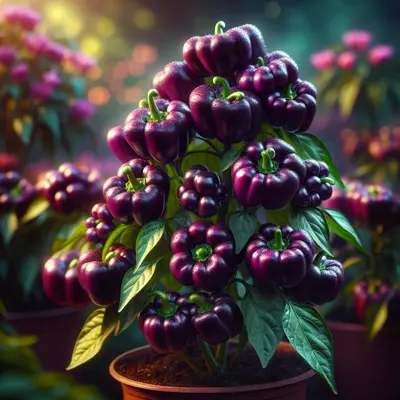
A stunning ornamental and edible bell pepper that produces gorgeous deep purple fruits that eventually ripen to red if left on the plant. This eye-catching variety combines the classic sweet bell pepper flavor with incredible visual appeal, making it perfect for gardeners who want both beauty and function in their vegetable gardens. The compact plants are ideal for containers and add dramatic color to any garden space.
Harvest
70-75d
Days to harvest
Sun
Full sun
Zones
4–11
USDA hardiness
Height
1-3 feet
Planting Timeline
Showing dates for Purple Beauty Bell Pepper in USDA Zone 7
All Zone 7 pepper →Zone Map
Click a state to update dates
Purple Beauty Bell Pepper · Zones 4–11
Growing Details
Succession Planting
Purple Beauty keeps setting fruit on the same plant from midsummer through first frost, so a single transplant set is all you need — succession planting doesn't change your yield here. Start seeds indoors 10–12 weeks before your last frost date, transplant out once nights hold reliably above 55°F, and that planting carries you through a July–September harvest without any additional rounds.
Complete Growing Guide
Purple Beauty bell peppers require consistent warmth and benefit from starting seeds indoors 8-10 weeks before your last frost, as they need 70-75 days of heat to develop their signature purple color fully. Plant in full sun with rich, well-draining soil amended with compost, spacing plants 18-24 inches apart; the compact growth habit means they thrive in containers, which also allows you to move plants for optimal light exposure. These peppers are prone to blossom-end rot in inconsistent watering conditions, so maintain even soil moisture throughout the season without waterlogging. Watch for spider mites and aphids, which are attracted to purple foliage varieties. The purple coloring develops best when nights stay above 60°F and days exceed 75°F—if temperatures dip, fruit may remain green longer. Practical tip: pinch off the first flower cluster when plants reach 6-8 inches tall to encourage bushier growth and more prolific fruiting on these already-compact specimens.
Light: Full sun (6 or more hours of direct sunlight a day). Soil: Clay, High Organic Matter, Loam (Silt), Sand. Soil pH: Acid (<6.0), Alkaline (>8.0), Neutral (6.0-8.0). Drainage: Good Drainage. Height: 1 ft. 0 in. - 3 ft. 8 in.. Spread: 0 ft. 6 in. - 1 ft. 0 in.. Spacing: 12 inches-3 feet. Growth rate: Medium. Maintenance: Low. Propagation: Seed. Regions: Coastal, Mountains, Piedmont.
Harvesting
Harvest Purple Beauty bell peppers when they reach full size and develop their characteristic deep purple color, which signals peak sweetness and flavor development. Gently squeeze the fruit to ensure firmness, and cut rather than pull peppers from the plant to avoid damage to branches. For continuous harvests throughout the season, pick peppers regularly at the purple stage, which encourages the plant to produce more flowers and fruits. However, if you prefer to experience the full color transformation, leave some peppers on the plant to ripen from purple to red, a process taking an additional 2-3 weeks. Timing your first harvest around day 70-75 from transplanting ensures mature fruit while allowing sufficient time for secondary harvests before season's end.
Fruits are a non-pulpy berry and vary considerably across cultivars. Some are long, thin, bright red, and spicy; others are thick, large, and sweet-tasting; others still are small and in ornamental shapes and colors, grown as decoration.
Color: Black, Gold/Yellow, Green, Orange, Red/Burgundy. Type: Berry. Length: 1-3 inches. Width: < 1 inch.
Garden value: Edible, Good Dried, Showy
Harvest time: Summer
Edibility: Fruits edible, but spiciness is unpredictable in intensity.
Storage & Preservation
Store freshly harvested Purple Beauty peppers in a plastic bag in the refrigerator's crisper drawer, maintaining temperatures between 45–50°F with 90–95% humidity. Avoid storing near ethylene-producing fruits like apples or bananas, which accelerate ripening and decay. Under these conditions, expect a fresh shelf life of two to three weeks.
For longer preservation, freezing works well: dice or slice the peppers, spread them on a tray to freeze individually, then transfer to freezer bags for up to eight months. Roasting before freezing concentrates their natural sweetness. Canning as pickled peppers or in relish recipes is popular, though raw pack freezing better preserves their tender texture and mild flavor. Drying is also effective—slice lengthwise, dehydrate at 135°F until leathery, and store in airtight containers. The thin walls of Purple Beauty peppers make them ideal candidates for drying, producing intensely flavored strips useful in soups and stir-fries year-round.
History & Origin
The Purple Beauty bell pepper belongs to the broader lineage of ornamental pepper cultivars developed throughout the late 20th century, though specific breeder attribution and introduction year remain undocumented in readily available sources. It represents the modern horticultural trend of combining edible function with striking visual ornament, building on decades of Capsicum annuum breeding that emphasized both productivity and aesthetic appeal. The variety likely emerged from seed companies specializing in vegetable cultivars, though its exact origin within commercial breeding programs remains unclear. Its characteristics—compact stature, purple-to-red color transformation, and sweet flavor—align with breeding objectives common among multiple seed houses, suggesting either independent development or wider circulation among cultivators rather than a single, clearly attributed source.
Origin: Tropical North and South America
Advantages
- +Stunning deep purple fruits provide ornamental beauty and edible value together
- +Compact plants thrive in containers, perfect for small space gardeners
- +Sweet mild flavor matches traditional bell peppers without any heat
- +Relatively easy to grow with straightforward care requirements
- +Fruits ripen from purple to red, extending visual interest period
Considerations
- -Susceptible to pepper mosaic virus and bacterial leaf spot infections
- -Vulnerable to multiple pests including aphids, weevils, and flea beetles
- -Prone to blossom end rot requiring consistent calcium and watering
- -Takes 70-75 days to mature, limiting growing season in cool climates
Companion Plants
Basil planted 12–18 inches away is a reasonable neighbor — both crops want the same heat and consistent moisture, and they don't compete for root space at those depths. Marigolds (Tagetes spp.) are worth more than decoration here: aphids and flea beetles both show a preference for them over Capsicum annuum, which means they're doing real work as a trap crop at the row edges. Fennel is the one to pull far from this bed — it releases allelopathic compounds that measurably stunt most vegetables, and peppers are not an exception. Black walnut is a harder constraint: juglone toxicity to Capsicum annuum starts within the drip line and persists in the soil long after a tree is removed.
Plant Together
Basil
Repels aphids, thrips, and hornworms while potentially improving pepper flavor
Marigold
Deters nematodes, aphids, and whiteflies with strong scent compounds
Tomato
Similar growing requirements and can share support structures
Oregano
Repels aphids and spider mites while attracting beneficial insects
Parsley
Attracts beneficial predatory insects like hoverflies and parasitic wasps
Carrots
Different root depths prevent competition and carrots help break up soil
Chives
Repels aphids and may help deter cutworms with sulfur compounds
Nasturtium
Acts as trap crop for aphids and cucumber beetles
Keep Apart
Fennel
Releases allelopathic compounds that inhibit pepper growth and development
Black Walnut
Produces juglone toxin that causes wilting and stunted growth in peppers
Brassicas
Compete for similar nutrients and may stunt pepper growth through root competition
Nutrition Facts
Per 100g serving. % Daily Value based on 2,000 calorie diet. Source: USDA FoodData Central (FDC #2258588)
Pests & Disease Resistance
Resistance
Good hybrid vigor with resistance to tobacco mosaic virus
Common Pests
Aphids, pepper weevil, flea beetles, cutworms
Diseases
Bacterial leaf spot, pepper mosaic virus, blossom end rot
Troubleshooting Purple Beauty Bell Pepper
What you'll see, why it happens, and what to do about it.
Flattened, tan or dark sunken spot on the bottom or side of the fruit — shows up once peppers start sizing up
Likely Causes
- Blossom end rot — localized calcium deficiency in the developing fruit, not necessarily a soil calcium shortage overall
- Inconsistent watering causing calcium uptake to stall mid-fruit development
- Over-fertilization with high-nitrogen (especially ammonium) fertilizers, which interferes with calcium movement into fruit tissue
What to Do
- 1.Mulch heavily around plants to even out soil moisture swings — straw works fine and keeps the root zone 10–15°F cooler on hot days
- 2.Water to 1–1.5 inches per week on a consistent schedule; letting the soil dry unevenly between waterings is the fastest way to trigger this
- 3.Back off high-nitrogen fertilizer; test soil pH and lime to the 6.5–6.8 range where calcium stays available — NC State Extension flags improper pH as a primary driver of this disorder
Leaves puckered, curled, or showing a yellow-green mosaic pattern; plant is visibly stunted relative to neighbors of the same age
Likely Causes
- Pepper mosaic virus (including Tobacco mosaic virus) — no cure once a plant is infected
- Aphid pressure — colonies establish fast on new growth, and each feeding move can spread the virus to clean plants
What to Do
- 1.Pull and bag any severely affected plants immediately; leaving them in the row gives the virus more time to spread
- 2.Knock aphid colonies back with a hard spray of water first; follow up with insecticidal soap if populations don't drop within 3–4 days
- 3.Set marigolds (Tagetes spp.) at the row ends as a trap crop — aphids preferentially colonize them and are easier to manage there than mid-canopy on your peppers
Frequently Asked Questions
How long does Purple Beauty bell pepper take to grow from seed?▼
Can you grow Purple Beauty peppers in containers?▼
Do Purple Beauty peppers turn red if left on the plant?▼
What does Purple Beauty bell pepper taste like?▼
Is Purple Beauty bell pepper good for beginners?▼
When should I plant Purple Beauty bell pepper seeds?▼
Zone-by-Zone Planting Calendar
| Zone | Indoor Start | Transplant | Direct Sow | Harvest |
|---|---|---|---|---|
| Zone 1 | May – May | July – August | — | September – August |
| Zone 2 | April – May | June – July | — | September – September |
| Zone 11 | January – January | January – February | — | April – June |
| Zone 12 | January – January | January – February | — | April – June |
| Zone 13 | January – January | January – February | — | April – June |
| Zone 3 | April – April | June – July | — | August – October |
| Zone 4 | March – April | June – June | — | August – October |
| Zone 5 | March – March | May – June | — | August – October |
| Zone 6 | March – March | May – June | — | July – September |
| Zone 7 | February – March | April – May | — | July – September |
| Zone 8 | February – February | April – May | — | June – August |
| Zone 9 | January – January | March – April | — | May – July |
| Zone 10 | January – January | February – March | — | May – July |
Growing Guides from Wind River Greens
Sources & References
External authority sources used in compiling this guide.
See the Methodology page for how this data is sourced, what's AI-assisted, and known limitations.
More Peppers
Carolina Reaper
Sweet Pepper 'Carmen'
Ghost Pepper 'Bhut Jolokia'
Scotch Bonnet 'Scotch Bonnet Orange'
Chocolate Habanero
Sweet Italian Pepper 'Marconi Rosso'
Mad Hatter
Chipotle 'Morita'