Planting Timeline
Showing dates for Swiss Chard Microgreens in USDA Zone 7
All Zone 7 microgreen →Zone Map
Click a state to update dates
Swiss Chard Microgreens · Zones 2–11
Growing Details
Zone-by-Zone Planting Calendar
| Zone | Indoor Start | Transplant | Direct Sow | Harvest |
|---|---|---|---|---|
| Zone 3 | January – December | — | — | January – December |
| Zone 4 | January – December | — | — | January – December |
| Zone 5 | January – December | — | — | January – December |
| Zone 6 | January – December | — | — | January – December |
| Zone 7 | January – December | — | — | January – December |
| Zone 8 | January – December | — | — | January – December |
| Zone 9 | January – December | — | — | January – December |
| Zone 10 | January – December | — | — | January – December |
Complete Growing Guide
Setting up your Swiss chard microgreen operation requires minimal space but attention to cleanliness. You'll need shallow trays with drainage holes, a spray bottle for misting, and either a sunny windowsill or basic LED grow lights. Clean all equipment with diluted bleach solution to prevent fungal issues that can devastate entire trays.
Start by soaking your rainbow chard seeds for 8-12 hours in room temperature water. This softens the tough seed coat and dramatically improves germination rates. While seeds soak, prepare your growing medium—either fine potting mix or coconut coir works excellently. Avoid regular garden soil, which is too heavy and may harbor pathogens.
Fill your trays with about half an inch of growing medium, then mist until evenly damp but not waterlogged. Broadcast the soaked seeds densely across the surface—you want them almost touching but not overlapping. Cover with a thin layer of growing medium, just enough to anchor the seeds.
Place trays in indirect bright light or under grow lights positioned 6-12 inches above. Maintain 65-75°F temperatures for optimal germination. Keep the surface consistently moist using a fine mist spray—never allow it to dry out completely, but avoid creating puddles that encourage damping off.
Skip fertilizing entirely—microgreens derive all necessary nutrients from the seed itself. Adding fertilizer actually reduces flavor intensity and can promote unwanted algae growth on your growing medium.
The biggest mistake new growers make is overwatering. Your growing medium should feel like a wrung-out sponge—moist throughout but not dripping. Poor air circulation is another killer; ensure gentle airflow around your trays without creating drafts that dry out the surface.
In northern zones (3-6), you'll likely need supplemental lighting year-round for consistent harvests. Southern gardeners (zones 9-11) should avoid direct afternoon sun, which can cause rapid moisture loss and bitter flavors. Expect your first harvest in 7-10 days during warm weather, extending to 14 days in cooler conditions.
Harvesting
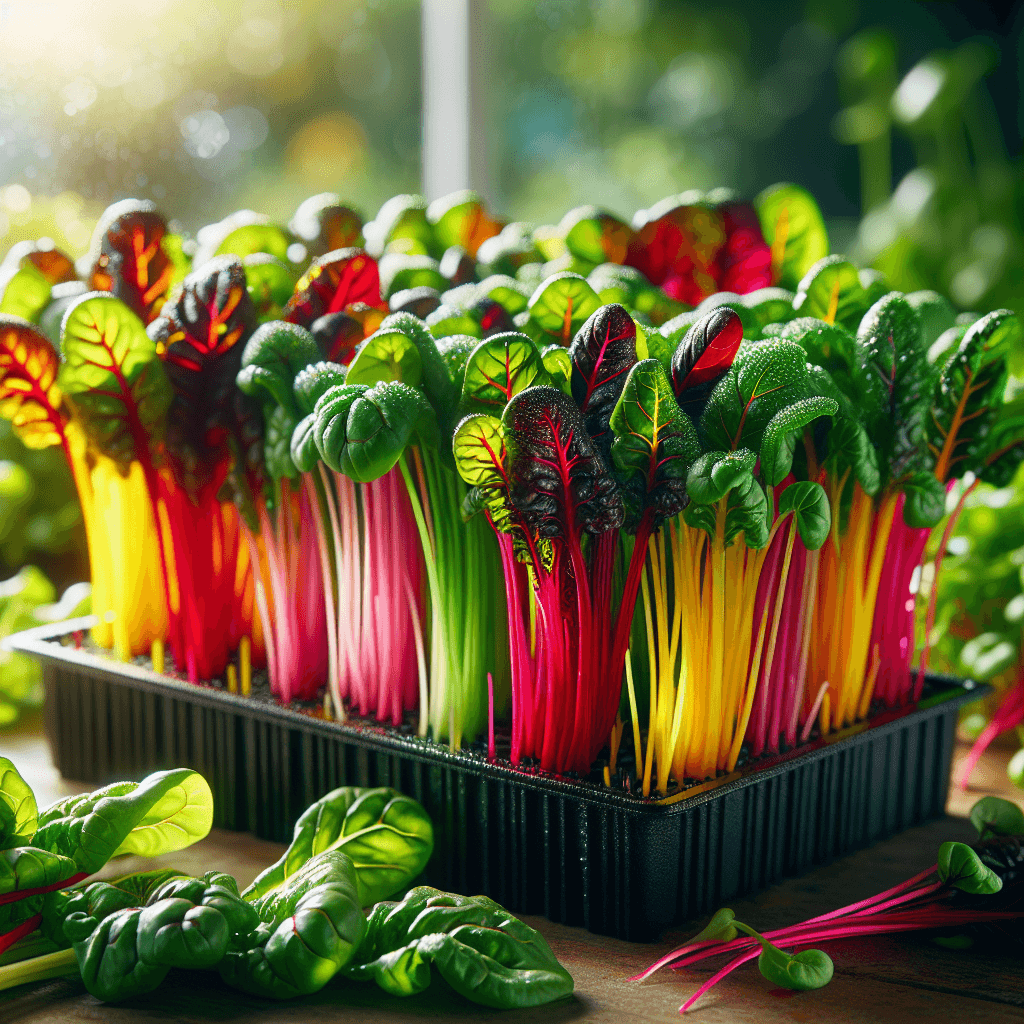
Harvest your Swiss chard microgreens when the first true leaves appear, typically 7-14 days after sowing. Look for stems that are 1-2 inches tall with vibrant red, yellow, orange, or white coloration clearly visible. The cotyledon leaves should be fully expanded and bright green, while the first true leaves are just beginning to unfold.
Harvest in the morning when stems are most turgid and flavorful. Use clean, sharp scissors to cut about half an inch above the growing medium—never pull or tear, which can uproot neighboring plants. Cut in small sections rather than attempting to harvest an entire tray at once, which helps maintain freshness.
Test readiness by gently tugging a few stems—they should resist pulling and feel firm, not limp or waterlogged. Avoid harvesting if you notice any yellowing, wilting, or fuzzy white growth that indicates fungal problems. The characteristic earthy, slightly sweet flavor will be most pronounced just as the first true leaves emerge—waiting longer results in tougher stems and more pronounced mineral notes that some find unpalatable.
Storage & Preservation
Fresh Swiss chard microgreens are highly perishable and best used within 3-5 days of harvest. Rinse gently in cold water immediately after cutting, then spin dry in a salad spinner or pat with paper towels. Store in airtight containers lined with paper towels in your refrigerator's crisper drawer at 32-38°F.
For longer storage, microgreens can be frozen, though texture becomes limp after thawing—best reserved for smoothies or cooked applications. Flash-freeze clean, dry microgreens on parchment-lined baking sheets for 2 hours, then transfer to freezer bags for up to 3 months.
Dehydrating is another option for extending shelf life. Use a dehydrator at 95°F for 4-6 hours until completely crisp, then store in airtight jars for up to 6 months. Dehydrated microgreens make excellent flavor-packed additions to soups, stews, and seasoning blends, though they lose their visual appeal and fresh crunch.
History & Origin
Swiss chard microgreens represent a modern adaptation of an ancient Mediterranean vegetable that's been cultivated for over 2,000 years. Despite its name, Swiss chard originated along the Mediterranean coast, where wild sea beets were first domesticated by ancient Greeks and Romans who prized both the leaves and colorful stems.
The rainbow-colored varieties we grow as microgreens today trace their lineage to 19th-century European breeding programs, particularly in Switzerland and France, where gardeners selected for increasingly vibrant stem colors. The variety 'Bright Lights,' developed in the 1990s, became the foundation for most modern rainbow chard varieties.
Microgreen cultivation itself emerged in the 1980s in upscale California restaurants, where chefs sought intense flavors and visual appeal in small packages. Swiss chard microgreens gained popularity in the 2000s as home gardeners discovered they could grow these colorful, nutrient-dense greens year-round indoors. The combination of chard's naturally sweet, earthy flavor and striking multicolored stems made it a natural fit for the microgreen movement, offering both culinary versatility and Instagram-worthy presentations.
Advantages
- +Exceptionally fast germination, often sprouting within 24-48 hours in optimal conditions
- +Natural disease resistance makes them more forgiving than many microgreen varieties
- +Stunning rainbow stem colors create restaurant-quality visual appeal for home dishes
- +Mild, sweet flavor appeals to children and picky eaters unlike stronger microgreens
- +Large seeds are easier to handle and sow evenly compared to tiny varieties like basil
- +Excellent shelf life for microgreens—stays fresh 5-7 days when properly stored
- +High germination rates mean less seed waste and more predictable harvests
Considerations
- -Seeds are more expensive than common microgreens like radish or pea shoots
- -Stems can become tough and fibrous if harvested too late
- -Requires consistent moisture—more sensitive to drying out than hardier varieties
- -Color intensity diminishes in low-light conditions, reducing visual appeal
- -Prone to algae growth on growing medium surface in humid conditions
Companion Plants
Plant Together
Lettuce
Similar growing conditions and harvesting schedule, efficient space usage
Radish Microgreens
Fast germination helps break soil crust for slower-germinating seeds
Arugula Microgreens
Compatible growth rates and similar light requirements
Kale Microgreens
Same family (Brassicaceae) with similar nutritional needs and growing conditions
Spinach Microgreens
Similar water and temperature requirements, complementary harvest timing
Pea Shoots
Nitrogen fixation enriches growing medium for leafy greens
Cilantro Microgreens
Natural pest deterrent properties protect tender chard leaves
Chives
Natural antifungal properties help prevent damping-off disease
Keep Apart
Sunflower Microgreens
Allelopathic compounds inhibit germination and growth of smaller seeds
Fennel
Strong allelopathic effects inhibit growth of most other plants
Mint
Aggressive spreading and strong essential oils can overwhelm delicate microgreens
Pests & Disease Resistance
Resistance
Good resistance when grown in clean conditions
Common Pests
Aphids, fungus gnats (indoor growing)
Diseases
Damping off, root rot from overwatering