Moon and Stars Watermelon
Citrullus lanatus 'Moon and Stars'
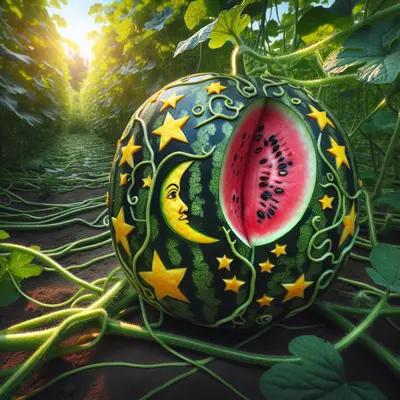
A spectacular heirloom watermelon famous for its mystical dark green rind decorated with yellow 'stars' and larger yellow 'moons' that make each fruit a work of art. Nearly lost to extinction until the 1980s, this Cherokee heirloom produces large, sweet melons with pink-red flesh and the same celestial markings on its foliage. Moon and Stars is as much a conversation piece as it is a delicious watermelon, perfect for gardeners who love growing living history.
Harvest
90-100d
Days to harvest
Sun
Full sun
Zones
4–10
USDA hardiness
Height
4-8 inches
Planting Timeline
Showing dates for Moon and Stars Watermelon in USDA Zone 7
All Zone 7 melon →Zone Map
Click a state to update dates
Moon and Stars Watermelon · Zones 4–10
Growing Details
Complete Growing Guide
Moon and Stars watermelons require a full 90-100 days of warm growing season, so in cooler climates, start seeds indoors 3-4 weeks before the last frost to maximize ripening time before fall temperatures drop. This heirloom thrives in rich, well-draining soil with consistent warmth—nighttime temperatures below 60°F significantly slow growth and sugar development. Unlike modern hybrids, Moon and Stars is moderately susceptible to powdery mildew on its distinctive starred foliage, so ensure good air circulation and avoid overhead watering. The vines produce abundant runners that sprawl 4-8 inches tall, requiring ample space; crowding increases disease pressure. A practical tip: monitor soil moisture carefully during fruit sizing, as inconsistent watering can cause the flesh to become mealy and reduces that signature sweetness. Mulch heavily to maintain even moisture and warmth throughout the season.
Light: Full sun (6 or more hours of direct sunlight a day). Soil: Loam (Silt). Soil pH: Neutral (6.0-8.0). Drainage: Good Drainage, Moist. Height: 0 ft. 4 in. - 0 ft. 8 in.. Spread: 5 ft. 0 in. - 10 ft. 0 in.. Growth rate: Medium. Maintenance: Medium. Propagation: Seed. Regions: Coastal, Mountains, Piedmont.
Harvesting
Harvest Moon and Stars watermelons when the yellow moons and stars become bright and pronounced against the dark green rind, indicating peak sugar content, and when the fruit reaches 10–15 pounds with a firm, hollow sound when thumped. The underside should display a creamy yellow spot where it rested on soil. Unlike indeterminate varieties, Moon and Stars produces a single main crop rather than continuous harvesting, so monitor all developing fruits carefully for simultaneous ripeness. A crucial timing tip: cut the melon from the vine rather than pulling it, as the thick stems resist snapping and risk bruising the fruit; harvest in early morning when the rind is coolest for optimal sweetness and storage quality.
The plant produces melons which are large modified berries called a pepo. They are rounded to oval mottled green with darker green rind. Black, cream or mottled colored elliptic seeds. Flesh general red or pink but can also be yellowish.
Color: Green. Type: Berry. Length: > 3 inches. Width: > 3 inches.
Garden value: Edible
Harvest time: Summer
Edibility: The fruit can be eaten raw or pickled. The rind is edible after cooking.
Storage & Preservation
Store whole Moon and Stars watermelons in a cool location between 50–70°F with moderate humidity; they'll keep for 2–3 weeks at room temperature or up to a month in a cool cellar or refrigerator crisper drawer. Once cut, wrap pieces tightly in plastic wrap and consume within 3–5 days. For preservation, freezing works well—cube the flesh, remove seeds, and freeze on a tray before transferring to freezer bags for smoothies and beverages. Canning is not recommended due to the fruit's low acid content and high water content. You can dry thin slices in a dehydrator at 135°F until leathery for chewy treats, or save seeds by scooping them out, rinsing thoroughly, air-drying completely on screens, and storing in airtight containers in a cool place. Since this variety is prized for seed saving, allow one or two fruits to fully mature on the vine and harden completely before harvest to ensure seed viability for next season.
History & Origin
The Moon and Stars watermelon traces its lineage to Cherokee agricultural traditions, representing a distinctive heirloom cultivar that nearly disappeared from cultivation by the mid-twentieth century. Documentation of its specific breeder and original development year remains limited in accessible records, though seed savers and heirloom enthusiasts credit its revival during the 1980s to dedicated collectors working to preserve endangered crop varieties. The variety's celestial markings on both rind and foliage suggest deliberate selection within Cherokee growing practices, though formal breeding records are sparse. Its reintroduction into commercial seed catalogs and home gardens emerged through the broader heirloom seed movement, when organizations and seed companies began actively sourcing and propagating culturally significant plant varieties before they were lost entirely.
Origin: Africa
Advantages
- +Stunning yellow star and moon markings make each fruit a unique decorative centerpiece.
- +Cherokee heirloom variety preserves rare genetic diversity rescued from near extinction.
- +Sweet, juicy pink-red flesh delivers authentic traditional watermelon flavor and texture.
- +Celestial foliage markings match the rind, creating complete ornamental garden appeal.
- +90-100 day maturity fits most growing seasons without requiring extremely long summers.
Considerations
- -Vulnerable to multiple serious diseases including anthracnose, fusarium wilt, and bacterial fruit blotch.
- -Susceptible to cucumber beetles, squash bugs, and spider mites requiring consistent pest management.
- -Moderate difficulty rating means less reliable harvests than modern disease-resistant hybrid varieties.
- -Large fruit size demands substantial garden space and well-draining, nutrient-rich soil conditions.
Companion Plants
Nasturtiums and marigolds do the most work here. Nasturtiums act as a trap crop for aphids — the bugs pile onto them instead of your watermelon vines, and you can pull the nasturtium plants once they're loaded. French marigolds (Tagetes patula) release thiopene compounds from their roots that suppress soil nematodes over a full growing season — useful given how long Moon and Stars sits in the ground at 90–100 days to harvest. Radishes planted at the bed edge can deter cucumber beetles, which are the primary vector for fusarium wilt in Citrullus lanatus. Bush beans fix a modest amount of nitrogen and don't compete for the deep moisture watermelons need during the final 30 days of fruit development.
Keep cucumbers out of the same bed entirely — they share identical pest and disease pressure (anthracnose, cucumber beetles, bacterial fruit blotch), and planting them together concentrates problems rather than distributing them. Potatoes compete for water at the same soil depth and can harbor pathogens that cross to cucurbits. Sage at high planting density has shown allelopathic effects on neighboring root development, which isn't what you want around a vine that needs to run 6 feet in every direction.
Plant Together
Nasturtiums
Act as trap crops for cucumber beetles and squash bugs while repelling aphids
Marigolds
Deter nematodes and cucumber beetles with their strong scent
Radishes
Repel cucumber beetles and squash vine borers, improve soil aeration
Bush Beans
Fix nitrogen in soil and don't compete for space with sprawling melons
Catnip
Repels ants, aphids, and cucumber beetles more effectively than DEET
Corn
Provides natural shade and wind protection for developing melons
Oregano
Repels cucumber beetles and provides general pest deterrence
Sunflowers
Attract beneficial insects and provide shade, while roots don't compete
Keep Apart
Cucumber
Competes for same nutrients and attracts shared pests like cucumber beetles
Potatoes
Both are heavy feeders that compete for nutrients, potatoes may harbor harmful soil pathogens
Aromatic herbs (Sage)
Strong oils can inhibit germination and growth of melon seeds and young plants
Nutrition Facts
Per 100g serving. % Daily Value based on 2,000 calorie diet. Source: USDA FoodData Central (FDC #167765)
Pests & Disease Resistance
Resistance
Limited disease resistance typical of heirlooms, susceptible to common watermelon diseases
Common Pests
Cucumber beetles, squash bugs, aphids, spider mites
Diseases
Anthracnose, fusarium wilt, powdery mildew, bacterial fruit blotch
Troubleshooting Moon and Stars Watermelon
What you'll see, why it happens, and what to do about it.
Dark, sunken spot on the blossom end of the fruit — dry, leathery, and sometimes moldy
Likely Causes
- Blossom-end rot from calcium deficiency in developing fruit
- Irregular watering — wet-dry cycles that prevent calcium uptake
- Overfertilization with high-nitrogen fertilizers, or soil pH below 6.0
What to Do
- 1.Mulch heavily (3-4 inches of straw) and water deeply on a consistent schedule — 1 to 2 inches per week, no skipping
- 2.Test your soil and lime to bring pH to 6.5–6.8, as NC State Extension recommends; calcium availability drops sharply below that range
- 3.Back off high-nitrogen fertilizers once vines start running — switch to a lower-N formula at fruit set
Yellowing, wilting vines that don't recover overnight — even when soil is moist — starting mid-season around day 50-60
Likely Causes
- Fusarium wilt (Fusarium oxysporum f. sp. niveum) — a soil-borne fungus that plugs the vascular tissue
- Cucumber beetles feeding on roots and transmitting the pathogen
What to Do
- 1.Pull and bag the affected vine — don't compost it; the fungus persists in soil for years
- 2.Rotate watermelons out of that bed for at least 3 seasons
- 3.Use row cover over transplants until flowers open to reduce cucumber beetle feeding pressure early on
Tan to dark water-soaked lesions on rind, fruit, or leaves — sometimes with a pinkish-orange spore mass in wet weather
Likely Causes
- Anthracnose (Colletotrichum orbiculare) — a fungal disease that spreads rapidly in warm, wet conditions above 75°F
- Overhead irrigation or rain splashing spores from infected debris onto fruit and foliage
What to Do
- 1.Switch to drip irrigation if you can — keeping water off the leaves and fruit cuts transmission significantly
- 2.Remove and trash infected fruit and foliage; don't leave debris on the soil surface at season's end
- 3.Rotate out of cucurbits for 2 years and start with clean, disease-free seed — Moon and Stars is open-pollinated heirloom stock, so seed source quality varies more than with commercial hybrid lines
Frequently Asked Questions
How long does Moon and Stars watermelon take to grow?▼
Can you grow Moon and Stars watermelon in containers?▼
What does Moon and Stars watermelon taste like?▼
Is Moon and Stars watermelon good for beginners?▼
When should I plant Moon and Stars watermelon seeds?▼
Why is my Moon and Stars watermelon not showing the star patterns?▼
Zone-by-Zone Planting Calendar
| Zone | Indoor Start | Transplant | Direct Sow | Harvest |
|---|---|---|---|---|
| Zone 1 | June – June | July – August | July – September | November – August |
| Zone 2 | May – June | July – July | July – August | October – September |
| Zone 11 | January – January | February – February | February – March | May – July |
| Zone 12 | January – January | February – February | February – March | May – July |
| Zone 13 | January – January | February – February | February – March | May – July |
| Zone 3 | May – May | June – July | June – August | October – October |
| Zone 4 | April – May | June – June | June – July | September – October |
| Zone 5 | April – April | May – June | May – July | September – October |
| Zone 6 | April – April | May – June | May – July | September – October |
| Zone 7 | March – April | May – May | May – June | August – October |
| Zone 8 | March – March | April – May | April – June | August – September |
| Zone 9 | February – February | March – April | March – May | July – August |
| Zone 10 | January – February | March – March | March – April | June – August |
Growing Guides from Wind River Greens
Sources & References
External authority sources used in compiling this guide.
See the Methodology page for how this data is sourced, what's AI-assisted, and known limitations.
More Melons
Charleston Gray Watermelon
Ali Baba Watermelon
Cantaloup Charentais
Watermelon Charleston Gray
Hale's Best Cantaloupe
Cantaloupe Iroquois
Sugar Baby Watermelon
Tiger Baby Watermelon