Ali Baba Watermelon
Citrullus lanatus 'Ali Baba'
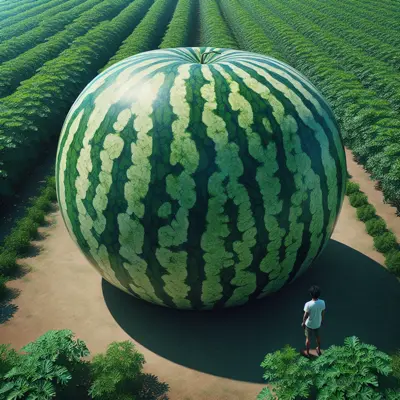
An remarkable Iraqi heirloom watermelon that produces enormous fruits weighing up to 100 pounds with incredibly sweet, crisp flesh that stays fresh for weeks after harvest. Ali Baba features distinctive pale green skin with dark stripes and develops exceptional sweetness while maintaining excellent texture even in its massive size. This conversation-starting variety is perfect for gardeners who want to grow something truly spectacular and have the space for its vigorous vines.
Harvest
100-110d
Days to harvest
Sun
Full sun
Zones
5–10
USDA hardiness
Height
4-8 inches
Planting Timeline
Showing dates for Ali Baba Watermelon in USDA Zone 7
All Zone 7 melon →Zone Map
Click a state to update dates
Ali Baba Watermelon · Zones 5–10
Growing Details
Complete Growing Guide
With a 100-110 day maturation and massive fruit size, Ali Baba demands an extended, warm growing season—start seeds indoors 3-4 weeks before your last frost and transplant only when soil reaches 70°F, as this heirloom struggles in cool conditions. This cultivar needs robust vine vigor and space; plant in full sun with rich, well-draining soil amended with compost, spacing vines 4-5 feet apart to accommodate their aggressive growth. Ali Baba is particularly susceptible to powdery mildew in humid climates and prone to blossom-end rot if irrigation becomes inconsistent during fruit development—maintain steady moisture without waterlogging. The enormous fruits take significant energy to mature, so pinch lateral vines once 2-3 fruits set per plant, directing all resources into these heavy specimens. A practical tip: lay down straw or cardboard under developing fruits to prevent soil-borne rot and provide insulation in cooler microclimates, ensuring those 100-pound melons reach full sweetness and crispness.
Light: Full sun (6 or more hours of direct sunlight a day). Soil: Loam (Silt). Soil pH: Neutral (6.0-8.0). Drainage: Good Drainage, Moist. Height: 0 ft. 4 in. - 0 ft. 8 in.. Spread: 5 ft. 0 in. - 10 ft. 0 in.. Growth rate: Medium. Maintenance: Medium. Propagation: Seed. Regions: Coastal, Mountains, Piedmont.
Harvesting
Harvest Ali Baba watermelons when the pale green skin darkens to a deeper sage or olive tone with prominent dark stripes becoming nearly black, and the fruit reaches 80-100 pounds in weight. Check readiness by pressing the bottom blossom end—it should yield slightly to pressure and feel velvety rather than hard. The tendril nearest the fruit stem will brown and dry completely when fully ripe. Ali Baba produces a single main fruit per vine rather than continuous harvests, so focus your attention on that primary melon. For optimal timing, harvest in early morning when temperatures are coolest, as this helps the fruit maintain its exceptional crispness and juice content during storage and transport.
The plant produces melons which are large modified berries called a pepo. They are rounded to oval mottled green with darker green rind. Black, cream or mottled colored elliptic seeds. Flesh general red or pink but can also be yellowish.
Color: Green. Type: Berry. Length: > 3 inches. Width: > 3 inches.
Garden value: Edible
Harvest time: Summer
Edibility: The fruit can be eaten raw or pickled. The rind is edible after cooking.
Storage & Preservation
Store freshly harvested Ali Baba watermelons in a cool location between 50–60°F with moderate humidity, ideally in a single layer on straw or cardboard to prevent bruising. Whole melons will keep for 2–3 weeks under these conditions; once cut, refrigerate at 35–40°F and use within 3–5 days. For preservation, freezing works best: cut flesh into cubes, remove seeds, and freeze on trays before transferring to bags for up to three months. The juice freezes exceptionally well and maintains its crisp, refreshing character when thawed. Canning is possible using a tested pickling recipe for watermelon rinds, though the flesh itself has low acidity for traditional canning. Given this variety's exceptional juice quality, consider making fresh juice and freezing it in ice cube trays for long-term storage and easy portioning. Because Ali Babas are bred for competition growing, handle harvested fruits carefully during storage—the thin skin bruises readily, affecting appearance and shelf life.
History & Origin
This Iraqi heirloom watermelon represents the rich agricultural heritage of the Middle East, where watermelon cultivation dates back millennia. While specific breeder documentation and introduction dates remain sparse in English-language horticultural records, Ali Baba belongs to the traditional landrace varieties developed and maintained by Iraqi farmers over generations. The variety's name references the famous Arabian Nights character, reflecting its cultural significance in its region of origin. Like many heirloom melons from Iraq and surrounding areas, Ali Baba was preserved through seed-saving practices within farming communities, ensuring the survival of this giant-fruiting type with its distinctive striping and exceptional sweetness. Modern seed companies have since catalogued and distributed this variety to gardeners worldwide, though its exact evolutionary history remains embedded in folk agricultural tradition rather than formal breeding records.
Origin: Africa
Advantages
- +Produces enormous 100-pound fruits that become true garden showstoppers and conversation pieces
- +Exceptional sweetness and crisp texture maintained even at massive fruit sizes
- +Exceptional storage life of weeks after harvest provides extended enjoyment and freshness
- +Iraqi heirloom variety offers unique flavor profile unavailable in common commercial watermelons
Considerations
- -Requires significant garden space for vigorous, sprawling vines and fruit development
- -Moderate to challenging difficulty level demands experienced growers and careful cultivation practices
- -Susceptible to multiple serious diseases including fusarium wilt and gummy stem blight
- -Long 100-110 day growing season demands warm climate and full season commitment
Companion Plants
Nasturtiums and marigolds pull double duty near Ali Baba vines — they draw aphids and cucumber beetles away from the watermelons themselves, and they're easy to tuck at the row ends without eating into the 8–10 feet of spread the vines need. Radishes planted around the perimeter are out of the ground in 30 days, so they don't compete once the vines start running, and they do meaningful work against cucumber beetle pressure early in the season. Beans are worth including if you have room: the nitrogen they fix at the root level takes some pressure off a 100–110 day crop that's asking a lot from your soil all summer.
Fennel will stunt nearby plants through allelopathic root compounds — keep it on the opposite end of the garden entirely. Potatoes are a problem for a different reason: they share Fusarium disease pressure with cucurbits, and in the warm, persistent soils of a zone 7 Georgia summer, putting them in adjacent beds just means you're building up that pathogen load faster. Tomatoes carry similar overlap and compete hard for the same soil depth and water — and with watermelons pulling 2–3 inches per week through a long season, that's not a fight worth starting.
Plant Together
Nasturtiums
Acts as trap crop for cucumber beetles and aphids, repels squash bugs
Marigolds
Deters nematodes and cucumber beetles, attracts beneficial insects
Radishes
Repels cucumber beetles and squash bugs, breaks up soil for watermelon roots
Beans
Fixes nitrogen in soil, provides ground cover to retain moisture
Corn
Provides natural windbreak and partial shade, supports beneficial insects
Sunflowers
Attracts pollinators essential for fruit set, provides beneficial shade
Catnip
Repels ants, aphids, and cucumber beetles more effectively than DEET
Oregano
Repels cucumber beetles and provides general pest deterrence
Keep Apart
Fennel
Allelopathic properties inhibit growth and can stunt watermelon development
Potatoes
Compete for similar nutrients and space, may harbor similar fungal diseases
Tomatoes
Heavy feeders that compete for nutrients, attract similar pests like aphids
Nutrition Facts
Per 100g serving. % Daily Value based on 2,000 calorie diet. Source: USDA FoodData Central (FDC #167765)
Pests & Disease Resistance
Resistance
Good natural vigor but limited specific disease resistance
Common Pests
Cucumber beetles, squash bugs, aphids, vine borers
Diseases
Fusarium wilt, anthracnose, gummy stem blight, bacterial fruit blotch
Troubleshooting Ali Baba Watermelon
What you'll see, why it happens, and what to do about it.
Fruit develops a sunken, tan or brown leathery patch on the blossom end, often with mold growing on the damaged area
Likely Causes
- Blossom-end rot — calcium deficiency in developing fruit caused by uneven soil moisture
- Overfertilization with high-nitrogen fertilizer, which drives rapid growth that outpaces calcium uptake
- Soil pH outside the 6.0–7.0 range, limiting calcium availability
What to Do
- 1.Mulch heavily with 3–4 inches of straw to hold soil moisture between waterings — consistency matters more than volume
- 2.Back off nitrogen-heavy fertilizers once vines are running; side-dress with compost instead
- 3.Test your soil and lime to a pH of 6.5–6.8 per NC State Extension recommendations; calcium availability drops sharply below 6.0
Vines collapse mid-day on one or two plants first, then spread — soil isn't dry, and roots look intact
Likely Causes
- Fusarium wilt (Fusarium oxysporum f. sp. niveum) — soil-borne fungus that colonizes the vascular system; split the stem near the base and look for brown discoloration inside
- Cucumber beetles (Acalymma vittatum or Diabrotica undecimpunctata) vectoring bacterial wilt as a secondary issue
What to Do
- 1.Pull and bag infected plants immediately — don't compost them; Fusarium persists in soil for years
- 2.Rotate cucurbits out of that bed for at least 3 seasons
- 3.Cover transplants with row cover for the first 3–4 weeks to cut cucumber beetle feeding pressure; pull it once flowers open so pollinators can get in
Dark, water-soaked spots on the rind that enlarge and turn tan or brown, sometimes with pink spore masses visible after rain
Likely Causes
- Anthracnose (Colletotrichum orbiculare) — spreads fast in warm, humid conditions, especially after repeated rain events
- Gummy stem blight (Didymella bryoniae) — can look similar on the rind; check stems for brown, gummy ooze to tell them apart
What to Do
- 1.Switch to drip or soaker hose at the base — keeping foliage dry slows both pathogens significantly
- 2.Remove and dispose of infected fruit and foliage; don't leave them on the ground where they'll keep sporulating
- 3.Give vines the full 96–120 inches of spacing; crowded canopy traps humidity and turns a minor infection into a field-wide problem
Frequently Asked Questions
How long does Ali Baba watermelon take to grow?▼
Can you grow Ali Baba watermelon in containers?▼
Is Ali Baba watermelon good for beginners?▼
What does Ali Baba watermelon taste like?▼
How much space does Ali Baba watermelon need?▼
When should I plant Ali Baba watermelon seeds?▼
Zone-by-Zone Planting Calendar
| Zone | Indoor Start | Transplant | Direct Sow | Harvest |
|---|---|---|---|---|
| Zone 1 | June – June | July – August | July – September | November – August |
| Zone 2 | May – June | July – July | July – August | November – September |
| Zone 11 | January – January | February – February | February – March | June – July |
| Zone 12 | January – January | February – February | February – March | June – July |
| Zone 13 | January – January | February – February | February – March | June – July |
| Zone 3 | May – May | June – July | June – August | October – October |
| Zone 4 | April – May | June – June | June – July | October – October |
| Zone 5 | April – April | May – June | May – July | September – October |
| Zone 6 | April – April | May – June | May – July | September – November |
| Zone 7 | March – April | May – May | May – June | September – October |
| Zone 8 | March – March | April – May | April – June | August – October |
| Zone 9 | February – February | March – April | March – May | July – September |
| Zone 10 | January – February | March – March | March – April | July – August |
Growing Guides from Wind River Greens
Sources & References
External authority sources used in compiling this guide.
See the Methodology page for how this data is sourced, what's AI-assisted, and known limitations.