Tiger Baby Watermelon
Citrullus lanatus 'Tiger Baby'
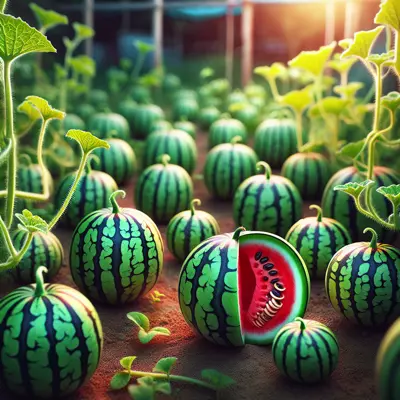
A delightful personal-sized watermelon perfect for small gardens and container growing, featuring distinctive dark green stripes over a lighter green background. This compact variety produces sweet, crisp red flesh in perfectly portioned individual melons that are ideal for picnics and small families. Tiger Baby combines space-saving growth habits with traditional watermelon flavor in an adorable, manageable package.
Harvest
75-85d
Days to harvest
Sun
Full sun
Zones
3–11
USDA hardiness
Height
4-8 inches
Planting Timeline
Showing dates for Tiger Baby Watermelon in USDA Zone 7
All Zone 7 melon →Zone Map
Click a state to update dates
Tiger Baby Watermelon · Zones 3–11
Growing Details
Succession Planting
Tiger Baby is a one-time fruiting crop per plant — once the melons set and ripen, the vine is done. Succession planting a second wave is worth doing if your season allows it. In zone 7, start a second round of seeds indoors in late April, targeting a transplant date in early June; that puts harvest in late August to early September before nights cool below 55°F and ripening stalls. Don't push a third sowing — seeds started after mid-June rarely accumulate enough heat days to finish their 75–85 day cycle before first frost.
If space is tight, stagger two plantings 3 weeks apart rather than three. The goal is keeping fresh melons coming for 4–6 weeks rather than a single glut, and two waves will usually get you there without gambling on a late-season finish.
Complete Growing Guide
Tiger Baby watermelons thrive in warm soil (at least 70°F) and require consistent warmth throughout their 75-85 day season, so delay planting until late spring frost danger passes completely. These compact vines need full sun and well-draining, fertile soil rich in organic matter to produce their signature sweet flesh reliably. Unlike larger watermelon varieties, Tiger Baby's diminutive size means it's more prone to cracking if watering becomes irregular during ripening, so maintain steady moisture rather than alternating between wet and dry periods. Watch for common vine pests like cucumber beetles and spider mites, which can stress these smaller plants disproportionately. A practical approach: since each plant produces multiple melons, thin competing fruits early by removing smaller specimens, allowing remaining melons to develop maximum sweetness and reach full size within your compact garden space.
Light: Full sun (6 or more hours of direct sunlight a day). Soil: Loam (Silt). Soil pH: Neutral (6.0-8.0). Drainage: Good Drainage, Moist. Height: 0 ft. 4 in. - 0 ft. 8 in.. Spread: 5 ft. 0 in. - 10 ft. 0 in.. Growth rate: Medium. Maintenance: Medium. Propagation: Seed. Regions: Coastal, Mountains, Piedmont.
Harvesting
Tiger Baby watermelons are ready to harvest when the skin darkens to a deep green with pronounced stripes and the melon reaches 4-6 inches in diameter, roughly the size of a small cantaloupe. Press the rind firmly—ripe melons should feel hard and slightly waxy rather than soft or yielding. Look for a creamy yellow or pale spot where the melon rested on soil, indicating maturity. These compact melons produce in succession rather than all at once, so check plants every 2-3 days during peak season for continuous harvesting. A helpful timing tip: harvest in the early morning when temperatures are cooler, as this preserves crispness and sweetness, and use a sharp knife to cut the stem cleanly rather than pulling, which prevents plant damage.
The plant produces melons which are large modified berries called a pepo. They are rounded to oval mottled green with darker green rind. Black, cream or mottled colored elliptic seeds. Flesh general red or pink but can also be yellowish.
Color: Green. Type: Berry. Length: > 3 inches. Width: > 3 inches.
Garden value: Edible
Harvest time: Summer
Edibility: The fruit can be eaten raw or pickled. The rind is edible after cooking.
Storage & Preservation
Store freshly harvested Tiger Baby watermelons at 50-60°F with 85-90% humidity in a cool, dark place—a root cellar or refrigerator crisper drawer works well. Keep them whole and unwashed until use to prevent moisture loss and mold. Whole melons will keep for 2-3 weeks under these conditions, while cut fruit should be used within 3-5 days when stored in airtight containers. For preservation, freezing is your best option: cube the flesh, remove seeds, and freeze on trays before bagging for up to three months. The cubes work beautifully in smoothies and agua frescas. You can also dehydrate the flesh into chewy strips or blend and freeze as sorbet. Because of their small size, these melons are ideal for consuming fresh rather than canning, which tends to dilute their bright, crisp flavor. Their convenient portion size means less waste if you simply enjoy them fresh over several days.
History & Origin
The precise origins of Tiger Baby Watermelon remain sparsely documented in readily available horticultural records. This compact melon appears to represent a modern breeding development within the miniature watermelon category that gained commercial popularity during the late 20th century as home gardeners and seed companies increasingly sought space-efficient produce varieties. While specific breeder attribution or introduction year is unclear, Tiger Baby likely descends from traditional icebox and personal-sized watermelon lines, possibly developed or popularized through seed company selection rather than a formal university breeding program. The variety embodies the broader horticultural trend toward container-friendly cultivars designed for small-space gardening, though its exact genealogy requires further documentation.
Origin: Africa
Advantages
- +Perfect for small gardens and container growing without sacrificing flavor.
- +Matures quickly in just 75-85 days, ideal for shorter growing seasons.
- +Individual-sized melons eliminate waste and suit small households perfectly.
- +Distinctive tiger striping adds ornamental appeal alongside practical edibility.
- +Easy to grow variety with manageable plant size for beginners.
Considerations
- -Susceptible to multiple fungal diseases including powdery and downy mildew.
- -Small fruit size means significantly lower total yield per plant.
- -Requires consistent moisture and well-draining soil to prevent fruit cracking.
Companion Plants
Nasturtiums and marigolds pull pest pressure away from the vines in different ways. Nasturtiums act as a trap crop for aphids — colonies pile onto them instead of your fruit, and you can pull the infested plants in one go. French marigolds (Tagetes patula) are worth planting densely in any bed with a nematode history; NC State Extension specifically recommends a solid French marigold planting to knock back root-knot nematode populations before returning susceptible cucurbits to a bed. Radishes planted at the bed edge can confuse cucumber beetles and are out of the ground long before the watermelon vines need the space.
Cucumbers don't belong in the same bed. They carry the same disease load — downy mildew, powdery mildew, gummy stem blight — and stacking two cucurbit crops together just gives those pathogens more targets in a tighter area. Black walnut is a harder problem: the roots release juglone, a compound directly toxic to many cucurbits, and the affected zone extends well beyond what the canopy suggests. If there's a walnut on the property, site your melons as far from it as you can manage.
Plant Together
Nasturtiums
Trap crop for cucumber beetles and aphids, natural pest deterrent
Marigolds
Repel nematodes and cucumber beetles, reduce soil pests
Radishes
Deter cucumber beetles and squash bugs, quick harvest before melons spread
Beans
Fix nitrogen in soil, provide natural fertilizer for heavy-feeding melons
Corn
Provides natural trellis and wind protection, complementary root depths
Sunflowers
Attract beneficial insects and pollinators, provide shade and wind protection
Oregano
Repels cucumber beetles and improves soil health through natural compounds
Lettuce
Ground cover crop, harvested before melons need full space, retains soil moisture
Keep Apart
Black Walnut Trees
Produce juglone which is toxic to melons and causes wilting and death
Cucumbers
Compete for same nutrients and space, share common pests and diseases
Aromatic Herbs (Sage)
Strong essential oils can inhibit melon seed germination and growth
Nutrition Facts
Per 100g serving. % Daily Value based on 2,000 calorie diet. Source: USDA FoodData Central (FDC #167765)
Pests & Disease Resistance
Resistance
Good resistance to anthracnose and fusarium wilt
Common Pests
Cucumber beetles, aphids, squash bugs, spider mites
Diseases
Powdery mildew, downy mildew, bacterial fruit blotch, gummy stem blight
Troubleshooting Tiger Baby Watermelon
What you'll see, why it happens, and what to do about it.
Dark, sunken spot on the blossom end of the fruit — leathery, dry, and spreading inward
Likely Causes
- Blossom-end rot — calcium deficiency in the developing fruit, typically triggered by uneven soil moisture rather than an actual lack of calcium in the soil
- Overfertilization with high-nitrogen fertilizers, which drives rapid vegetative growth at the expense of calcium uptake
- Soil pH below 6.0, which reduces calcium availability even when it's present
What to Do
- 1.Mulch 3 to 4 inches deep with straw to buffer soil moisture swings, and water consistently to deliver 1 to 2 inches per week
- 2.Avoid high-nitrogen fertilizer pushes once vines are running; switch to a lower-N formula at fruit set
- 3.Test your soil and lime to bring pH to 6.5–6.8, per NC State Extension — that's usually the cheapest fix if your pH is off
Yellow angular patches on the upper leaf surface with grayish-purple fuzz underneath, spreading fast in humid weather
Likely Causes
- Downy mildew (Peronospora cubensis) — NC State Extension notes this water mold shows up at different times and places each year and requires active monitoring
- Dense canopy with poor airflow trapping humidity against the foliage
What to Do
- 1.Give vines the full 24–36 inch spacing at planting — crowded plants are the first to collapse when downy mildew hits
- 2.Apply a copper-based fungicide on a 7-day schedule once you see the first lesions; don't wait for the fuzz to spread
- 3.Pull and bag (don't compost) heavily infected leaves to slow spore spread to neighboring vines
Striped or spotted beetles chewing ragged holes in leaves and flowers, seedlings wilting rapidly after transplant
Likely Causes
- Striped cucumber beetle (Acalymma vittatum) or spotted cucumber beetle (Diabrotica undecimpunctata) — both vectors for bacterial wilt, which is the bigger threat beyond the feeding damage itself
- Transplants set out before soil hits 65°F are slower to outgrow the pressure
What to Do
- 1.Cover transplants with row cover immediately after planting; remove it once female flowers open (around day 45–55) to allow pollination
- 2.Set yellow sticky traps at vine level to monitor population levels before deciding on a spray
- 3.If beetle pressure is severe, kaolin clay applied to leaves and stems creates a physical deterrent without broad pesticide impact on pollinators
Frequently Asked Questions
How long does Tiger Baby watermelon take to grow from seed?▼
Can you grow Tiger Baby watermelon in containers?▼
What does Tiger Baby watermelon taste like?▼
Is Tiger Baby watermelon good for beginners?▼
When should I plant Tiger Baby watermelon seeds?▼
How big do Tiger Baby watermelons get?▼
Zone-by-Zone Planting Calendar
| Zone | Indoor Start | Transplant | Direct Sow | Harvest |
|---|---|---|---|---|
| Zone 1 | June – June | July – August | July – September | October – August |
| Zone 2 | May – June | July – July | July – August | October – September |
| Zone 11 | January – January | February – February | February – March | May – June |
| Zone 12 | January – January | February – February | February – March | May – June |
| Zone 13 | January – January | February – February | February – March | May – June |
| Zone 3 | May – May | June – July | June – August | September – October |
| Zone 4 | April – May | June – June | June – July | September – October |
| Zone 5 | April – April | May – June | May – July | September – October |
| Zone 6 | April – April | May – June | May – July | August – October |
| Zone 7 | March – April | May – May | May – June | August – September |
| Zone 8 | March – March | April – May | April – June | July – September |
| Zone 9 | February – February | March – April | March – May | June – August |
| Zone 10 | January – February | March – March | March – April | June – July |
Growing Guides from Wind River Greens
Sources & References
External authority sources used in compiling this guide.
See the Methodology page for how this data is sourced, what's AI-assisted, and known limitations.
More Melons
Charleston Gray Watermelon
Ali Baba Watermelon
Cantaloup Charentais
Watermelon Charleston Gray
Hale's Best Cantaloupe
Cantaloupe Iroquois
Sugar Baby Watermelon
Early Dew Honeydew