Crimson Sweet Watermelon
Citrullus lanatus var. lanatus
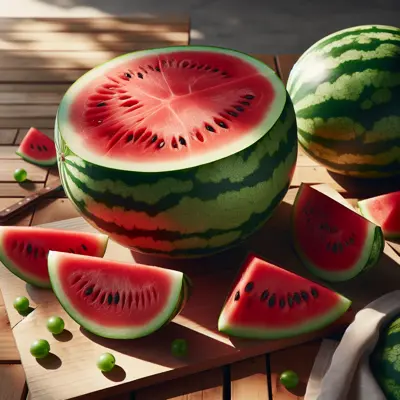
Dark and light yellow-green striped, 10" x 12" blocky oval fruits weigh in at 15-25 lb. Crisp, sweet pink flesh and vigorous vines. Avg. 1-2 fruits/plant.
Harvest
85d
Days to harvest
Sun
Full sun
Zones
3–11
USDA hardiness
Height
4-8 inches
Planting Timeline
Showing dates for Crimson Sweet Watermelon in USDA Zone 7
All Zone 7 melon →Zone Map
Click a state to update dates
Crimson Sweet Watermelon · Zones 3–11
Growing Details
Complete Growing Guide
Crimson Sweet demands consistent warmth and at least 85 frost-free days, making it unsuitable for short-season regions unless started indoors 3-4 weeks before transplanting. Plant in full sun on warm soil (at least 70°F) spaced 4-6 feet apart to accommodate vigorous vines that sprawl considerably. This cultivar is moderately susceptible to fusarium wilt and anthracnose, so avoid overhead watering and ensure excellent air circulation; rotate planting sites yearly. While the blocky fruit shape resists splitting better than some watermelons, inconsistent moisture during fruit development causes internal cracking despite the crisp flesh. Monitor closely for cucumber beetles and squash bugs early in the season, as they transmit viral diseases that severely stress these heavy producers. A practical tip: thin to 1-2 fruits per vine once they reach fist-size, allowing concentrated sugars to fully develop the exceptional sweetness this variety is known for rather than spreading resources across marginal fruits.
Light: Full sun (6 or more hours of direct sunlight a day). Soil: Loam (Silt). Soil pH: Neutral (6.0-8.0). Drainage: Good Drainage, Moist. Height: 0 ft. 4 in. - 0 ft. 8 in.. Spread: 5 ft. 0 in. - 10 ft. 0 in.. Growth rate: Medium. Maintenance: Medium. Propagation: Seed. Regions: Coastal, Mountains, Piedmont.
Harvesting
Crimson Sweet watermelons reach peak ripeness when their dark and light yellow-green stripes deepen and the ground spot transitions to creamy yellow, typically at 85 days from planting. The fruit should feel heavy for its size and produce a hollow sound when thumped, indicating fully developed flesh. Expect a single harvest of one to two fruits per plant rather than continuous production, so timing is crucial for optimal sweetness and juiciness. A practical tip: harvest in early morning when temperatures are cool, as the flesh maintains better crispness and flavor immediately after picking.
The plant produces melons which are large modified berries called a pepo. They are rounded to oval mottled green with darker green rind. Black, cream or mottled colored elliptic seeds. Flesh general red or pink but can also be yellowish.
Color: Green. Type: Berry. Length: > 3 inches. Width: > 3 inches.
Garden value: Edible
Harvest time: Summer
Edibility: The fruit can be eaten raw or pickled. The rind is edible after cooking.
Storage & Preservation
Store whole Crimson Sweet watermelons at 50–60°F with moderate humidity, ideally in a cool cellar or shaded garden shed rather than the refrigerator, which can damage flavor and texture. Keep them on straw or cardboard to prevent bruising. Whole melons will hold for 2–3 weeks under these conditions; cut fruit keeps refrigerated for 3–5 days when wrapped tightly. For preservation, freeze cubed flesh in airtight containers or on trays for smoothies and beverages, though texture suffers for fresh eating. The high water content makes this variety poor for traditional canning, but the crisp rinds pickle exceptionally well when cut into spears or chunks and processed in a vinegar brine. For juice, blend fresh fruit and freeze in ice cube trays. These melons develop superior sweetness when stored briefly at room temperature after harvest before chilling, allowing flavors to fully develop.
History & Origin
Developed by the USDA and released in 1963, Crimson Sweet represents a significant achievement in American watermelon breeding aimed at producing uniform, shipping-friendly cultivars for commercial markets. The variety emerged from systematic breeding programs focused on disease resistance and consistent fruit quality, drawing on diverse watermelon germplasm to establish its characteristic dark striping and pink flesh. Its vigorous vine habit and reliable productivity made it rapidly popular among growers in the 1960s and 1970s. While detailed parentage records remain limited in readily accessible literature, Crimson Sweet's development reflects the era's emphasis on standardization and mechanization in vegetable production, establishing it as a foundational modern cultivar that influenced subsequent watermelon breeding programs across North America.
Origin: Africa
Advantages
- +Exceptionally sweet and juicy flavor makes it a top choice for fresh eating
- +Medium 15-25 lb size is manageable for most home gardeners to handle
- +Dark striped skin pattern is visually attractive and classic watermelon appearance
- +Relatively quick 85-day maturity allows growing in shorter season climates
- +Crisp texture and vigorous vine growth indicate reliable plant performance
Considerations
- -Susceptible to multiple fungal diseases including powdery mildew and gummy stem blight
- -Low yield of only 1-2 fruits per plant limits harvest quantity
- -Multiple pest pressures from cucumber beetles, borers, aphids, and thrips require management
- -Moderate difficulty level demands careful attention to growing conditions and pest control
Companion Plants
French marigolds are worth planting along the bed edges — NC State Extension recommends a solid planting of them in cucurbit beds with a history of root-knot nematodes, and they're one of the few companions with real documented mechanism behind the claim. Nasturtiums and catnip pull some weight against aphids and cucumber beetles, though you'll get more out of them as part of a diverse planting than as a dedicated pest barrier. Bush beans fix nitrogen at a shallow depth that doesn't compete with watermelon's deeper roots, and corn planted on the north side can break wind across sprawling vines without casting enough shade to matter.
Fennel produces root exudates that actively suppress neighboring plants — keep it at least 3 feet away, or just plant it somewhere else entirely. Tomatoes and sunflowers both make a heavy draw on water and nutrients through the same 6-week window that Crimson Sweet is sizing up its fruit, and that competition shows up as uneven ripening and smaller melons at harvest.
Plant Together
Marigolds
Deter nematodes and cucumber beetles with their strong scent
Bush Beans
Fix nitrogen in soil and don't compete for space with sprawling vines
Corn
Provides vertical structure and wind protection without root competition
Catnip
Repels ants, aphids, and cucumber beetles while attracting beneficial insects
Oregano
Deters pests and may enhance watermelon flavor through aromatic compounds
Lettuce
Acts as living mulch, conserves soil moisture, and matures before watermelons spread
Nasturtiums
Trap crop for cucumber beetles and squash bugs, repels aphids
Radishes
Break up compacted soil and deter cucumber beetles and squash vine borers
Keep Apart
Fennel
Allelopathic properties inhibit growth and development of watermelon plants
Tomatoes
Both heavy feeders competing for nutrients, increased disease risk from shared pathogens
Sunflowers
Allelopathic compounds suppress watermelon growth and compete heavily for nutrients
Nutrition Facts
Per 100g serving. % Daily Value based on 2,000 calorie diet. Source: USDA FoodData Central (FDC #167765)
Pests & Disease Resistance
Resistance
Excellent resistance to anthracnose and fusarium wilt
Common Pests
Cucumber beetles, squash vine borers, aphids, thrips
Diseases
Powdery mildew, bacterial fruit blotch, gummy stem blight
Troubleshooting Crimson Sweet Watermelon
What you'll see, why it happens, and what to do about it.
Dark, sunken, leathery spot on the blossom end of the fruit, sometimes with mold growing on the rotted area
Likely Causes
- Blossom-end rot — calcium deficiency in the developing fruit, triggered by inconsistent soil moisture
- Overfertilization with high-nitrogen fertilizers, which interferes with calcium uptake
- Soil pH outside the 6.5–6.8 range, limiting calcium availability
What to Do
- 1.Water deeply and consistently — 1 to 2 inches per week — and lay 3–4 inches of straw mulch to buffer moisture swings
- 2.Avoid high-nitrogen fertilizers once vines start running; switch to a lower-nitrogen option
- 3.Test your soil and lime to bring pH up to 6.5–6.8 as NC State Extension recommends; calcium sprays are not reliably effective
White powdery coating on the upper surface of leaves, usually showing up mid-season after the vines spread
Likely Causes
- Powdery mildew — a fungal disease that thrives in warm days and cool nights with low humidity at the leaf surface
- Dense canopy with poor airflow between vines
What to Do
- 1.Remove the most heavily infected leaves and dispose of them in the trash, not the compost
- 2.Thin overlapping vines to open up airflow; this slows spread more than any spray
- 3.Apply potassium bicarbonate or a sulfur-based fungicide at first sign — waiting until the canopy is covered won't reverse it
Water-soaked lesions on the rind that turn brown and may ooze a sticky, foul-smelling bacterial residue
Likely Causes
- Bacterial fruit blotch (Acidovorax citrulli) — a seed-borne bacterium that spreads fast in warm, wet weather
- Overhead irrigation or rain splashing infected soil or debris onto the fruit
What to Do
- 1.Pull and bag infected fruit immediately — the bacteria spread fast once one fruit shows symptoms
- 2.Switch to drip irrigation if you're using overhead sprinklers; keep water off the fruit and foliage
- 3.Rotate this bed out of cucurbits for at least 2 seasons; the pathogen persists in crop debris
Tan to brown lesions with dark borders at the crown, with vines wilting despite adequate soil moisture
Likely Causes
- Gummy stem blight (Didymella bryoniae) — a fungal pathogen that attacks stems at or near the soil line
- Wounds from hoeing or cultivating too close to the crown, giving the fungus an entry point
What to Do
- 1.Stop cultivating within 12 inches of the crown once vines are established — pull weeds near the base by hand instead
- 2.Apply a copper-based fungicide to the crown area at first sign of lesions; it won't cure advanced infections but can slow spread
- 3.Remove and trash the entire plant if the main stem is girdled — it won't recover, and leaving it spreads spores to neighboring vines
Frequently Asked Questions
How long does Crimson Sweet watermelon take to grow?▼
Can you grow Crimson Sweet watermelon in containers?▼
Is Crimson Sweet watermelon good for beginners?▼
What does Crimson Sweet watermelon taste like?▼
When should I plant Crimson Sweet watermelon seeds?▼
How do you know when Crimson Sweet watermelon is ripe?▼
Zone-by-Zone Planting Calendar
| Zone | Indoor Start | Transplant | Direct Sow | Harvest |
|---|---|---|---|---|
| Zone 1 | June – June | July – August | July – September | October – August |
| Zone 2 | May – June | July – July | July – August | October – September |
| Zone 11 | January – January | February – February | February – March | May – June |
| Zone 12 | January – January | February – February | February – March | May – June |
| Zone 13 | January – January | February – February | February – March | May – June |
| Zone 3 | May – May | June – July | June – August | September – October |
| Zone 4 | April – May | June – June | June – July | September – October |
| Zone 5 | April – April | May – June | May – July | September – October |
| Zone 6 | April – April | May – June | May – July | August – October |
| Zone 7 | March – April | May – May | May – June | August – September |
| Zone 8 | March – March | April – May | April – June | July – September |
| Zone 9 | February – February | March – April | March – May | June – August |
| Zone 10 | January – February | March – March | March – April | June – July |
Growing Guides from Wind River Greens
Sources & References
External authority sources used in compiling this guide.
See the Methodology page for how this data is sourced, what's AI-assisted, and known limitations.
More Melons
Charleston Gray Watermelon
Ali Baba Watermelon
Cantaloup Charentais
Watermelon Charleston Gray
Hale's Best Cantaloupe
Cantaloupe Iroquois
Sugar Baby Watermelon
Tiger Baby Watermelon