Charentais Cantaloupe
Cucumis melo
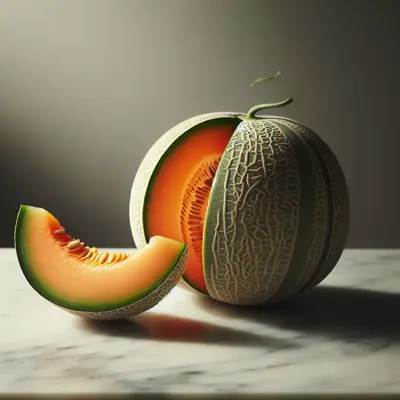
Charentais cantaloupe is a French heirloom melon prized for its distinctive netted, pale golden-orange rind and dense, silky orange flesh. Reaching harvest in approximately 75 days, this hybrid variety produces small to medium-sized fruits (2-3 lbs) with exceptional sugar content and aromatic complexity. The intensely sweet, perfumed flavor features subtle floral notes that distinguish it from conventional cantaloupes, making it a favorite among discerning gardeners and chefs. Requires full sun and excellent drainage to thrive in home gardens.
Harvest
75d
Days to harvest
Sun
Full sun
Zones
2–11
USDA hardiness
Height
6-9 feet
Planting Timeline
Showing dates for Charentais Cantaloupe in USDA Zone 7
All Zone 7 melon →Zone Map
Click a state to update dates
Charentais Cantaloupe · Zones 2–11
Growing Details
Complete Growing Guide
Charentais cantaloupes demand warmer soil and air temperatures than standard melons, requiring consistent heat above 70°F and benefit from starting indoors 3-4 weeks before transplanting to achieve their tight 75-day window. This heirloom cultivar is particularly susceptible to powdery mildew and fusarium wilt in humid conditions, making excellent air circulation essential; space plants generously and avoid overhead watering. Unlike many melons, Charentais exhibits a strong tendency toward the forced-slip stage, where the stem naturally detaches when fully ripe—learning to recognize this subtle release rather than relying on skin color alone prevents both premature harvesting and overshooting peak sweetness. The dense, perfumed flesh demands consistent moisture during fruit development but not waterlogging, as this cultivar cracks more readily than modern hybrids. To maximize success, mulch heavily to regulate soil temperature and moisture while reducing disease pressure from soil splash.
Light: Full sun (6 or more hours of direct sunlight a day). Soil: Clay, High Organic Matter, Loam (Silt). Soil pH: Acid (<6.0), Neutral (6.0-8.0). Drainage: Good Drainage, Moist. Height: 6 ft. 0 in. - 9 ft. 0 in.. Spread: 1 ft. 0 in. - 3 ft. 0 in.. Spacing: 12 inches-3 feet. Growth rate: Medium. Maintenance: Medium. Propagation: Seed. Regions: Coastal, Mountains, Piedmont.
Harvesting
Peak readiness for Charentais cantaloupes arrives when the fruit develops a distinctive dark yellow skin color, signaling maturity at approximately 75 days. At this stage, melons reach their target size of 5 to 5½ inches in diameter and weigh around 4 pounds. The "forced-slip" stage—when the fruit detaches with gentle pressure at the stem—provides the most reliable harvest indicator. Growers can either cut mature fruit from the vine or wait for natural abscission. For optimal flavor, harvest in early morning when the melon's characteristic sweet, floral aroma intensifies, ensuring you capture the silky, dense flesh at its most intensely perfumed peak. Single harvest per plant is typical for this cultivar.
Musky-scented, spherical to oblong berry with a rind (pepo), often furrowed with yellow, white or green flesh and many seeds. The rind may be green, yellow, tan, beige or white and the surface may be smooth, rough, warty, scaly, or netted. Seeds white, about 1/2 inch long, narrow. Seeds ripen in August and September.
Color: Gold/Yellow, Green, White. Type: Berry. Length: < 1 inch. Width: < 1 inch.
Garden value: Edible, Showy
Harvest time: Fall
Edibility: Eaten fresh, wrapped in prosciutto, in salads, or as a dessert. Watery, but delicate, flavor. Avoid the seeds as the sprouting seed produces a toxic substance in its embryo.
Storage & Preservation
Freshly harvested Charentais should ripen at room temperature for 2-3 days to develop full flavor complexity, then refrigerate for up to one week. Store whole melons at 45-50°F with high humidity—wrap in perforated plastic bags to prevent moisture loss while allowing air circulation.
Once cut, Charentais deteriorates rapidly and should be consumed within 2-3 days for optimal flavor. The delicate flesh doesn't freeze well for fresh eating but can be pureed and frozen for sorbets or smoothies. For preservation, the intense flavor makes Charentais excellent for artisanal jams and preserves—the natural high sugar content requires less added sugar than other melons. Dehydrating concentrates the complex flavors beautifully; slice thin and dry at 135°F until leathery. The resulting melon leather captures much of the original aromatic intensity.
History & Origin
The Charentais cantaloupe originates from the Charente region of France, where it has been cultivated as a heritage melon variety for centuries. While precise breeding records and specific dates are not well documented, this variety emerged from traditional French agricultural practices and represents a distinct lineage within European cantaloupe development. The variety became commercially significant in France during the 19th and 20th centuries, eventually gaining international recognition for its exceptional flavor profile. Unlike many modern hybrids developed by seed companies, Charentais represents a time-honored selection within French melon-growing traditions, refined through generations of cultivation in its namesake region.
Origin: Africa, Arabian Peninsula, India, Australia
Advantages
- +Intensely sweet and perfumed flavor with complex floral notes distinguishes it from standard cantaloupes
- +Compact 4-pound size ideal for small families or container gardening spaces
- +Smooth yellow skin simplifies ripeness assessment and harvesting at forced-slip stage
- +Silky, dense flesh texture and juicy character create premium eating experience
- +Moderate 75-day maturity allows cultivation in shorter growing season regions
Considerations
- -Challenging difficulty level requires experienced gardeners and precise growing conditions
- -Highly susceptible to multiple serious diseases including fusarium wilt and bacterial wilt
- -Vulnerable to several damaging pests including aphids, spider mites, and melon flies
- -Demanding French heirloom requires careful soil management and consistent moisture control
Companion Plants
Basil and marigolds are worth planting closest to your melons. Basil's volatile oils may interfere with aphid and thrips host-finding, and French marigolds (Tagetes patula) are well-documented for suppressing root-knot nematodes — NC State Extension recommends a solid planting of them in any bed with nematode history before returning susceptible crops. Nasturtiums work as a trap crop for aphids, drawing them away from the vines. Radishes at the bed edges can reduce cucumber beetle pressure, which matters here because those beetles are the primary vector for bacterial wilt.
Keep cucumbers out of this bed entirely — they share the same disease triangle (powdery mildew, bacterial wilt, cucumber beetles), and grouping them concentrates all that pressure in one place. Sage and other strongly aromatic herbs can inhibit cucurbit root development at close range; keep them at least 18 inches back from the planting. Potatoes bring their own soil disease load and compete for the same nutrient profile — the proximity just isn't worth it.
Plant Together
Basil
Repels aphids, whiteflies, and thrips while potentially improving melon flavor
Marigold
Deters cucumber beetles, aphids, and nematodes that commonly attack melons
Nasturtium
Acts as trap crop for cucumber beetles and squash bugs, repels aphids
Radish
Repels cucumber beetles and squash vine borers, improves soil structure
Sunflower
Provides beneficial shade and attracts pollinators essential for melon fruit set
Oregano
Repels cucumber beetles and provides general pest deterrent properties
Corn
Provides natural windbreak and partial shade without competing for nutrients
Tansy
Repels ants, cucumber beetles, and squash bugs that damage melon plants
Keep Apart
Cucumber
Competes for same nutrients and attracts shared pests like cucumber beetles
Potato
May stunt melon growth and both plants compete for similar soil nutrients
Aromatic Herbs (Sage)
Strong aromatic compounds can inhibit melon seed germination and growth
Nutrition Facts
Per 100g serving. % Daily Value based on 2,000 calorie diet. Source: USDA FoodData Central (FDC #169092)
Pests & Disease Resistance
Resistance
Fusarium Wilt races 0-2 (High); Powdery Mildew (Intermediate)
Common Pests
Aphids, spider mites, cucumber beetles, melon fly
Diseases
Powdery mildew, fusarium wilt, bacterial wilt, crown rot
Troubleshooting Charentais Cantaloupe
What you'll see, why it happens, and what to do about it.
Wilting vines that don't recover overnight, even with adequate water, starting anytime after the seedling stage
Likely Causes
- Bacterial wilt (Erwinia tracheiphila) — spread by cucumber beetles feeding on stems and leaves
- Fusarium wilt (Fusarium oxysporum f. sp. melonis) — soil-borne fungus that persists for years
What to Do
- 1.Pull and bag the affected plant immediately — don't compost it — roots and all
- 2.Check for cucumber beetles and treat with a labeled foliar insecticide; NC State Extension's IPM guidance notes that controlling beetles at the cotyledon stage is critical to stopping bacterial wilt spread
- 3.Rotate cucurbits out of that bed for at least 3 years; fusarium lives in the soil indefinitely once established
White powdery coating on upper leaf surfaces, typically showing up 40–50 days after transplant in hot, dry stretches
Likely Causes
- Powdery mildew (Podosphaera xanthii or Golovinomyces cichoracearum) — thrives in warm, dry conditions with poor airflow
- Crowded vines that keep humidity trapped around the canopy
What to Do
- 1.Remove the worst-affected leaves and dispose of them in the trash
- 2.Apply a sulfur-based or potassium bicarbonate fungicide at first sign — waiting until it spreads across multiple plants makes it much harder to manage
- 3.Next season, space plants at least 4 feet apart and train vines outward to keep air moving through
Dark, sunken, dry spot on the blossom end of the fruit — no smell, just a leathery collapsed area
Likely Causes
- Blossom-end rot from calcium deficiency in the developing fruit — caused by uneven soil moisture, not a lack of calcium in the soil itself
- Overfertilizing with high-nitrogen fertilizer, which drives rapid vegetative growth at the expense of calcium uptake
- Soil pH outside the 6.5–6.8 range, which limits how much calcium the roots can actually pull in
What to Do
- 1.Water consistently — 1 to 1.5 inches per week — and mulch heavily to flatten out the wet-dry swings; NC State Extension's vegetable FAQ identifies moisture fluctuation as the primary driver of this problem
- 2.Cut back on nitrogen fertilizer once fruits set
- 3.Test your soil pH and lime to 6.5–6.8 if it's low; that range is where calcium availability peaks
Seedlings or young transplants chewed down near the soil line, or cotyledons riddled with small feeding holes within the first week after planting
Likely Causes
- Striped cucumber beetle (Acalymma vittatum) or spotted cucumber beetle (Diabrotica undecimpunctata) — both hit cucurbits hard at emergence
- Transplanting into cool soil below 65°F, which slows establishment and extends the window when plants are too small to outgrow the damage
What to Do
- 1.Cover transplants with row fabric or cone-shaped wire screen protectors right after planting — NC State Extension's cantaloupe IPM case study recommends these until plants are established
- 2.If beetle pressure is heavy, apply a foliar insecticide at the cotyledon stage; consult the current NC Agricultural Chemicals Manual for labeled rates
- 3.Wait until soil temperatures are reliably above 65°F before transplanting — a plant that takes off fast spends far less time in the danger zone
Frequently Asked Questions
How long does Charentais cantaloupe take to grow from seed to harvest?▼
Is Charentais cantaloupe good for beginning gardeners?▼
Can you grow Charentais cantaloupe in containers?▼
What does Charentais cantaloupe taste like compared to regular cantaloupe?▼
When should I plant Charentais cantaloupe seeds?▼
Why is my Charentais cantaloupe not sweet or aromatic?▼
Zone-by-Zone Planting Calendar
| Zone | Indoor Start | Transplant | Direct Sow | Harvest |
|---|---|---|---|---|
| Zone 1 | June – June | July – August | July – September | October – August |
| Zone 2 | May – June | July – July | July – August | October – September |
| Zone 11 | January – January | February – February | February – March | May – June |
| Zone 12 | January – January | February – February | February – March | May – June |
| Zone 13 | January – January | February – February | February – March | May – June |
| Zone 3 | May – May | June – July | June – August | September – October |
| Zone 4 | April – May | June – June | June – July | September – October |
| Zone 5 | April – April | May – June | May – July | August – October |
| Zone 6 | April – April | May – June | May – July | August – October |
| Zone 7 | March – April | May – May | May – June | August – September |
| Zone 8 | March – March | April – May | April – June | July – September |
| Zone 9 | February – February | March – April | March – May | June – August |
| Zone 10 | January – February | March – March | March – April | June – July |
Growing Guides from Wind River Greens
Sources & References
External authority sources used in compiling this guide.
See the Methodology page for how this data is sourced, what's AI-assisted, and known limitations.
More Melons
Charleston Gray Watermelon
Ali Baba Watermelon
Cantaloup Charentais
Watermelon Charleston Gray
Hale's Best Cantaloupe
Cantaloupe Iroquois
Sugar Baby Watermelon
Tiger Baby Watermelon