Casaba Golden Beauty
Cucumis melo var. inodorus 'Golden Beauty'
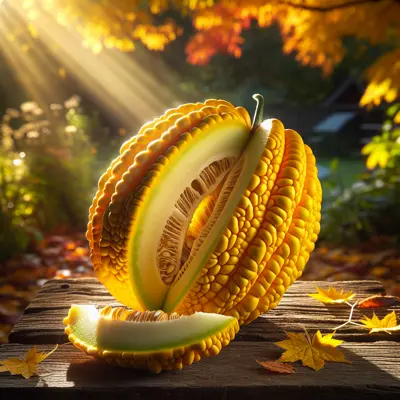
An heirloom winter melon with bright yellow, wrinkled rind and sweet, creamy white flesh that stores exceptionally well. This unique variety ripens late in the season and actually improves in flavor during storage, making it perfect for extending the melon season into fall and winter. The distinctive appearance and honey-sweet flavor make it a conversation starter in any garden.
Harvest
110-120d
Days to harvest
Sun
Full sun
Zones
2–11
USDA hardiness
Height
6-9 feet
Planting Timeline
Showing dates for Casaba Golden Beauty in USDA Zone 7
All Zone 7 melon →Zone Map
Click a state to update dates
Casaba Golden Beauty · Zones 2–11
Growing Details
Complete Growing Guide
With a 110-120 day maturity, start 'Golden Beauty' seeds indoors 3-4 weeks before your last frost or direct sow after soil reaches 70°F, timing planting so vines mature in late summer heat rather than cool fall. This late-season cultivar demands consistent warmth, full sun, and well-draining soil rich in compost—inadequate heat stunts development and prevents proper sugar accumulation. Unlike earlier melons, 'Golden Beauty' shows remarkable resistance to powdery mildew but remains susceptible to fusarium wilt; rotate planting sites yearly and avoid overhead watering. The vines sprawl vigorously (expect 6-9 feet), so provide sturdy trellising or ample space to prevent fruit rot from ground contact. One critical difference: don't harvest at full maturity—pick when the rind just begins turning golden and the blossom end yields slightly to pressure, then store in a cool (50-60°F), well-ventilated space where the flesh sweetens dramatically over 2-3 weeks, truly maximizing this heirloom's honey-like flavor potential.
Light: Full sun (6 or more hours of direct sunlight a day). Soil: Clay, High Organic Matter, Loam (Silt). Soil pH: Acid (<6.0), Neutral (6.0-8.0). Drainage: Good Drainage, Moist. Height: 6 ft. 0 in. - 9 ft. 0 in.. Spread: 1 ft. 0 in. - 3 ft. 0 in.. Spacing: 12 inches-3 feet. Growth rate: Medium. Maintenance: Medium. Propagation: Seed. Regions: Coastal, Mountains, Piedmont.
Harvesting
Harvest Casaba Golden Beauty when the rind transforms from pale green to a deep, rich golden yellow with pronounced wrinkles forming across the surface, and the melon yields slightly to gentle thumb pressure at the blossom end. Unlike determinate melons, this cultivar produces a single main fruit per plant rather than multiple harvests, so timing is critical—pick when the stem begins to crack or separate naturally from the vine. A key indicator specific to this variety is checking for a subtle honeyed fragrance at the blossom end, which signals peak sugar development. Cut rather than twist the melon from the vine to avoid damage, then allow it to cure in a cool, dry location for two weeks before storage, as this post-harvest conditioning further sweetens the flesh and extends keeping quality through winter months.
Musky-scented, spherical to oblong berry with a rind (pepo), often furrowed with yellow, white or green flesh and many seeds. The rind may be green, yellow, tan, beige or white and the surface may be smooth, rough, warty, scaly, or netted. Seeds white, about 1/2 inch long, narrow. Seeds ripen in August and September.
Color: Gold/Yellow, Green, White. Type: Berry. Length: < 1 inch. Width: < 1 inch.
Garden value: Edible, Showy
Harvest time: Fall
Edibility: Eaten fresh, wrapped in prosciutto, in salads, or as a dessert. Watery, but delicate, flavor. Avoid the seeds as the sprouting seed produces a toxic substance in its embryo.
Storage & Preservation
Casaba Golden Beauty's exceptional storage ability sets it apart from summer melons. Store freshly harvested melons at room temperature for 2-3 weeks to fully develop their honey-sweet flavor – they actually improve during this curing period. Once fully ripe, refrigerate for up to 2 months at 32-40°F with high humidity.
For longer preservation, cube the flesh and freeze for up to 8 months, though texture becomes softer when thawed. The thick rind makes excellent pickles – peel away the outer skin and pickle the white rind layer using traditional watermelon rind recipes. You can also dehydrate thin slices for winter snacking, though the high moisture content requires extended drying time.
The key to maximum storage life is harvesting at proper maturity and avoiding any skin damage that allows decay to enter.
History & Origin
The Casaba Golden Beauty belongs to the inodorus melon group, a lineage of non-netted, winter-storage melons that includes the original Casaba variety from Turkey. While specific breeder information and introduction year for this particular cultivar remain undocumented in readily available horticultural records, Golden Beauty represents the continuation of heirloom melon traditions developed through seed-saving practices among home gardeners and specialized seed companies. The variety embodies traits selectively preserved within Casaba breeding lines—extended storage capability and late-season ripening—characteristics highly valued since the variety's introduction to American gardens in the early twentieth century. Its golden rind and improved post-harvest flavor development reflect decades of informal selection within heritage gardening communities.
Origin: Africa, Arabian Peninsula, India, Australia
Advantages
- +Exceptional storage life extends melon enjoyment into winter months
- +Flavor improves during storage, unlike most other melon varieties
- +Stunning golden wrinkled appearance makes it visually distinctive and striking
- +Late-season ripening allows harvesting after most melons finish
- +Sweet honey-like flavor with creamy texture impresses taste-testers
Considerations
- -Long 110-120 day season requires warm climates or early starts
- -Susceptible to multiple fungal diseases including powdery and downy mildew
- -Vulnerable to several serious pests like squash vine borers
Companion Plants
Marigolds — French varieties specifically, like 'Nematode Fighter' or 'Tangerine' — are worth planting densely around melon beds. Their roots release thiophene compounds that suppress root-knot nematodes, and NC State Extension's IPM case studies specifically recommend a solid French marigold planting to draw down nematode populations in beds with a cucurbit history. Nasturtium acts as a trap crop for aphids, pulling them off the melon vines and onto itself where you can deal with them in one place. Borage draws pollinators during the narrow window when Casaba flowers need visits — these melons require good pollination to set fruit, and that window is only 3 to 5 days per flower.
Cucumbers are the companion to avoid most firmly. They share the same pest and disease roster as Casaba — cucumber beetles, bacterial wilt (Erwinia tracheiphila), powdery mildew — so planting them together just doubles the target for everything you're trying to manage. Potatoes can harbor soilborne pathogens that persist and cause trouble for subsequent cucurbit plantings. Fennel is the other one to keep on the far side of the garden; its root exudates are broadly inhibiting to most vegetable crops and melons are no exception.
Plant Together
Basil
Repels aphids, whiteflies, and thrips that commonly attack melons
Marigold
Deters cucumber beetles, aphids, and nematodes while attracting beneficial insects
Nasturtium
Acts as trap crop for squash bugs and cucumber beetles, repels ants
Radish
Repels cucumber beetles and squash bugs, breaks up soil for melon roots
Corn
Provides natural shade and wind protection without competing for nutrients
Sunflower
Attracts pollinators essential for melon fruit set and provides beneficial shade
Oregano
Repels cucumber beetles and improves overall garden pest management
Borage
Attracts pollinators and may improve melon flavor and growth
Keep Apart
Cucumber
Shares same diseases like powdery mildew and attracts similar pests
Potato
May stunt melon growth and both compete heavily for soil nutrients
Aromatic herbs
Strong herbs like sage can inhibit melon germination and growth
Nutrition Facts
Per 100g serving. % Daily Value based on 2,000 calorie diet. Source: USDA FoodData Central (FDC #167765)
Pests & Disease Resistance
Resistance
Moderate resistance to common melon diseases
Common Pests
Cucumber beetles, squash vine borers, aphids, thrips
Diseases
Powdery mildew, downy mildew, bacterial wilt, fusarium wilt
Troubleshooting Casaba Golden Beauty
What you'll see, why it happens, and what to do about it.
Sunken, tan or black leathery patch on the blossom end of the fruit, usually noticed once the melon is half-sized or larger
Likely Causes
- Blossom-end rot from calcium deficiency in developing tissue — not a soil calcium shortage so much as the plant's inability to move calcium fast enough, usually triggered by uneven soil moisture
- Wide swings between dry and wet conditions, or overfertilizing with high-nitrogen fertilizers early in the season
What to Do
- 1.Mulch heavily — 3 to 4 inches of straw — to buffer soil moisture swings, and water to a consistent 1 to 2 inches per week
- 2.Pull back on nitrogen fertilizers once vines are running; excess nitrogen pushes leafy growth at the expense of calcium transport
- 3.Test your soil pH and lime to bring it into the 6.5–6.8 range, where calcium availability is best — NC State Extension recommends this as the baseline corrective step
White powdery coating on upper leaf surfaces, starting on older leaves mid-season and spreading fast in late summer
Likely Causes
- Powdery mildew (Podosphaera xanthii or Erysiphe cichoracearum) — a dry-weather fungus that doesn't need wet leaves to spread; thrives when days are warm and nights cool
- Crowded vines with poor air circulation
What to Do
- 1.Remove and trash the worst-affected leaves — don't compost them
- 2.Spray with potassium bicarbonate or a diluted neem oil solution at first sign; waiting until the whole vine is coated means you've already lost ground
- 3.Give vines their full 48–72 inches of spacing at planting; trellising vertically also opens up airflow considerably
Vine wilts suddenly during the day, recovers overnight at first, then collapses entirely — no yellowing, no spots on the leaves
Likely Causes
- Bacterial wilt (Erwinia tracheiphila), spread by cucumber beetles (Acalymma vittatum and Diabrotica undecimpunctata) feeding on the leaves
- Fusarium wilt (Fusarium oxysporum f. sp. melonis), a soil-borne fungus that blocks vascular tissue — a cross-section of the stem near the base will show brown discoloration
What to Do
- 1.Check for cucumber beetles immediately — yellow-green with black spots or stripes; row cover from transplant through early flowering prevents the feeding that introduces bacterial wilt
- 2.Do the stem test: cut near the base, touch both cut ends with a toothpick, pull apart slowly — if you see stringy bacterial ooze bridging the gap, that plant has bacterial wilt and won't recover; pull and discard it
- 3.For fusarium, rotate out of all cucurbits for at least 3 seasons in that bed; there's no in-season treatment once a plant is infected
Frequently Asked Questions
How long does Casaba Golden Beauty take to grow?▼
Can you grow Casaba Golden Beauty in containers?▼
What does Casaba Golden Beauty taste like?▼
When should I plant Casaba Golden Beauty seeds?▼
How do you know when Casaba Golden Beauty is ripe?▼
Is Casaba Golden Beauty good for beginners?▼
Zone-by-Zone Planting Calendar
| Zone | Indoor Start | Transplant | Direct Sow | Harvest |
|---|---|---|---|---|
| Zone 1 | June – June | July – August | July – September | November – August |
| Zone 2 | May – June | July – July | July – August | November – September |
| Zone 11 | January – January | February – February | February – March | June – July |
| Zone 12 | January – January | February – February | February – March | June – July |
| Zone 13 | January – January | February – February | February – March | June – July |
| Zone 3 | May – May | June – July | June – August | October – October |
| Zone 4 | April – May | June – June | June – July | October – October |
| Zone 5 | April – April | May – June | May – July | October – October |
| Zone 6 | April – April | May – June | May – July | September – November |
| Zone 7 | March – April | May – May | May – June | September – October |
| Zone 8 | March – March | April – May | April – June | August – October |
| Zone 9 | February – February | March – April | March – May | July – September |
| Zone 10 | January – February | March – March | March – April | July – August |
Growing Guides from Wind River Greens
Sources & References
External authority sources used in compiling this guide.
See the Methodology page for how this data is sourced, what's AI-assisted, and known limitations.
More Melons
Charleston Gray Watermelon
Ali Baba Watermelon
Cantaloup Charentais
Watermelon Charleston Gray
Hale's Best Cantaloupe
Cantaloupe Iroquois
Sugar Baby Watermelon
Tiger Baby Watermelon