Boule d'Or Charentais
Cucumis melo var. cantalupensis 'Boule d'Or'
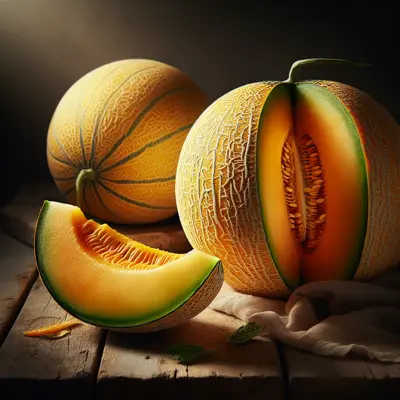
An authentic French Charentais melon that represents the pinnacle of melon flavor with its incredibly aromatic, orange flesh that's intensely sweet and perfumed. Boule d'Or produces small, personal-sized fruits with smooth, pale skin that turns golden when ripe, each one delivering the authentic taste of French summer markets. This heirloom variety requires patience but rewards gardeners with unparalleled flavor that commercial melons simply cannot match.
Harvest
75-85d
Days to harvest
Sun
Full sun
Zones
2–11
USDA hardiness
Height
6-9 feet
Planting Timeline
Showing dates for Boule d'Or Charentais in USDA Zone 7
All Zone 7 melon →Zone Map
Click a state to update dates
Boule d'Or Charentais · Zones 2–11
Growing Details
Succession Planting
Boule d'Or takes 75–85 days to harvest and each vine produces a handful of fruits over a few weeks before it's finished — this isn't a cut-and-come-again situation. Start seeds indoors 3–4 weeks before your last frost date, transplant in May once soil temperatures are reliably above 65°F, and that's your season. If you want to stagger ripening slightly, two small plantings 2 weeks apart will do it, but a single mid-May sowing is usually enough for a home garden.
Complete Growing Guide
Boule d'Or Charentais demands warmer soil than standard melons—wait until soil reaches 70°F and nighttime temperatures stabilize above 60°F before direct sowing, as this French cultivar resists germination in cool conditions and may rot if planted too early. This variety is particularly susceptible to powdery mildew in humid climates, so ensure excellent air circulation and avoid overhead watering; space plants generously and consider preventative sulfur applications in regions with high humidity. Unlike vigorous American melons, Boule d'Or can struggle in extreme heat above 95°F, which may cause flower drop and reduce fruit set—afternoon shade in hot climates helps. The fruits mature within a narrow window (75-85 days), so monitor closely once flowering begins; slice a test melon near day 80 to check for peak sweetness rather than relying solely on appearance. A practical strategy: reduce nitrogen fertilizer once flowering starts and increase potassium to concentrate sugars in the fruit, enhancing the perfumed complexity this heirloom demands.
Light: Full sun (6 or more hours of direct sunlight a day). Soil: Clay, High Organic Matter, Loam (Silt). Soil pH: Acid (<6.0), Neutral (6.0-8.0). Drainage: Good Drainage, Moist. Height: 6 ft. 0 in. - 9 ft. 0 in.. Spread: 1 ft. 0 in. - 3 ft. 0 in.. Spacing: 12 inches-3 feet. Growth rate: Medium. Maintenance: Medium. Propagation: Seed. Regions: Coastal, Mountains, Piedmont.
Harvesting
Harvest Boule d'Or when the skin transitions from pale green to golden yellow and the fruit reaches its characteristic small, personal size of 3-4 pounds. Press gently near the blossom end—ripe melons yield slightly to pressure and emit a sweet, perfumed fragrance that intensifies as ripeness peaks. Unlike larger cantaloupe varieties, Boule d'Or produces a continuous but modest harvest rather than a single flush, so monitor vines regularly throughout the season for optimal flavor development. Pick fruits in early morning when temperatures are coolest, as the aromatic compounds are most pronounced before midday heat dissipates them, ensuring you capture the full complexity of this heirloom's renowned floral notes.
Musky-scented, spherical to oblong berry with a rind (pepo), often furrowed with yellow, white or green flesh and many seeds. The rind may be green, yellow, tan, beige or white and the surface may be smooth, rough, warty, scaly, or netted. Seeds white, about 1/2 inch long, narrow. Seeds ripen in August and September.
Color: Gold/Yellow, Green, White. Type: Berry. Length: < 1 inch. Width: < 1 inch.
Garden value: Edible, Showy
Harvest time: Fall
Edibility: Eaten fresh, wrapped in prosciutto, in salads, or as a dessert. Watery, but delicate, flavor. Avoid the seeds as the sprouting seed produces a toxic substance in its embryo.
Storage & Preservation
Store freshly harvested Boule d'Or Charentais at room temperature for 2-3 days to allow full flavor development – this variety continues to sweeten slightly after harvest. Once fully aromatic, refrigerate for up to one week, though the perfumed fragrance diminishes rapidly in cold storage. Never refrigerate unripe melons as cold temperatures halt the ripening process permanently.
For preservation, remove seeds and cut flesh into cubes for freezing, though texture becomes soft and is best used for smoothies or sorbets. The intense flavor makes Boule d'Or excellent for jam or preserves – combine with lemon juice and minimal added sugar to preserve the natural sweetness. Dehydrating produces intensely flavored fruit leather, while the aromatic properties make this variety perfect for infusing vinegars or creating melon wine. Slice and freeze on parchment-lined trays before transferring to freezer bags for best results.
History & Origin
Boule d'Or Charentais emerged from the Charentais melon tradition of western France, specifically the Charente region renowned for exceptional cantaloupe cultivation. While precise breeding documentation and individual breeder attribution remain obscure, this variety represents a refinement within the broader Charentais lineage—melons celebrated for their aromatic orange flesh and superior flavor since at least the early 20th century. The "Boule d'Or" (golden ball) designation reflects the variety's characteristic pale, smooth skin that develops golden tones at maturity, distinguishing it within the Charentais family. Like many French heirloom vegetables, its development occurred through careful seed selection within farming communities rather than formal institutional breeding programs, making its exact origins difficult to pinpoint with certainty.
Origin: Africa, Arabian Peninsula, India, Australia
Advantages
- +Unmatched aromatic flavor with complex floral notes that commercial melons cannot replicate
- +Small personal-sized fruits perfect for individual consumption and smaller gardens
- +Authentic French heirloom variety delivers genuine taste of Charentais melon markets
- +Golden skin color at maturity provides clear visual ripeness indicator for harvesting
- +Intensely sweet orange flesh with perfumed fragrance justifies the moderate growing difficulty
Considerations
- -Susceptible to multiple fungal diseases including powdery mildew and downy mildew
- -Requires consistent warm temperatures and careful watering to prevent fusarium and bacterial wilt
- -Extended 75-85 day growing season demands warm climates or early spring planting
- -Vulnerable to multiple pest pressures including aphids, cucumber beetles, spider mites, and thrips
Companion Plants
French marigolds (Tagetes patula) are worth planting densely in any bed with a nematode history — NC State Extension specifically recommends a solid planting of them before returning cucurbits to an affected area. Nasturtiums pull double duty as a trap crop: aphids prefer them over melon leaves, and you can yank the infested nasturtium plants rather than spray anything. Keep cucumbers at least 10–15 feet away — they share the exact same pest and disease load as Boule d'Or (cucumber beetles, Erwinia tracheiphila, downy mildew), and putting them side by side just concentrates the pressure. Fennel is allelopathic and stunts the roots of most vegetables within a few feet, so it has no place near this bed.
Plant Together
Basil
Repels aphids and thrips while potentially improving melon flavor
Marigold
Deters cucumber beetles and aphids that commonly attack melons
Nasturtium
Acts as trap crop for cucumber beetles and squash bugs
Radish
Helps deter cucumber beetles and vine borers when planted around melon hills
Sunflower
Provides beneficial shade and attracts pollinators essential for melon fruit set
Beans
Fix nitrogen in soil and provide ground cover without competing for nutrients
Oregano
Repels cucumber beetles and provides aromatic pest deterrent
Corn
Offers natural windbreak and vertical growing space without root competition
Keep Apart
Cucumber
Shares same pests and diseases, increasing risk of cucumber beetle and bacterial wilt
Potato
Competes heavily for nutrients and may harbor similar fungal diseases
Fennel
Produces allelopathic compounds that inhibit growth of cucurbit family plants
Nutrition Facts
Per 100g serving. % Daily Value based on 2,000 calorie diet. Source: USDA FoodData Central (FDC #167765)
Pests & Disease Resistance
Resistance
Limited disease resistance typical of heirlooms, susceptible to fungal diseases in humid conditions
Common Pests
Aphids, cucumber beetles, spider mites, thrips
Diseases
Powdery mildew, downy mildew, fusarium wilt, bacterial wilt
Troubleshooting Boule d'Or Charentais
What you'll see, why it happens, and what to do about it.
Sunken, dry, tan or brown rotten spot on the blossom end of the fruit
Likely Causes
- Blossom-end rot from calcium deficiency in the developing fruit — usually triggered by inconsistent soil moisture rather than a true calcium shortage in the soil
- Overfertilization with high-nitrogen fertilizer pushing rapid vegetative growth that outpaces calcium uptake
- Soil pH outside the 6.5–7.5 range, locking out calcium even when it's present
What to Do
- 1.Mulch with 3–4 inches of straw to even out soil moisture swings, and water consistently to 1–1.5 inches per week
- 2.Pull back on high-nitrogen fertilizers once vines start running — switch to a balanced 10-10-10 or lower-nitrogen side-dress
- 3.Test your soil pH; NC State Extension recommends liming to bring pH up to 6.5–6.8 if it's running low
White powdery coating on upper leaf surfaces, typically showing up mid-season as vines mature
Likely Causes
- Powdery mildew (Podosphaera xanthii or Golovinomyces cichoracearum) — thrives in warm, dry days combined with high humidity at night
- Dense canopy with poor airflow, especially on vines that have been left to tangle
What to Do
- 1.Thin out crowded foliage and keep vines off the ground where possible to improve air circulation
- 2.Apply a potassium bicarbonate or sulfur-based fungicide at first sign — don't wait until the whole plant is coated
- 3.Rotate out of cucurbits (including cucumber, squash, and other melons) for at least 2 seasons in that bed
Vine wilts rapidly — sometimes one runner, sometimes the whole plant — and doesn't recover overnight
Likely Causes
- Bacterial wilt (Erwinia tracheiphila), spread by cucumber beetles (Acalymma vittatum and Diabrotica undecimpunctata) feeding on leaves
- Fusarium wilt (Fusarium oxysporum f. sp. melonis), a soil-borne fungus that blocks vascular tissue — check for brown discoloration in a stem cross-section
What to Do
- 1.Do the stem-thread test for bacterial wilt: cut a wilted stem, press the cut ends together, pull apart slowly — stringy threads confirm bacterial wilt, and that plant needs to come out immediately
- 2.Control cucumber beetle populations with row cover from transplant until flowering (remove covers for pollination), or apply kaolin clay as a deterrent
- 3.For fusarium, there's no in-season fix — remove and bag the plant, don't compost it, and keep all cucurbits out of that spot for 3–4 years
Frequently Asked Questions
How long does Boule d'Or Charentais take to grow from seed?▼
Can you grow Boule d'Or Charentais in containers?▼
Is Boule d'Or Charentais good for beginners?▼
What does Boule d'Or Charentais taste like compared to regular cantaloupe?▼
When should I plant Boule d'Or Charentais seeds?▼
Why are my Boule d'Or Charentais melons not sweet?▼
Zone-by-Zone Planting Calendar
| Zone | Indoor Start | Transplant | Direct Sow | Harvest |
|---|---|---|---|---|
| Zone 3 | May – May | June – July | June – August | September – October |
| Zone 4 | April – May | June – June | June – July | September – October |
| Zone 5 | April – April | May – June | May – July | September – October |
| Zone 6 | April – April | May – June | May – July | August – October |
| Zone 7 | March – April | May – May | May – June | August – September |
| Zone 8 | March – March | April – May | April – June | July – September |
| Zone 9 | February – February | March – April | March – May | June – August |
| Zone 10 | January – February | March – March | March – April | June – July |
| Zone 1 | June – June | July – August | July – September | October – August |
| Zone 2 | May – June | July – July | July – August | October – September |
| Zone 11 | January – January | February – February | February – March | May – June |
| Zone 12 | January – January | February – February | February – March | May – June |
| Zone 13 | January – January | February – February | February – March | May – June |
Growing Guides from Wind River Greens
Sources & References
External authority sources used in compiling this guide.
See the Methodology page for how this data is sourced, what's AI-assisted, and known limitations.
More Melons
Charleston Gray Watermelon
Ali Baba Watermelon
Cantaloup Charentais
Watermelon Charleston Gray
Hale's Best Cantaloupe
Cantaloupe Iroquois
Sugar Baby Watermelon
Tiger Baby Watermelon