Hyssop
Hyssopus officinalis
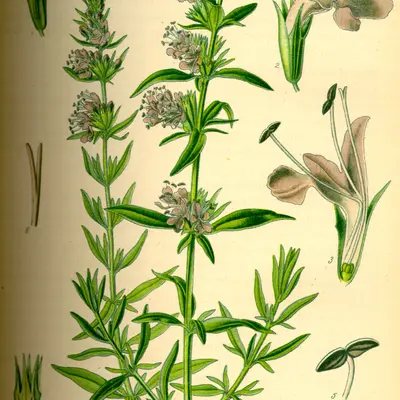
Mint family plant has bright blue-violet flowers. Popular ornamental for the perennial bed. Tea has a soothing quality.
Harvest
85-90d
Days to harvest
Sun
Full sun to partial shade
Zones
4–9
USDA hardiness
Height
18-24 inches
Planting Timeline
Showing dates for Hyssop in USDA Zone 7
All Zone 7 herb →Zone Map
Click a state to update dates
Hyssop · Zones 4–9
Growing Details
Complete Growing Guide
Light: Full sun (6 or more hours of direct sunlight a day), Partial Shade (Direct sunlight only part of the day, 2-6 hours). Soil: Loam (Silt), Sand, Shallow Rocky. Soil pH: Alkaline (>8.0), Neutral (6.0-8.0). Drainage: Good Drainage, Occasionally Dry, Very Dry. Height: 1 ft. 6 in. - 2 ft. 0 in.. Spread: 1 ft. 0 in. - 1 ft. 6 in.. Spacing: 12 inches-3 feet. Growth rate: Medium. Maintenance: Low. Propagation: Division, Seed, Stem Cutting. Regions: Coastal, Mountains, Piedmont.
Harvesting
Edibility: Its leaves and young shoot tips are edible both raw or used as a flavoring in a variety of dishes, including soups, stews, and salads.
Storage & Preservation
Freshly harvested hyssop keeps best in a cool, humid environment between 32–40°F with 85–90% relative humidity; store stems loosely in a perforated plastic bag in the refrigerator crisper drawer for up to two weeks. For longer preservation, air-drying is ideal—hang small bundles in a warm, dark, well-ventilated space for 7–10 days until leaves crumble easily. Dried hyssop retains its peppery, minty flavor exceptionally well and stores for over a year in airtight glass jars away from light. Freezing also works: chop fresh leaves and pack them into ice cube trays with water or oil, then transfer frozen cubes to freezer bags for convenient portioning through winter. Hyssop's volatile oils are heat-stable, making it one of the few culinary herbs that doesn't lose significant flavor intensity when dried, so drying is particularly worthwhile over other methods if space allows.
History & Origin
Origin: Southern and eastern Europe, Northern Africa, West Asia
Advantages
- +Attracts: Bees, Butterflies, Hummingbirds
- +Edible: Its leaves and young shoot tips are edible both raw or used as a flavoring in a variety of dishes, including soups, stews, and salads.
- +Low maintenance
Companion Plants
Hyssop's volatile oils and nectar-heavy flower spikes do real work near brassicas — cabbage, broccoli, cauliflower, and Brussels sprouts. The blooms attract parasitic wasps that prey on cabbage loopers (Trichoplusia ni) and imported cabbageworm (Pieris rapae larvae), so planting a low border of hyssop about 18 inches out from a brassica bed gives those beneficials a reliable food source while keeping pest pressure down. The same flower-to-beneficial-insect dynamic plays out near grapes and tomatoes. Sage pairs well for a different reason entirely — both are drought-tolerant Mediterranean plants with near-identical water and sun needs, so they don't fight over soil moisture the way mismatched neighbors often do.
Radishes, lettuce, and spinach are genuinely poor fits. Those crops want consistent moisture and cooler soil temperatures, and hyssop wants the opposite — dry conditions with good drainage. You'll end up either stressing the greens or rotting the hyssop trying to split the difference. There's also documented allelopathic inhibition from aromatic herbs on shallow-rooted salad crops. Give them separate beds, or at minimum 24 inches of buffer.
Plant Together
Cabbage
Hyssop repels cabbage moths and flea beetles that damage brassicas
Tomatoes
Hyssop deters tomato hornworms and may improve tomato flavor
Grapes
Traditional pairing where hyssop repels harmful insects and may enhance grape growth
Broccoli
Hyssop's strong scent confuses cabbage white butterflies and other brassica pests
Cauliflower
Provides pest protection against cabbage worms and aphids
Brussels Sprouts
Hyssop's aromatic oils help mask the scent that attracts brassica pests
Beans
Hyssop attracts beneficial insects like bees while beans fix nitrogen in soil
Sage
Both herbs have similar growing requirements and complement each other's pest-repelling properties
Keep Apart
Radishes
Hyssop's strong root system and allelopathic compounds can inhibit radish development
Lettuce
Hyssop's vigorous growth can overshadow lettuce and its oils may inhibit germination
Spinach
Competitive for nutrients and hyssop's strong presence can stunt spinach growth
Nutrition Facts
Per 100g serving. % Daily Value based on 2,000 calorie diet. Source: USDA FoodData Central (FDC #172232)
Pests & Disease Resistance
Common Pests
Whiteflies, spider mites, aphids
Diseases
Powdery mildew, root rot in waterlogged soil
Troubleshooting Hyssop
What you'll see, why it happens, and what to do about it.
White powdery coating on leaves and stems, usually starting mid-summer
Likely Causes
- Powdery mildew — a fungal infection that thrives in warm days, cool nights, and poor airflow
- Crowded spacing under 12 inches, which traps humidity around the foliage
What to Do
- 1.Mix 1 tablespoon baking soda plus 1 tablespoon summer horticultural oil per gallon of water and spray every 3 to 5 days as a preventive — NC State Extension's organic disease management guidance lists this combination as effective against powdery mildew
- 2.OMRI-listed sulfur fungicides are a step up if the baking soda spray isn't keeping pace
- 3.Cut back affected stems by about one-third and open up spacing so air moves between plants
Wilting despite adequate watering, with blackened or mushy tissue at the crown and roots
Likely Causes
- Root rot — most often Phytophthora spp. or Pythium spp. in poorly drained or waterlogged soil
- Planting in a low spot that pools water after rain, even briefly
What to Do
- 1.Dig the plant, cut off any black or soft root tissue back to firm white root, and replant in a raised bed or a spot amended with coarse grit
- 2.Don't replant hyssop in the same soggy location — it's a Mediterranean herb and wet feet will kill it faster than drought ever will
- 3.Water only when the top inch of soil is dry; established plants at 18–24 inches tall handle dry spells far better than saturated conditions
Sticky residue on leaves with tiny insects clustered on new growth or leaf undersides, sometimes with fine webbing
Likely Causes
- Aphids (Aphis spp.) feeding on soft new growth and excreting honeydew
- Spider mites — they produce the fine webbing and spike in populations during hot, dry stretches above 85°F
- Whiteflies, which scatter in a cloud when you brush the foliage
What to Do
- 1.Knock aphids off with a firm stream of water from a hose; repeat every 2 to 3 days until the population collapses
- 2.For spider mites, coat the undersides of leaves thoroughly with insecticidal soap — contact is everything, the spray has no residual effect
- 3.NC State Extension's container plant guidance flags sticky leaves and cottony masses as early warning signs worth catching at your weekly grooming pass, before a small colony becomes a full infestation
Frequently Asked Questions
How long does it take hyssop to grow from seed to harvest?▼
Is hyssop good for beginners?▼
Can you grow hyssop in containers?▼
When should I plant hyssop seeds?▼
What does hyssop tea taste like and how do you use it?▼
How much sun does hyssop need to thrive?▼
Zone-by-Zone Planting Calendar
| Zone | Indoor Start | Transplant | Direct Sow | Harvest |
|---|---|---|---|---|
| Zone 3 | April – May | June – July | — | July – October |
| Zone 4 | March – April | June – July | — | July – October |
| Zone 5 | March – April | May – June | — | June – October |
| Zone 6 | March – April | May – June | — | June – November |
| Zone 7 | February – March | April – June | — | June – November |
| Zone 8 | February – March | April – May | — | May – December |
| Zone 9 | January – February | March – April | — | April – December |
| Zone 10 | January – January | February – April | — | April – December |
Growing Guides from Wind River Greens
Sources & References
External authority sources used in compiling this guide.
- ExtensionNC State Extension
- BreederJohnny's Selected Seeds
- USDAUSDA FoodData Central
See the Methodology page for how this data is sourced, what's AI-assisted, and known limitations.