Cumin
Cuminum cyminum
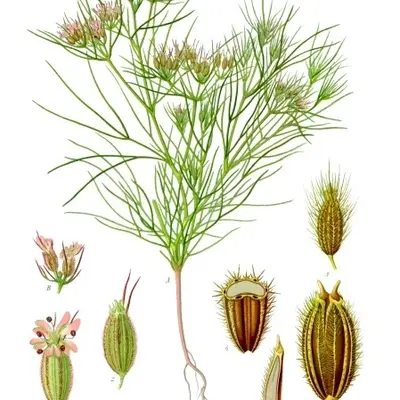
Fragrant, ferny foliage is similar to dill. Young leaves make a nice addition to salad mixes. Grows best in warmer climates, but will produce seeds in northern areas if started early. Medicinal: Seed aids digestion.
Harvest
100-115d
Days to harvest
Sun
Full sun
Zones
5–10
USDA hardiness
Height
12-24 inches
Planting Timeline
Showing dates for Cumin in USDA Zone 7
All Zone 7 herb →Zone Map
Click a state to update dates
Cumin · Zones 5–10
Growing Details
Succession Planting
Cumin runs 100–115 days from transplant to seed harvest, which leaves almost no room for a second sowing in most climates. Start indoors in February or March, transplant after last frost between April and June, and plan on a single harvest per season. A midsummer direct sowing will still be maturing when cool fall nights arrive — cumin needs warm, dry conditions to ripen seed properly, and nights dropping below about 60°F stall that process before the umbels dry down. One well-timed planting is the practical approach.
Complete Growing Guide
Light: Full sun (6 or more hours of direct sunlight a day). Soil: Clay, High Organic Matter, Loam (Silt), Sand. Soil pH: Acid (<6.0), Neutral (6.0-8.0). Drainage: Good Drainage, Occasionally Dry. Spacing: Less than 12 inches. Growth rate: Rapid. Maintenance: Low. Propagation: Seed. Regions: Coastal, Mountains, Piedmont.
Harvesting
The fruit of the cumin plant is dry, conical shaped, less than 1/4 inch in length, and covered with minute hairs. The fruit does not split open when ripe. It contains a single seed that is harvested by hand and is then used as a spice. The seed is yellow-brown to gray, having eight ridges with oil canals.
Color: Brown/Copper, Gold/Yellow, Gray/Silver. Type: Schizocarp. Length: < 1 inch.
Garden value: Edible
Harvest time: Fall, Summer
Edibility: The cumin seed is a popular spice used either whole or ground in flavoring in stews, bean dishes, sausages, pickles, cheese, and many other food dishes. It has a hot and aromatic flavor and is often used in curries. The essential oil obtained from the seed is used as flavoring as well.
Storage & Preservation
Cumin seeds should be harvested when fully mature and dried on the plant or in a warm, well-ventilated space until they rattle in their pods. Store dried seeds in airtight glass containers away from light and heat, ideally between 50–70°F with low humidity; they remain viable for 2–3 years under these conditions. Fresh cumin leaves have a short shelf life of 3–5 days in the refrigerator when sealed in a damp cloth within a plastic bag. For long-term preservation, dry the seeds completely and store in a cool, dark cupboard—this is the standard method and preserves both flavor and germination ability. Alternatively, freeze fresh leaves in ice cube trays with water or oil for convenient portioning. Cumin's volatile oils concentrate significantly during drying, so freshly dried homegrown seeds often taste more potent than store-bought versions; store small batches separately to appreciate the distinction between harvest seasons.
History & Origin
Origin: Mediterranean into India. Iraq to Afghanistan, upper Egypt.
Advantages
- +Attracts: Pollinators
- +Edible: The cumin seed is a popular spice used either whole or ground in flavoring in stews, bean dishes, sausages, pickles, cheese, and many other food dishes. It has a hot and aromatic flavor and is often used in curries. The essential oil obtained from the seed is used as flavoring as well.
- +Fast-growing
- +Low maintenance
Companion Plants
Marigolds are the most practical companion here. NC State Extension is candid that blanket pest-repellent claims for marigolds are largely unproven, but what they reliably do is break up a solid block of cumin — and NC State's IPM guidance confirms that mixing plant families slows pest and disease spread by giving problems fewer consecutive hosts to move through. Coriander and dill are genuinely good neighbors: neither competes aggressively at 6–12 inch spacing, and they draw different pest pressure than cumin does, so early damage in one doesn't automatically jump to the other.
Fennel is the problem plant. It releases allelopathic root exudates that suppress neighboring herbs, and cumin's shallow feeder roots put it squarely in range. Mint is a different kind of trouble — not allelopathic, just relentless. Left uncontained, it can colonize a bed in a single season and physically crowd cumin out before the plants hit 60 days.
Plant Together
Lettuce
Cumin provides light shade for lettuce in hot weather while lettuce acts as living mulch
Marigolds
Natural pest deterrent that protects cumin from nematodes and aphids
Coriander
Both are Mediterranean herbs with similar growing requirements and water needs
Dill
Attracts beneficial insects like parasitic wasps that control cumin pests
Tomatoes
Cumin's aromatic oils help repel tomato hornworms and other pests
Peppers
Similar heat tolerance and cumin's scent deters aphids that attack peppers
Onions
Onion's sulfur compounds repel thrips and other small insects that damage cumin
Carrots
Cumin's deep taproot doesn't compete with carrots' root system
Keep Apart
Fennel
Releases allelopathic compounds that inhibit cumin seed germination and growth
Mint
Aggressive spreader that competes for nutrients and can overwhelm cumin plants
Black Walnut
Produces juglone toxin that is highly toxic to cumin and most herbs
Nutrition Facts
Per 100g serving. % Daily Value based on 2,000 calorie diet. Source: USDA FoodData Central (FDC #172232)
Pests & Disease Resistance
Common Pests
Aphids, spider mites
Diseases
Root rot in waterlogged conditions, powdery mildew in humid climates
Troubleshooting Cumin
What you'll see, why it happens, and what to do about it.
Seedlings damping off or mature plants wilting at the base with yellowing lower stems, soil staying wet
Likely Causes
- Root rot from waterlogged conditions — cumin has almost no tolerance for standing water
- Heavy clay soil with poor drainage
What to Do
- 1.Pull affected plants immediately; they won't recover once the crown rots
- 2.Amend beds with coarse sand or perlite before the next sowing, and build raised rows if your soil drains slowly
- 3.Water deeply but infrequently — cumin is drought tolerant once established, so err toward dry rather than wet
White or gray powdery coating on leaves and stems, usually showing up after day 60 in warm, humid stretches
Likely Causes
- Powdery mildew — a fungal infection that spreads fast in humid air, especially when plants are crowded
- Poor airflow from tight spacing under 6 inches
What to Do
- 1.Strip and trash affected leaves; don't compost them
- 2.Thin plants to at least 6 inches apart — NC State Extension notes that overcrowding decreases air movement and creates ideal disease conditions
- 3.Apply a diluted neem oil or potassium bicarbonate spray every 7 days until the flush passes
Leaves stippled with tiny pale dots, fine webbing on undersides, plants looking dusty and dull
Likely Causes
- Spider mites (Tetranychus urticae) — they flare up fast in hot, dry conditions above 85°F
- Aphid colonies on new growth can produce similar stippling if mites aren't visible under a hand lens
What to Do
- 1.Knock mites off with a strong spray of water from a hose, hitting leaf undersides directly
- 2.For persistent infestations, apply insecticidal soap every 5–7 days for 2–3 applications
- 3.Breaking up a solid block of cumin by interplanting with marigolds or dill slows pest spread — NC State's IPM guidance notes that mixing plant families dilutes the attractive odor of the preferred crop
Frequently Asked Questions
How long does cumin take to grow from seed to harvest?▼
Is cumin easy to grow for beginners?▼
Can you grow cumin in containers?▼
What does cumin taste like?▼
When should I plant cumin seeds?▼
What are the medicinal benefits of cumin?▼
Zone-by-Zone Planting Calendar
| Zone | Indoor Start | Transplant | Direct Sow | Harvest |
|---|---|---|---|---|
| Zone 3 | April – May | June – July | — | July – October |
| Zone 4 | March – April | June – July | — | July – October |
| Zone 5 | March – April | May – June | — | June – October |
| Zone 6 | March – April | May – June | — | June – November |
| Zone 7 | February – March | April – June | — | June – November |
| Zone 8 | February – March | April – May | — | May – December |
| Zone 9 | January – February | March – April | — | April – December |
| Zone 10 | January – January | February – April | — | April – December |
Growing Guides from Wind River Greens
Sources & References
External authority sources used in compiling this guide.
- ExtensionNC State Extension
- BreederJohnny's Selected Seeds
- USDAUSDA FoodData Central
See the Methodology page for how this data is sourced, what's AI-assisted, and known limitations.