Borage
Borago officinalis
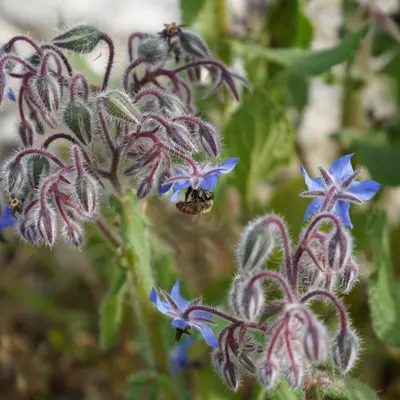
Large plants bear hundreds of small edible flowers, mostly blue and some pink. Long harvest period. Borage flowers attract bees and butterflies. Also available in organic seed.Edible Flowers: Add the flowers to salads or use to garnish cold drinks and desserts. Freeze as ice cubes. Mild cucumber flavor.
Harvest
50-60d
Days to harvest
Sun
Full sun to partial shade
Zones
2–11
USDA hardiness
Height
1-3 feet
Planting Timeline
Showing dates for Borage in USDA Zone 7
All Zone 7 herb →Zone Map
Click a state to update dates
Borage · Zones 2–11
Growing Details
Succession Planting
Borage self-seeds so aggressively that formal succession planting is almost unnecessary — once you've had it in a bed, you'll spend more time managing volunteers than scheduling new sowings. That said, if you want a controlled harvest window, direct sow every 3–4 weeks from your last frost date through early summer, stopping once daytime highs are consistently above 85°F; heat doesn't kill it outright, but flowering slows and the leaves get noticeably coarser. In zone 7, that gives you a practical sowing window from late March through late May for peak summer harvest starting around June.
Complete Growing Guide
Light: Full sun (6 or more hours of direct sunlight a day), Partial Shade (Direct sunlight only part of the day, 2-6 hours). Soil: Clay, Loam (Silt), Sand. Soil pH: Acid (<6.0), Alkaline (>8.0), Neutral (6.0-8.0). Drainage: Good Drainage, Occasionally Dry. Height: 1 ft. 7 in. - 3 ft. 2 in.. Spread: 1 ft. 0 in. - 1 ft. 4 in.. Spacing: Less than 12 inches. Growth rate: Medium. Maintenance: Low. Propagation: Seed. Regions: Coastal, Mountains, Piedmont.
Harvesting
Edibility: In general, the flowers (used as edible flowers) and leaves (used in salads, teas, and sandwiches) are edible. They should only be usred sparingly as liver damage can occur. Only use borage seed oil that is certified as PA-free.
Storage & Preservation
Harvest borage leaves when young and tender, ideally in the morning after dew dries. Store fresh leaves in a breathable container lined with paper towels in the refrigerator at 35–40°F with moderate humidity; they'll keep for 3–5 days before wilting. For longer preservation, freeze leaves whole on a tray, then transfer to freezer bags—they'll blacken slightly but retain flavor for up to three months. Alternatively, dry leaves in a warm, well-ventilated space or use a dehydrator at low heat (95–115°F) until papery, then store in airtight containers away from light. The delicate star-shaped flowers are best used fresh or frozen in ice cubes for drinks, as drying diminishes their appeal. Borage doesn't preserve well through canning or fermentation due to its high water content and delicate structure.
History & Origin
Origin: Mediterranean
Advantages
- +Attracts: Bees, Pollinators
- +Edible: In general, the flowers (used as edible flowers) and leaves (used in salads, teas, and sandwiches) are edible. They should only be usred sparingly as liver damage can occur. Only use borage seed oil that is certified as PA-free.
- +Low maintenance
Considerations
- -Toxic (Leaves): Low severity
Companion Plants
Borage pairs well with tomatoes, squash, and strawberries because its continuous bloom from around day 50 onward draws in pollinators and predatory wasps — that's a real, observable effect on fruit set, not garden folklore. The hairy stems and leaves appear to confuse or deter tomato hornworm and cabbage worms, which is why it also pulls its weight next to brassicas. Fennel is the one to skip nearby: its root exudates suppress a wide range of vegetables, and there's no upside to the gamble. Black walnut produces juglone, a compound toxic to most plants, so anything growing within the canopy drip line is already fighting a losing battle regardless of what you pair with it.
Plant Together
Tomatoes
Borage repels tomato hornworms and may improve tomato flavor and growth
Strawberries
Borage attracts beneficial insects and may enhance strawberry flavor and yield
Squash
Borage attracts pollinators essential for squash fruit production and deters squash bugs
Cucumber
Borage repels cucumber beetles and attracts pollinators for better fruit set
Cabbage
Borage deters cabbage worms and other brassica pests while attracting beneficial predatory insects
Beans
Borage attracts pollinators and beneficial insects that help control bean pests
Peppers
Borage may repel aphids and other soft-bodied insects that attack pepper plants
Marigolds
Both attract beneficial insects and create a diverse ecosystem that supports garden health
Keep Apart
Black Walnut
Juglone produced by black walnut trees is toxic to borage and inhibits its growth
Rue
Rue can inhibit the growth of borage and other herbs through allelopathic compounds
Fennel
Fennel inhibits growth of most garden plants including borage through allelopathy
Nutrition Facts
Per 100g serving. % Daily Value based on 2,000 calorie diet. Source: USDA FoodData Central (FDC #172232)
Pests & Disease Resistance
Common Pests
Aphids, spider mites, sawfly larvae
Diseases
Downy mildew, root rot in poorly drained soil
Troubleshooting Borage
What you'll see, why it happens, and what to do about it.
Soft, gray-purple fuzz on the undersides of leaves, with yellowing on the upper surface — usually appearing in cool, wet stretches
Likely Causes
- Downy mildew (Peronospora boraginacearum) — thrives when nights stay below 65°F and humidity is high
- Overcrowded planting with poor airflow between plants
What to Do
- 1.Remove and trash (don't compost) affected leaves immediately
- 2.Space plants at least 12–18 inches apart and avoid overhead watering in the evening
- 3.If it spreads to more than a third of the plant, pull and dispose of the whole thing — borage re-seeds freely, so starting fresh beats fighting a bad infection
Plant wilting and collapsing at the base, stem looks dark and mushy at soil level
Likely Causes
- Root rot — most often Pythium or Phytophthora species in waterlogged or compacted soil
- Planting in a low spot that holds water after rain
What to Do
- 1.Pull the plant; there's no recovery once the crown rots through
- 2.Improve drainage before replanting — amend with compost or raise the bed by 4–6 inches
- 3.Don't water again until the top inch of soil is dry; borage handles dry spells far better than wet feet
Clusters of small soft-bodied insects (green, black, or gray) on new growth and flower buds, leaves curling inward
Likely Causes
- Aphids (commonly Myzus persicae or Macrosiphum euphorbiae) — they colonize fast in warm weather
- Absence of predatory insects, often because of nearby pesticide use
What to Do
- 1.Knock them off with a hard spray of water — do this in the morning so foliage dries before evening
- 2.If the colony persists after 3–4 days, apply insecticidal soap directly to the affected stems and buds
- 3.Borage planted near tomatoes or strawberries tends to carry populations of predatory wasps and ladybugs that chip away at aphid numbers over time
Leaves stippled with tiny pale dots, fine webbing visible on undersides, plant looks dull and washed out
Likely Causes
- Spider mites (Tetranychus urticae) — almost always shows up during hot, dry spells above 85°F
- Water stress making the plant more susceptible
What to Do
- 1.Spray the undersides of leaves thoroughly with water every 2–3 days for a week — mites hate moisture
- 2.Apply neem oil or insecticidal soap in the evening to avoid burning foliage; repeat every 5–7 days
- 3.Keep soil consistently moist during heat stretches — a stressed plant draws heavier infestations
Frequently Asked Questions
How long does it take borage to grow from seed to harvest?▼
Is borage good for beginner gardeners?▼
Can you grow borage in containers?▼
What does borage taste like and how do you use the flowers?▼
When should I plant borage seeds?▼
Why do gardeners grow borage besides eating it?▼
Zone-by-Zone Planting Calendar
| Zone | Indoor Start | Transplant | Direct Sow | Harvest |
|---|---|---|---|---|
| Zone 2 | April – May | June – August | — | August – September |
| Zone 11 | January – January | January – March | — | March – December |
| Zone 3 | April – May | June – July | — | July – October |
| Zone 4 | March – April | June – July | — | July – October |
| Zone 5 | March – April | May – June | — | June – October |
| Zone 6 | March – April | May – June | — | June – November |
| Zone 7 | February – March | April – June | — | June – November |
| Zone 8 | February – March | April – May | — | May – December |
| Zone 9 | January – February | March – April | — | April – December |
| Zone 10 | January – January | February – April | — | April – December |
Growing Guides from Wind River Greens
Sources & References
External authority sources used in compiling this guide.
- ExtensionNC State Extension
- BreederJohnny's Selected Seeds
- USDAUSDA FoodData Central
See the Methodology page for how this data is sourced, what's AI-assisted, and known limitations.