Peaches and Cream
Zea mays var. saccharata 'Peaches and Cream'
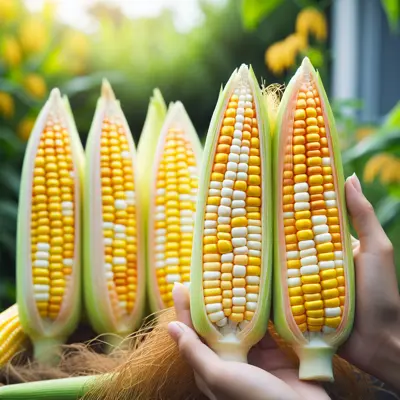
This stunning bicolor variety produces ears with a beautiful mix of white and yellow kernels that look like peaches and cream. Known for its exceptional sweetness and tender texture, this hybrid variety stays sweet longer than many other corns after picking. The reliable production and gorgeous appearance make it a favorite for both home gardens and farmers markets.
Harvest
75-83d
Days to harvest
Sun
Full sun
Zones
2–11
USDA hardiness
Height
5-8 feet
Planting Timeline
Showing dates for Peaches and Cream in USDA Zone 7
All Zone 7 corn →Zone Map
Click a state to update dates
Peaches and Cream · Zones 2–11
Growing Details
Succession Planting
Direct sow Peaches and Cream every 14–18 days from your last frost date through about mid-June. The cutoff is driven by pollination: sustained daytime temps above 95°F during silking cause poorly filled ears with blank rows, so count back 75–83 days from when your summers typically hit that wall and that's your last safe sowing. In zone 7, June 10–15 is usually the limit for a clean summer crop. Each planting block needs to be at least 4 rows wide with 8–12 inch in-row spacing — a single long row pollinates poorly because corn relies entirely on wind.
If you want a fall crop, one more sowing in late July is worth trying — but Peaches and Cream needs up to 83 days, so map that against your first expected frost before you commit the bed space. In zone 7, a July 25 sowing can just reach harvest before a mid-October frost, and a cool September actually helps kernel quality. It's tight, and a warm fall makes it; an early frost kills it.
Complete Growing Guide
This hybrid's extended sugar retention is its defining advantage, but it requires careful timing to realize it—plant in successive sowings every two weeks from late spring through early summer to ensure continuous harvest at peak sweetness, as the window closes quickly once ears mature. Peaches and Cream thrives in full sun with consistently moist, well-draining soil rich in nitrogen, which fuels both the tall stalks and kernel development. While generally disease-resistant, the dense foliage can trap moisture and invite rust and leaf blight in humid climates, so ensure adequate spacing and avoid overhead watering. This variety occasionally exhibits bolting in stressed conditions, particularly during cool springs or inconsistent moisture, so maintain steady soil hydration from silking through grain fill. A practical strategy is to harvest ears in the early morning when sugar content peaks, then refrigerate immediately to lock in that creamy sweetness before natural sugars convert to starch.
Light: Full sun (6 or more hours of direct sunlight a day). Soil: Clay, High Organic Matter, Loam (Silt). Soil pH: Acid (<6.0), Neutral (6.0-8.0). Drainage: Good Drainage. Height: 5 ft. 0 in. - 8 ft. 0 in.. Spread: 1 ft. 0 in. - 2 ft. 0 in.. Spacing: 12 inches-3 feet. Growth rate: Rapid. Maintenance: Medium. Propagation: Seed. Regions: Coastal, Mountains, Piedmont.
Harvesting
Harvest Peaches and Cream corn when the silk turns brown and dry, typically 20-25 days after pollination, and the kernels fill completely to the cob's tip with a slight give when squeezed. The distinctive bicolor ears should display a creamy yellow hue on the yellow kernels while the white kernels remain pearl-colored, signaling peak sugar content. Pick ears in the early morning when stalks are cool and turgid, as this preserves maximum sweetness and juiciness. This variety produces multiple ears per stalk, allowing for continuous harvesting over two to three weeks rather than a single picking; stagger your harvest by selecting fully mature ears while leaving younger ears to develop. A crucial timing tip: Peaches and Cream remains sweet longer after picking than standard corn varieties, but flavor peaks within 24 hours, so plan your harvest and cooking schedule accordingly to capture its exceptional taste.
Color: Gold/Yellow. Type: Caryopsis. Length: > 3 inches. Width: 1-3 inches.
Garden value: Edible, Showy
Harvest time: Fall
Edibility: Edibile
Storage & Preservation
Store unhusked ears immediately in the refrigerator to slow sugar conversion to starch. Keep husks on until ready to use — they protect kernels and maintain moisture. Fresh corn stays at peak quality for 3-5 days when properly refrigerated, though Peaches and Cream retains sweetness longer than many varieties.
For freezing, blanch whole kernels for 4 minutes or cut kernels from cob and blanch for 2 minutes before freezing. The bicolor appearance holds well when frozen. You can also freeze whole ears after blanching for 7-9 minutes. For longer preservation, pickle kernels in vinegar brine or dry kernels completely for grinding into cornmeal. Avoid canning fresh corn using water bath methods — pressure canning only for safety.
History & Origin
The precise origin of 'Peaches and Cream' is not extensively documented in publicly available breeding records, though it represents a modern hybrid development within the bicolor sweet corn category that emerged during the late twentieth century. The variety exemplifies the breeding work of major seed companies that focused on stabilizing the bicolor phenotype—combining white and yellow kernel genes—while selecting for enhanced sweetness through the sugary (su) gene and improved kernel tenderness. Its introduction coincides with the broader commercialization of bicolor varieties for both home gardeners and direct-market farmers in North America, where such varieties gained popularity during the 1980s and 1990s. The cultivar's reliability and market appeal suggest it may derive from lines developed by established seed companies, though specific parentage and breeder attribution remain obscure in accessible horticultural literature.
Origin: Mexico
Advantages
- +Stunning bicolor kernels with exceptional sweetness and creamy texture
- +Stays sweet longer after harvest than most other corn varieties
- +Reliable hybrid production suitable for home gardens and farmers markets
- +Matures in 75-83 days with easy-to-moderate growing difficulty
- +Beautiful appearance makes it ideal for fresh market sales
Considerations
- -Susceptible to multiple serious diseases including Stewart's wilt and leaf blight
- -Vulnerable to multiple pests requiring active management and monitoring
- -Requires consistent pest control for corn earworm and European corn borer prevention
Companion Plants
The Three Sisters combination — corn, squash, and beans — works because each crop occupies a genuinely different niche. Bush beans fix atmospheric nitrogen at root level, which corn pulls hard on (expect to side-dress with about 1 lb of actual nitrogen per 100 square feet mid-season regardless). Summer squash sprawls at ground level, shading out weeds and slowing soil moisture loss, which matters because Peaches and Cream needs consistent water all the way through kernel fill. Sunflowers on the north edge attract predatory wasps and act as a soft trap crop for aphids. Marigolds and nasturtiums do similar work at the perimeter — they pull in aphid predators — though neither will make a dent in corn earworm pressure on its own.
Fennel is a hard no at any closer than 20 feet; it's allelopathic and will suppress corn root development. Tomatoes look harmless on paper but they share corn earworm (Helicoverpa zea is also the tomato fruitworm — same moth, same larvae, as the UGA Vegetable Garden Calendar spells out), so planting them adjacent just pools that pest pressure in one spot. Keep them on opposite ends of the garden. Black walnut produces juglone, a root toxin that affects corn and most vegetables within the drip zone of a mature tree — if there's one nearby, that's your bed assignment problem, not a spray problem.
Plant Together
Bush Beans
Fix nitrogen in soil which corn needs, while corn provides support structure
Summer Squash
Large leaves provide ground cover and moisture retention, part of Three Sisters planting
Basil
Repels aphids, corn borers, and other pests that target corn
Marigolds
Deter corn earworms, aphids, and nematodes with their strong scent
Nasturtiums
Act as trap crop for aphids and cucumber beetles, keeping them away from corn
Sunflowers
Attract beneficial insects and birds that eat corn pests
Dill
Attracts beneficial insects like parasitic wasps that control corn borers
Lettuce
Benefits from corn's shade during hot weather, maximizes garden space
Keep Apart
Black Walnut
Produces juglone which inhibits corn growth and can cause stunting
Fennel
Allelopathic properties inhibit corn germination and growth
Tomatoes
Both are heavy nitrogen feeders competing for same nutrients, attract similar pests
Nutrition Facts
Per 100g serving. % Daily Value based on 2,000 calorie diet. Source: USDA FoodData Central (FDC #325430)
Pests & Disease Resistance
Resistance
Good resistance to northern corn leaf blight and rust
Common Pests
Corn earworm, European corn borer, Japanese beetles, raccoons
Diseases
Stewart's bacterial wilt, common smut, southern corn leaf blight
Troubleshooting Peaches and Cream
What you'll see, why it happens, and what to do about it.
Silks and ear tips show caterpillar damage or frass, often discovered at harvest
Likely Causes
- Corn earworm (Helicoverpa zea) — moths lay eggs directly on fresh silks, larvae tunnel into the ear tip
- European corn borer (Ostrinia nubilalis) — larvae also enter through the silk channel or bore into stalks
What to Do
- 1.Apply a few drops of mineral oil to each ear's silk channel 3-5 days after silks appear — this suffocates young larvae before they reach the kernels
- 2.The UGA Pest Management Handbook recommends monitoring with pheromone traps to catch earworm moth pressure early, so you can time sprays or interventions rather than guessing
- 3.At harvest, just cut off the damaged tip — the rest of the ear is fine to eat
Plants wilt suddenly and collapse in midsummer, often starting with one or two plants; a sticky bacterial ooze threads between cut stem ends when you press them together
Likely Causes
- Stewart's bacterial wilt (Pantoea stewartii) — overwinters in corn flea beetles, which spread it plant to plant during feeding
- Flea beetle pressure is heaviest after mild winters, so a warm January often predicts a bad Stewart's year
What to Do
- 1.Pull and bag affected plants immediately — there's no cure and the bacteria spread through feeding insects
- 2.Cover young seedlings with row cover through the V3 stage to limit flea beetle feeding during the most vulnerable weeks
- 3.Next year, look for hybrids rated with Stewart's wilt resistance — seed catalogs often list a numerical resistance score on the variety page
Swollen, grayish-white galls appear on ears, stalks, or tassels, eventually turning dark and releasing powdery black spores
Likely Causes
- Common smut (Ustilago maydis) — a fungal pathogen that enters through wounds, insect feeding sites, or hail damage
- Drought stress or excess nitrogen fertilization can increase susceptibility
What to Do
- 1.Remove galls while they're still white and firm — once they rupture, spores drop into the soil and can persist for several years
- 2.Bag the galls before pulling them off the plant, and throw them in the trash, not the compost
- 3.Rotate corn out of the affected bed for at least 3 years, consistent with NC State Extension's rotation guidance for soil-borne pathogens
Frequently Asked Questions
How long does Peaches and Cream corn take to grow?▼
Can you grow Peaches and Cream corn in containers?▼
What does Peaches and Cream corn taste like?▼
When should I plant Peaches and Cream corn?▼
Is Peaches and Cream corn good for beginners?▼
How many ears does Peaches and Cream corn produce per plant?▼
Zone-by-Zone Planting Calendar
| Zone | Indoor Start | Transplant | Direct Sow | Harvest |
|---|---|---|---|---|
| Zone 3 | — | — | June – July | September – October |
| Zone 4 | — | — | June – July | September – October |
| Zone 5 | — | — | May – June | September – October |
| Zone 6 | — | — | May – June | August – October |
| Zone 7 | — | — | April – June | August – September |
| Zone 8 | — | — | April – May | July – September |
| Zone 9 | — | — | March – April | June – August |
| Zone 10 | — | — | February – April | June – July |
| Zone 1 | — | — | July – August | October – August |
| Zone 2 | — | — | June – August | October – September |
| Zone 11 | — | — | January – March | May – June |
| Zone 12 | — | — | January – March | May – June |
| Zone 13 | — | — | January – March | May – June |
Growing Guides from Wind River Greens
Sources & References
External authority sources used in compiling this guide.
See the Methodology page for how this data is sourced, what's AI-assisted, and known limitations.