Threadleaf Coreopsis
Coreopsis verticillata
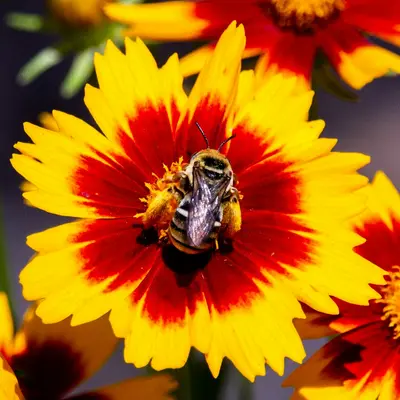
Threadleaf Coreopsis (Coreopsis verticillata) is a perennial native wildflower. Hardy in USDA zones 3 to 9.
Sun
Full sun to part shade
Zones
3–9
USDA hardiness
Height
12-18 inches
Planting Timeline
Showing dates for Threadleaf Coreopsis in USDA Zone 7
All Zone 7 native-wildflower →Zone Map
Click a state to update dates
Threadleaf Coreopsis · Zones 3–9
Growing Details
Complete Growing Guide
Light: kor-ee-OP-sis lan-see-oh-LAY-tah. Soil: Loam (Silt), Sand, Shallow Rocky. Soil pH: Acid (<6.0), Neutral (6.0-8.0). Drainage: Good Drainage, Moist, Occasionally Dry. Height: 1 ft. 0 in. - 3 ft. 0 in.. Spread: 1 ft. 0 in. - 2 ft. 0 in.. Spacing: 12 inches-3 feet. Growth rate: Rapid. Maintenance: Low, Medium. Propagation: Division, Seed. Regions: Coastal, Mountains, Piedmont.
Harvesting
Seeds are cypselae, commonly lacking pappus awns associated with tickseeds that adhere to fibers & skin. Displays from May to July.
Type: Achene. Length: < 1 inch. Width: < 1 inch.
Harvest time: Summer
Bloom time: Spring, Summer
Storage & Preservation
Threadleaf Coreopsis is primarily grown as an ornamental perennial for its flowers rather than for edible storage. Fresh cut flowers should be placed in cool water immediately after cutting and stored in a cool room (60-65°F) away from direct sunlight and ripening fruit. They have a vase life of 7-10 days. For preservation, flowers can be air-dried by hanging bundles upside-down in a warm, dry, well-ventilated space for 2-3 weeks to create long-lasting dried arrangements. Alternatively, press flowers between paper weights or book pages for 2-4 weeks for flat botanical specimens, or preserve in silica gel for 5-7 days to maintain color and shape for crafts.
History & Origin
Native to the southeastern United States, Threadleaf Coreopsis naturally occurs in open woodlands and prairies from North Carolina to Florida and westward to Missouri. The species was documented by botanists in the 19th century as part of the broader Coreopsis genus, which includes numerous North American natives valued for their delicate foliage and prolific flowering. While specific breeding records or cultivar development by professional breeders are limited in available documentation, the plant's introduction into horticulture reflects a growing appreciation for native wildflowers during the 20th century. Threadleaf Coreopsis has since become a staple in native plant gardens and seed company offerings, prized for its hardy, low-maintenance nature rather than the result of intentional hybridization programs.
Origin: Southeastern Canada to south Central U.S.A
Advantages
- +Disease resistance: Deer, Drought, Dry Soil, Heat, Humidity, Poor Soil
- +Attracts: Attractive Flowers, Attracts Pollinators, Wildlife Food Source
- +Wildlife value: Attracts butterflies, bees, and other pollinators. Seeds provide food for birds
- +Fast-growing
- +Low maintenance
Companion Plants
Pairing Threadleaf Coreopsis with Purple Coneflower (Echinacea purpurea), Black-eyed Susan (Rudbeckia hirta), and Butterfly Weed (Asclepias tuberosa) makes practical sense beyond the visual. All four are native prairie-edge plants with similar drought tolerance and lean-soil preferences, so they won't push each other toward the fertilizer or crowd the water. They also bloom in overlapping waves from June through September, which keeps pollinators cycling through the same bed rather than abandoning it between flushes. Little Bluestem and Prairie Dropseed work as structural neighbors too — their deeper, fibrous roots occupy a different soil layer than Coreopsis's shallow rhizomes, so there's no meaningful competition.
Tall Fescue is the one to pull back from. It's aggressive enough to physically overrun Coreopsis rhizomes, and in our zone 7 Georgia gardens it stays green and vigorous right through the spring establishment window when Coreopsis is most vulnerable. Tree of Heaven (Ailanthus altissima) releases allelopathic compounds from its roots that suppress many native forbs — keep at least 20-30 feet of distance if one is nearby. Crown Vetch is the bluntest problem: it spreads by both rhizome and seed and will smother a 12-18 inch plant like this one within a single season if it gets a foothold.
Plant Together
Purple Coneflower
Similar growing conditions, attracts beneficial pollinators and creates habitat diversity
Black-eyed Susan
Complementary bloom times extend pollinator season, both thrive in similar soil conditions
Little Bluestem Grass
Provides structural support and contrasting texture while sharing drought tolerance
Wild Bergamot
Attracts beneficial insects and native bees, both prefer well-draining soil
Lanceleaf Coreopsis
Creates pollinator corridors and extends blooming season with different peak times
Prairie Dropseed
Native grass companion that provides wind protection and soil stabilization
Butterfly Weed
Attracts butterflies and beneficial insects, complementary orange and yellow color scheme
Aromatic Aster
Late season blooms extend pollinator resources when coreopsis finishes flowering
Keep Apart
Tall Fescue
Aggressive root system competes for nutrients and can crowd out native wildflowers
Tree of Heaven
Produces allelopathic compounds that inhibit growth of native plants
Crown Vetch
Aggressive spreader that can smother and outcompete native wildflowers for space
Troubleshooting Threadleaf Coreopsis
What you'll see, why it happens, and what to do about it.
Powdery white coating on leaves and stems, usually showing up mid-to-late summer
Likely Causes
- Powdery mildew (Erysiphe cichoracearum) — common when nights cool down but days stay humid
- Poor airflow from crowded planting or nearby dense shrubs
What to Do
- 1.Cut affected stems back hard — down to 4-6 inches — which also encourages a second flush of blooms
- 2.Space plants at least 12 inches apart; this variety spreads by rhizome so divide clumps every 2-3 years to keep air moving
- 3.Avoid overhead watering in the evening; drip or early-morning watering keeps foliage dry
Stems flopping over or sprawling flat by midsummer, especially in shadier spots
Likely Causes
- Insufficient sun — Coreopsis verticillata needs at least 6 hours of direct sun to hold an upright habit
- Over-fertilization with nitrogen, which pushes lush, weak stem growth
What to Do
- 1.Cut the whole plant back by one-third in late June; it'll rebound compact and put out a second round of blooms by August
- 2.Skip fertilizing entirely — this plant is native to lean, dry soils and rich soil makes it floppy and short-lived
- 3.If the spot gets fewer than 5 hours of sun, move it in fall once temperatures drop below 70°F
Whole clumps dying out in the center, with healthy growth only around the outer edges
Likely Causes
- Crown rot from standing water or dense clay soil — Coreopsis verticillata has almost no tolerance for wet feet
- Natural die-out of older rhizomes in overcrowded clumps after 3-4 years without division
What to Do
- 1.Dig the entire clump, discard the dead center, and replant only the vigorous outer divisions at 12-18 inch spacing
- 2.If you're in heavy clay, work coarse sand or fine gravel into the bed before replanting — target a soil pH of 6.0-7.0 and sharp drainage
- 3.Keep mulch 2 inches back from the crown; burying it invites the same rot problem
Tiny, distorted new growth at shoot tips; buds failing to open or opening misshapen
Likely Causes
- Aphid colonies (commonly Aphis coreopsidis, the coreopsis aphid) feeding on new tissue
- Aster leafhopper (Macrosteles quadrilineatus) feeding and possible aster yellows phytoplasma transmission
What to Do
- 1.Knock aphids off with a hard stream of water from a garden hose — repeat every 2-3 days until populations drop
- 2.Check for leafhoppers early in the morning when they're slower; if aster yellows symptoms appear (yellowed, stunted, witches'-broom growth), pull and bag the entire plant — there is no cure
- 3.Leave some bare soil nearby to support ground beetles and lady beetles, and avoid broad-spectrum insecticides that wipe out both