Garnet Giant
Brassica juncea
Broad purple leaves with gently scalloped margins. Color appears early on young leaves, especially in spring and fall. Mild flavor. Somewhat quick to bolt. Plant densely so leaves remain a proper size for baby leaf and petioles elongate for easy harvest. Also available in organic seed.
Harvest
21d
Days to harvest
Sun
Full sun to partial shade
Zones
8–11
USDA hardiness
Height
12-18 inches
Planting Timeline
Showing dates for Garnet Giant in USDA Zone 7
All Zone 7 lettuce →Zone Map
Click a state to update dates
Garnet Giant · Zones 8–11
Growing Details
Succession Planting
Garnet Giant reaches harvest in about 21 days from direct sow, which makes it one of the easier crops to succession-plant. Put in a new 3–4 foot row every 14 days starting when soil temperature hits 50°F in early spring, and keep sowing until daytime highs are consistently above 85°F — past that threshold the leaves toughen and the heat-sharpened flavor stops being pleasant. In zones 8–11, pick back up with a fall run starting in late August or early September, sowing every 14 days through October.
Don't try to bridge the summer gap by moving to a shadier spot. Heat stress on Brassica juncea is driven by soil and air temperature, not light levels — plants in 90°F weather bolt and turn bitter regardless of how much shade they're getting. Stop sowing in June, let the bed rest, and come back to it in fall.
Complete Growing Guide
Broad purple leaves with gently scalloped margins. Color appears early on young leaves, especially in spring and fall. Mild flavor. Somewhat quick to bolt. Plant densely so leaves remain a proper size for baby leaf and petioles elongate for easy harvest. Also available in organic seed. According to Johnny's Selected Seeds, Garnet Giant is 21 baby; 45 full size to maturity, annual, open pollinated. Notable features: Cold Tolerant, Hydroponic Performer.
Light: Full sun (6 or more hours of direct sunlight a day), Partial Shade (Direct sunlight only part of the day, 2-6 hours). Soil: High Organic Matter. Soil pH: Neutral (6.0-8.0). Drainage: Good Drainage, Moist. Height: 1 ft. 0 in. - 1 ft. 6 in.. Spread: 1 ft. 0 in. - 1 ft. 6 in.. Spacing: Less than 12 inches. Growth rate: Rapid. Maintenance: Medium. Regions: Coastal, Mountains, Piedmont.
Harvesting
Garnet Giant reaches harvest at 21 baby; 45 full size from sowing per Johnny's Selected Seeds. As an annual, harvest continues until frost ends the season.
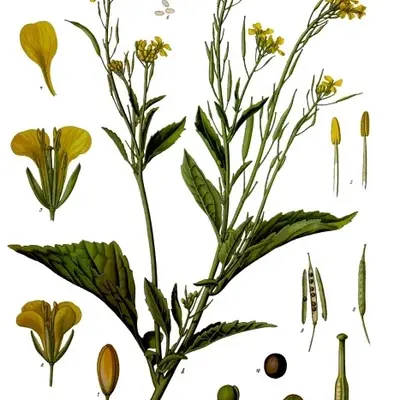
Long pods with round, brown seeds. The fruits will dry and split when ripe. The seeds are harvested for use in condiments and oil.
Color: Brown/Copper. Type: Siliqua.
Garden value: Edible
Edibility: The leaves, seeds, flowers, and stems of this mustard variety are edible raw or cooked. Harvested leaves can be stored in the fridge for 3-5 days.
Storage & Preservation
Harvest Garnet Giant at peak tenderness around day 21 and refrigerate immediately in a perforated plastic bag at 32–40°F with 95% humidity. Fresh leaves will keep for 5–7 days before wilting noticeably. For longer storage, freeze blanched leaves in ice cube trays with a little water—this preserves color and works well for cooking applications, though texture won't suit fresh salads afterward. Fermentation is viable; pack shredded leaves with salt (2–3% by weight) in a jar, weight down, and let sit 3–5 days at cool room temperature for a tangy condiment. Drying is less practical for this tender variety, as the delicate burgundy leaves lose appeal quickly. A useful tip: harvest in early morning when leaves are crisp and hydrated, which extends shelf life by a day or two compared to afternoon picking.
History & Origin
Garnet Giant is open-pollinated, meaning seed saved from healthy plants will produce true-to-type offspring. Listed in the Johnny's Selected Seeds catalog.
Origin: Russia to central Asia
Advantages
- +Stunning purple foliage appears early, especially in cool seasons
- +Mild flavor appeals to diverse palates and pairs with many dishes
- +Quick 21-day maturity enables frequent succession planting
- +Scalloped leaves and elongated petioles facilitate easy, attractive harvesting
- +Dense planting keeps leaves properly sized for baby leaf market
Considerations
- -Somewhat quick to bolt limits harvest window in warm weather
- -Requires dense spacing for optimal leaf size and appearance
- -Purple coloration may fade in intense summer heat
Companion Plants
Marigolds are worth planting near Garnet Giant — not as a vague "pest repellent," but because French marigolds (Tagetes patula) planted densely are a documented cultural tool against soil nematodes. NC State Extension specifically recommends a solid planting of French marigolds to draw down nematode populations before returning susceptible crops to a bed. Radishes are useful for a different reason: they germinate in 5–7 days and mark the row while the mustard greens are still getting started, and their pungent root compounds can throw off aphids and flea beetles looking for a brassica to land on. Chives and garlic work similarly — sulfur compounds in the foliage make the surrounding 12–18 inches less hospitable to soft-bodied pests.
Fennel is the one to leave out of the picture entirely. It releases allelopathic compounds from both roots and foliage that stunt nearby plants, and brassicas pick up that inhibition faster than most. Broccoli is a different kind of problem — not chemistry, just competition. Two heavy-feeding brassicas at the same 12-inch root depth in the same bed will both come up short on nutrients. Give Garnet Giant its own section of the bed.
Plant Together
Marigolds
Repels nematodes and various garden pests through scent
Basil
Repels aphids and whiteflies, may improve lettuce flavor
Chives
Deters aphids and other soft-bodied insects that damage lettuce
Carrots
Deep roots don't compete with shallow lettuce roots, maximizes space usage
Radishes
Quick harvest frees space, helps break up soil for lettuce roots
Nasturtiums
Acts as trap crop for aphids and cucumber beetles
Spinach
Similar growing requirements and harvest timing, efficient space usage
Garlic
Natural pest deterrent, repels aphids and slugs
Keep Apart
Broccoli
Large plants create excessive shade, stunting lettuce growth
Fennel
Allelopathic properties inhibit growth of most garden plants including lettuce
Sunflowers
Tall plants create too much shade and compete heavily for nutrients
Nutrition Facts
Per 100g serving. % Daily Value based on 2,000 calorie diet. Source: USDA FoodData Central (FDC #2346388)
Pests & Disease Resistance
Common Pests
Aphids, slugs, snails, flea beetles
Diseases
Downy mildew, lettuce mosaic virus, botrytis (gray mold)
Troubleshooting Garnet Giant
What you'll see, why it happens, and what to do about it.
Seedlings collapse at soil level within the first 7–10 days after sowing — stem looks pinched or water-soaked at the base
Likely Causes
- Damping off — a fungal complex (commonly Pythium or Rhizoctonia) that thrives in cold, wet, poorly drained soil
- Overwatering or soil that stays saturated after germination
What to Do
- 1.Pull the dead seedlings and check the soil: if you see fuzzy whitish mold on the surface, the bed is staying too wet — ease off irrigation and improve drainage before resowing
- 2.Direct sow into fresh, well-drained mix rather than reusing soil from a bed where you've had this problem before
- 3.If you're starting in trays, bottom-water only and let the surface dry slightly between waterings
Leaves develop small, irregular holes — sometimes a shotgun-scatter pattern — especially on younger foliage in spring and fall
Likely Causes
- Flea beetles (Phyllotreta spp.) — tiny, jumping black beetles that feed aggressively on brassica leaves
- Slugs or snails — similar damage but usually concentrated near soil level and accompanied by slime trails
What to Do
- 1.Cover the bed with row cover immediately after sowing — flea beetles find plants by sight and smell, and exclusion is more effective than spraying
- 2.For slugs, scatter iron phosphate bait (Sluggo) around the base of plants at dusk; reapply after heavy rain
- 3.Keep the bed clear of debris and standing water, which give slugs daytime cover
Frequently Asked Questions
How long does Garnet Giant lettuce take to harvest?▼
Is Garnet Giant lettuce good for beginners?▼
Can you grow Garnet Giant lettuce in containers?▼
What does Garnet Giant lettuce taste like?▼
When should I plant Garnet Giant lettuce?▼
Why should I plant Garnet Giant densely?▼
Zone-by-Zone Planting Calendar
| Zone | Indoor Start | Transplant | Direct Sow | Harvest |
|---|---|---|---|---|
| Zone 3 | — | — | May – June | May – October |
| Zone 4 | — | — | April – June | May – October |
| Zone 5 | — | — | April – May | May – November |
| Zone 6 | — | — | April – May | April – November |
| Zone 7 | — | — | March – May | April – November |
| Zone 8 | — | — | March – April | March – December |
| Zone 9 | — | — | February – March | February – December |
| Zone 10 | — | — | January – March | February – December |
| Zone 1 | — | — | June – July | June – September |
| Zone 2 | — | — | May – July | June – September |
| Zone 11 | — | — | January – February | January – December |
| Zone 12 | — | — | January – February | January – December |
| Zone 13 | — | — | January – February | January – December |
Growing Guides from Wind River Greens
Sources & References
External authority sources used in compiling this guide.
- BreederJohnny's Selected Seeds
- USDAUSDA FoodData Central
See the Methodology page for how this data is sourced, what's AI-assisted, and known limitations.