Claytonia
Claytonia perfoliata
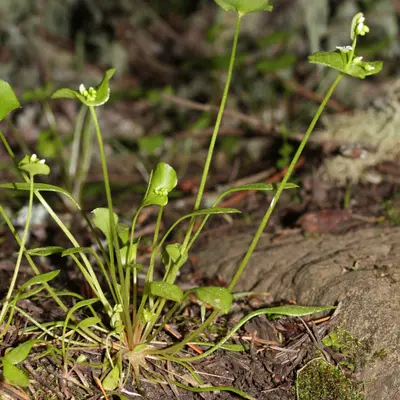
Quantities of heart-shaped leaf pairs, each "wrapped" around a white-flowered stem. Can tolerate moderate frost and can be grown all winter in mild regions or in cold greenhouses. The taste of the young leaves is wild and fresh. Suitable for multiple cuttings. Also known as miner's lettuce.
Harvest
40d
Days to harvest
Sun
Part sun
Zones
4–10
USDA hardiness
Height
1 feet
Planting Timeline
Showing dates for Claytonia in USDA Zone 7
All Zone 7 lettuce →Zone Map
Click a state to update dates
Claytonia · Zones 4–10
Growing Details
Succession Planting
Direct sow every 14 days starting March 1 in zone 7, continuing through early May. Once daytime highs are consistently above 75°F, claytonia bolts quickly and the leaves turn bitter — at that point pull it and plant something heat-tolerant in its place. You can pick back up with a late-summer sowing in late August or early September as temperatures fall back into the 60s, and in a mild year you'll be cutting leaves well into November. The fall window often outperforms spring: fewer slugs, lower aphid populations, and the foliage stays tender longer without the pressure of lengthening days pushing the plant to flower.
Complete Growing Guide
Growing Claytonia (Claytonia perfoliata) lettuce. Light: Part sun. Hardy in USDA zones 3 to 8. Days to maturity: 40. Difficulty: Easy.
Harvesting
Ready for harvest in 40 days from sowing or transplant. Harvest at peak ripeness for best flavor and storage life. Pick regularly to encourage continued production where applicable.
Storage & Preservation
Harvest Claytonia at 40 days when leaves are tender and succulent. Store freshly picked greens in a perforated plastic bag in the refrigerator's crisper drawer at 32–40°F with 95% humidity; they'll keep for 5–7 days before wilting. For longer preservation, blanch whole sprigs for two minutes, then freeze on a tray before bagging—frozen Claytonia works well in soups and smoothies but loses crispness for fresh eating. Drying is less rewarding due to the plant's high water content and delicate leaves, which shrivel considerably. Claytonia's mild, slightly nutty flavor fades quickly when cooked, so freezing raw rather than cooking first preserves better taste for later use. Unlike hardier lettuces, this variety doesn't respond well to canning or fermenting due to its tender texture and subtle flavor profile.
History & Origin
Claytonia perfoliata, commonly known as miner's lettuce or winter purslane, is a flowering plant in the family Montiaceae. It is an edible, fleshy, herbaceous, annual plant native to the western mountain and coastal regions of North America.
Advantages
- +Easy to grow — beginner-friendly
- +Quick harvest — ready in about 40 days
Companion Plants
Chives and garlic are the most useful companions here — both emit sulfur compounds that deter aphids, and since lettuce mosaic virus rides in on aphid vectors like green peach aphid (Myzus persicae), cutting down that pressure early pays off. Radishes and carrots work well because their roots occupy a different depth than claytonia's shallow mat, so neither plant is pulling from the same pocket of soil. Peas and mâche share claytonia's preference for cool, part-shade conditions and won't bully it for light. Keep mint well away — it spreads by underground runners and will consume the bed before claytonia hits 40 days. Fennel is allelopathic and tends to suppress most neighbors; give it its own isolated spot.
Plant Together
Chives
Repels aphids and improves soil health with shallow roots
Radishes
Quick harvest allows space for claytonia to spread, breaks up soil
Spinach
Similar growing conditions and harvest timing, compatible root systems
Carrots
Deep roots don't compete with shallow claytonia roots, maximizes space usage
Peas
Fix nitrogen in soil benefiting leafy greens, provide light shade
Garlic
Natural pest deterrent, doesn't compete for surface nutrients
Mâche (Corn Salad)
Similar cool-season growing requirements and compatible growth habits
Lettuce
Compatible growth requirements and harvest timing for succession planting
Keep Apart
Mint
Aggressive spreading nature can overwhelm delicate claytonia plants
Brassicas
Heavy feeders that compete for nutrients and may shade out low-growing claytonia
Fennel
Allelopathic compounds inhibit growth of most companion plants including claytonia
Nutrition Facts
Per 100g serving. % Daily Value based on 2,000 calorie diet. Source: USDA FoodData Central (FDC #2346388)
Pests & Disease Resistance
Common Pests
Slugs, snails, aphids
Diseases
Downy mildew, lettuce mosaic virus
Troubleshooting Claytonia
What you'll see, why it happens, and what to do about it.
Seedlings collapse at soil level within the first 7–10 days after direct sowing, sometimes with a fuzzy whitish mold on the soil surface nearby
Likely Causes
- Damping off — a complex of soil-borne fungi (Pythium spp., Rhizoctonia solani) that thrive in cold, waterlogged soil
- Overwatering or poor drainage holding moisture around the stem base
What to Do
- 1.Pull the dead seedlings and check the stem base — if it's pinched or rotted at soil level, damping off is your culprit
- 2.Let the soil surface dry slightly between waterings; claytonia doesn't need constant moisture to germinate
- 3.Next sowing, work in compost to improve drainage and avoid sowing into soil below 45°F, where these fungi have the advantage
Irregular yellow patches on the upper leaf surface with a gray-purple fuzzy coating on the underside, appearing after a stretch of cool, wet weather
Likely Causes
- Downy mildew (Peronospora farinosa or a related strain) — spreads fast in humid conditions below 65°F
- Dense plantings that trap moisture and limit airflow
What to Do
- 1.Remove and trash affected leaves immediately — don't compost them
- 2.Thin to at least 6 inches apart to open up airflow between plants
- 3.Switch to drip or base watering; overhead spray in the evening is about the best way to invite this disease back
Leaves show mosaic-pattern mottling — irregular light and dark green patches — with some distortion or puckering of young growth
Likely Causes
- Lettuce mosaic virus (LMV) — transmitted by aphids, particularly green peach aphid (Myzus persicae)
- Infected seed stock (LMV can be seed-borne)
What to Do
- 1.Pull and dispose of affected plants; there's no cure once a plant is infected
- 2.Check the undersides of leaves for aphid colonies and knock them off with a strong stream of water, or apply insecticidal soap at a 1–2% dilution
- 3.Source seed from a supplier that tests for LMV; certified virus-free seed exists for this reason
Ragged holes in leaves overnight, with silvery slime trails on the soil or foliage visible in the morning
Likely Causes
- Slugs or snails — especially active in the cool, moist conditions that claytonia prefers
- Mulch or debris too close to plant bases providing daytime cover
What to Do
- 1.Set out a shallow container of beer or a 1:1 water-yeast solution at soil level — slugs drop in and drown
- 2.Scatter iron phosphate bait (Sluggo or equivalent) around the bed; it breaks down into fertilizer and won't harm pets
- 3.Pull mulch back 3–4 inches from plant bases and clear any boards or debris near the bed where slugs hole up during the day
Frequently Asked Questions
How long does Claytonia lettuce take to grow from seed to harvest?▼
Is Claytonia lettuce good for beginner gardeners?▼
Can you grow Claytonia lettuce in containers?▼
What does Claytonia lettuce taste like?▼
When should I plant Claytonia lettuce?▼
What makes Claytonia lettuce different from regular lettuce?▼
Zone-by-Zone Planting Calendar
| Zone | Indoor Start | Transplant | Direct Sow | Harvest |
|---|---|---|---|---|
| Zone 1 | — | — | June – July | July – September |
| Zone 2 | — | — | May – July | June – September |
| Zone 11 | — | — | January – February | January – December |
| Zone 12 | — | — | January – February | January – December |
| Zone 13 | — | — | January – February | January – December |
| Zone 3 | — | — | May – June | June – October |
| Zone 4 | — | — | April – June | June – October |
| Zone 5 | — | — | April – May | May – November |
| Zone 6 | — | — | April – May | May – November |
| Zone 7 | — | — | March – May | April – November |
| Zone 8 | — | — | March – April | April – December |
| Zone 9 | — | — | February – March | March – December |
| Zone 10 | — | — | January – March | February – December |
Growing Guides from Wind River Greens
Sources & References
External authority sources used in compiling this guide.
- BreederJohnny's Selected Seeds
- USDAUSDA FoodData Central
See the Methodology page for how this data is sourced, what's AI-assisted, and known limitations.