Bel Fiore
Cichorium intybus
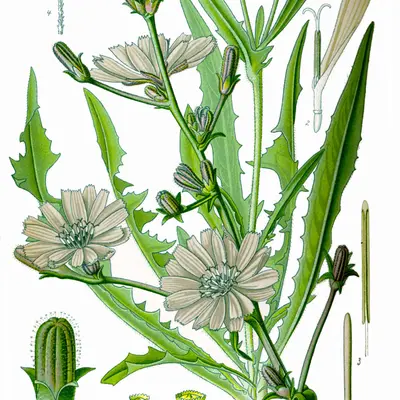
This Variegato di Lusia strain shows improved heading and consistent external and internal speckling in our trials. Although some heads will form very early, others will continue maturing over a long, 2-3 week period. Harvest when full but loose, like butterhead lettuce. Bel fiore, or "beautiful flower" in Italian, refers to how the heads can be displayed with centers opened to resemble a flower. Mild radicchio flavor in all seasons.
Harvest
52d
Days to harvest
Sun
Full sun
Zones
3–8
USDA hardiness
Height
3-4 feet
Planting Timeline
Showing dates for Bel Fiore in USDA Zone 7
All Zone 7 lettuce →Zone Map
Click a state to update dates
Bel Fiore · Zones 3–8
Growing Details
Succession Planting
Bel Fiore is a radicchio-type chicory with a defined harvest window around day 52 — not a cut-and-come-again green — so staggered sowing is worth the small effort. In zone 7, direct sow every 18–21 days starting around March 1 and run through early May; that spreads your harvest across a 6–8 week window instead of everything tightening heads at the same time. Stop once daytime highs are consistently at 80°F or above — chicory bolts in sustained heat, the heads go loose, and the bitterness tips from pleasant to punishing. Pick back up with a fall sowing in late August, timing for harvest before your first hard frost.
Complete Growing Guide
This Variegato di Lusia strain shows improved heading and consistent external and internal speckling in our trials. Although some heads will form very early, others will continue maturing over a long, 2-3 week period. Harvest when full but loose, like butterhead lettuce. Bel fiore, or "beautiful flower" in Italian, refers to how the heads can be displayed with centers opened to resemble a flower. Mild radicchio flavor in all seasons. According to Johnny's Selected Seeds, Bel Fiore is 52 days to maturity, annual, open pollinated.
Light: Full sun (6 or more hours of direct sunlight a day). Soil: Clay, High Organic Matter, Loam (Silt), Sand, Shallow Rocky. Soil pH: Alkaline (>8.0), Neutral (6.0-8.0). Drainage: Good Drainage, Moist, Occasionally Dry. Height: 3 ft. 0 in. - 4 ft. 0 in.. Spread: 1 ft. 6 in. - 2 ft. 0 in.. Spacing: 12 inches-3 feet. Growth rate: Rapid. Maintenance: High, Medium. Propagation: Seed. Regions: Coastal, Mountains, Piedmont.
Harvesting
Bel Fiore reaches harvest at 52 days from sowing per Johnny's Selected Seeds. As an annual, harvest continues until frost ends the season.
Brown oblong and 5-ribbed achene with blunt ends. The wider end has a bristles across the top.
Color: Brown/Copper, Cream/Tan. Type: Achene.
Edibility: Leaves can be used in salads or cooked to reduce bitter flavor. Roots can be dried and used as a coffee substitute.
Storage & Preservation
Harvest Bel Fiore chicory at 52 days and store immediately in the refrigerator at 32–40°F with 90–95% humidity, ideally in a perforated plastic bag or breathable container to maintain crispness without encouraging rot. Fresh leaves will keep for 7–10 days under these conditions. For longer preservation, blanch whole heads for 3 minutes, cool quickly, and freeze in airtight containers for up to three months—this method works better than raw freezing for maintaining texture in cooked dishes. Drying is also viable; slice thinly, dry at low heat (90–100°F) until brittle, and store in sealed jars away from light. Fermentation suits the tender inner leaves particularly well; pack with salt brine and let sit 2–3 weeks for a tangy preserve. Note that Bel Fiore's characteristically mild, slightly sweet flavor is best preserved by quick chilling immediately after cutting, which halts the enzymatic breakdown that increases bitterness.
History & Origin
Bel Fiore is open-pollinated, meaning seed saved from healthy plants will produce true-to-type offspring. Listed in the Johnny's Selected Seeds catalog.
Origin: Europe
Advantages
- +Beautiful variegated appearance with internal speckling adds visual appeal to salads
- +Consistent heading and reliable performance make it dependable for home gardeners
- +Long 2-3 week harvest window extends productivity and reduces replanting frequency
- +Mild radicchio flavor provides interesting taste variation from standard lettuce varieties
- +Ornamental presentation with flower-like opened centers works well for display platters
Considerations
- -Staggered maturity means uneven harvesting over extended period complicates planning
- -Some heads form too early while others lag, requiring careful monitoring
- -Variegato di Lusia genetics may show less vigor than solid-colored radicchio types
Companion Plants
Marigolds — French marigold (Tagetes patula) specifically — have documented nematode-suppressing compounds in their roots and help deter the aphids and flea beetles that hit chicory hardest; plant them within 12 inches for any real effect. Nasturtiums act as a trap crop, drawing aphid colonies onto themselves before populations migrate to your Bel Fiore heads. Garlic and chives work differently: their sulfur compounds disorient soft-bodied insects at close range rather than attracting them away. Skip broccoli as a neighbor — the two compete for the same soil nutrients at the same root depth, and broccoli's allelopathic exudates have been shown to suppress neighboring broadleaf crops. Walnut trees are a hard no; juglone toxicity extends 6–8 feet out from the drip line and will stunt or kill most broadleaf crops planted inside that zone.
Plant Together
Marigolds
Repels nematodes, aphids, and other harmful insects while attracting beneficial pollinators
Nasturtiums
Acts as trap crop for aphids and cucumber beetles, drawing pests away from lettuce
Garlic
Natural fungicide properties help prevent lettuce diseases and repel various pests
Spinach
Similar growing requirements and can provide beneficial ground cover without competition
Dill
Attracts beneficial insects like lacewings and parasitic wasps that control lettuce pests
Chives
Repels aphids and improves lettuce flavor while providing natural pest deterrent
Carrots
Loosens soil for lettuce roots and doesn't compete for space or nutrients
Radishes
Quick-growing crop that breaks up soil and can be harvested before lettuce needs full space
Keep Apart
Broccoli
Large leaves create too much shade and compete heavily for nutrients and water
Sunflowers
Allelopathic compounds inhibit lettuce germination and growth
Walnut Trees
Produces juglone which is toxic to lettuce and many other vegetables
Nutrition Facts
Per 100g serving. % Daily Value based on 2,000 calorie diet. Source: USDA FoodData Central (FDC #2346388)
Pests & Disease Resistance
Common Pests
Aphids, slugs, snails, flea beetles
Diseases
Lettuce mosaic virus, damping off, downy mildew
Troubleshooting Bel Fiore
What you'll see, why it happens, and what to do about it.
Seedlings collapse at soil level within the first 7–10 days after planting, sometimes with white fuzzy mold visible on the soil surface
Likely Causes
- Damping off — most commonly Pythium or Rhizoctonia solani — a soil-borne fungal complex that thrives in wet, poorly drained conditions
- Overwatering or compacted soil that holds moisture around the stem base
What to Do
- 1.Pull and discard affected seedlings; don't compost them
- 2.Let the top inch of soil dry slightly between waterings — Bel Fiore needs moderate moisture, not constant wet
- 3.If you've had damping off in the same bed two years running, start seeds in fresh sterile mix and move to a different spot; NC State Extension's IPM guidance notes that rotating out of a problem bed is more reliable than trying to treat the soil in place
Leaves show mosaic patterning — irregular light and dark green patches — with some leaf distortion or cupping, usually mid-season
Likely Causes
- Lettuce mosaic virus (LMV), spread by aphid vectors, especially Myzus persicae (green peach aphid)
- Using saved seed from infected plants
What to Do
- 1.Remove and bag infected plants immediately — there's no cure once a plant has LMV
- 2.Hit aphid colonies with insecticidal soap spray, focusing on the undersides of leaves where they cluster
- 3.Only use certified mosaic-free seed; LMV can be seed-transmitted in chicory relatives
Gray-purple fuzzy growth on the undersides of older leaves, with corresponding yellow patches on the upper surface
Likely Causes
- Downy mildew (Bremia lactucae) — favored by cool nights below 65°F combined with high humidity or overhead irrigation
What to Do
- 1.Strip affected leaves and bin them, not the compost pile
- 2.Switch to drip irrigation or water at the base early in the morning so foliage dries before nightfall
- 3.Space plants at the full 18-inch end of the recommended range — tight spacing traps humidity right where Bremia lactucae wants it
Ragged, irregular holes chewed in outer leaves overnight, with slime trails visible in the morning
Likely Causes
- Slugs and snails — most active in cool, moist weather and in beds with heavy mulch or dense ground-level debris
What to Do
- 1.Set out shallow traps (tuna cans work fine) filled with cheap beer near the base of plants; empty them every morning
- 2.Apply a 2–3 inch band of diatomaceous earth around the planting area and reapply after rain
- 3.Pull mulch back 4–6 inches from the stem zone — slugs need daytime cover, and you can deny them most of it
Frequently Asked Questions
How long does Bel Fiore lettuce take to harvest?▼
Is Bel Fiore lettuce good for beginners?▼
Can you grow Bel Fiore lettuce in containers?▼
What does Bel Fiore lettuce taste like?▼
Why is it called Bel Fiore?▼
When should I plant Bel Fiore lettuce?▼
Zone-by-Zone Planting Calendar
| Zone | Indoor Start | Transplant | Direct Sow | Harvest |
|---|---|---|---|---|
| Zone 1 | — | — | June – July | July – September |
| Zone 2 | — | — | May – July | July – September |
| Zone 11 | — | — | January – February | February – December |
| Zone 12 | — | — | January – February | February – December |
| Zone 13 | — | — | January – February | February – December |
| Zone 3 | — | — | May – June | June – October |
| Zone 4 | — | — | April – June | June – October |
| Zone 5 | — | — | April – May | June – November |
| Zone 6 | — | — | April – May | May – November |
| Zone 7 | — | — | March – May | May – November |
| Zone 8 | — | — | March – April | April – December |
| Zone 9 | — | — | February – March | March – December |
| Zone 10 | — | — | January – March | March – December |
Growing Guides from Wind River Greens
Sources & References
External authority sources used in compiling this guide.
- BreederJohnny's Selected Seeds
- USDAUSDA FoodData Central
See the Methodology page for how this data is sourced, what's AI-assisted, and known limitations.