Monstera Deliciosa 'Variegata'
Monstera deliciosa 'Albo Variegata'
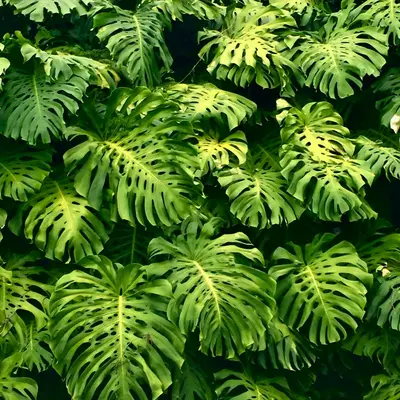
The unicorn of houseplants featuring stunning white and green variegated leaves with natural fenestrations that create living windows in each leaf. This rare cultivar commands premium prices among collectors but rewards patient growers with some of the most spectacular foliage in the plant kingdom.
Sun
Partial shade
Zones
10–12
USDA hardiness
Height
6-10 feet indoors
Complete Growing Guide
Unlike standard Monstera deliciosa, the variegated cultivar requires brighter indirect light to maintain white leaf sections, as insufficient light causes reversion to solid green foliage. This plant thrives in warm, humid conditions between 65–80°F with well-draining aroid mix and monthly feeding during growing season (spring through early fall), then minimal fertilizer in winter when growth naturally slows. Variegated monsteras are particularly susceptible to root rot—a common killer due to their sensitivity to overwatering—and spider mites exploit dry indoor air, so monitor carefully and mist regularly. Watch for leggy growth between leaf nodes in low light, which signals the plant is stretching to find adequate brightness; relocating to a brighter spot prevents this stretch and maintains compact, variegated leaf production. One practical tip: propagate from nodes showing white variegation to ensure cuttings inherit the prized coloring, since solid-green nodes may revert entirely.
Light: Dappled Sunlight (Shade through upper canopy all day), Partial Shade (Direct sunlight only part of the day, 2-6 hours). Soil: High Organic Matter, Loam (Silt). Soil pH: Neutral (6.0-8.0). Drainage: Good Drainage, Moist. Spacing: 6-feet-12 feet. Growth rate: Rapid. Maintenance: Medium. Propagation: Layering, Stem Cutting.
Harvesting
Since this cultivar is purely ornamental, "harvesting" refers to pruning for propagation and plant management. Harvest variegated stems when new growth reaches 6-12 inches with at least two nodes visible and leaves display vibrant white-to-green contrast—dull or pale variegation signals insufficient light, making cuttings less desirable. Prune continuously throughout the growing season to encourage bushier growth and maintain the plant's form, rather than waiting for a single harvest window. Time your cuts in spring or early summer when the plant's vigor peaks, as variegated varieties root more slowly than standard Monsteras and benefit from maximum growing conditions to establish successfully. Always cut just below a node using sterile shears to prevent disease.
This plant produces an aggregate of creamy-white berries covered by green hexagonal "scales"; the fruit is ripe once the scale covering it falls off naturally. These berries are edible and taste like a mixture of banana and pineapple. Rarely produces fruit as a houseplant.
Color: Cream/Tan, Green, White. Type: Aggregate, Berry. Length: > 3 inches. Width: 1-3 inches.
Garden value: Edible
Edibility: Only ripe fruits are edible and are used to flavor drinks and ice cream or are eaten fresh. Some people are allergic.
Storage & Preservation
Not applicable for ornamental houseplant storage in the traditional sense. However, if propagating, store stem cuttings in a sealed plastic bag with moist sphagnum moss at 65-75°F for up to 5 days before rooting if shipment or delay is necessary. Keep cuttings in humid conditions to prevent desiccation. For long-term plant care, maintain consistent indoor temperatures between 65-85°F and humidity above 50%—a pebble tray under the pot or weekly misting simulates natural humid rainforest conditions and keeps variegated foliage vibrant. Avoid cold exposure below 55°F, which shocks the plant and can trigger leaf drop.
History & Origin
This striking variegated cultivar emerged from the already impressive Monstera deliciosa species, which is native to the rainforests of Central America. The exact origins of the white variegation remain poorly documented in mainstream horticultural records, though the trait appears to have arisen as a spontaneous chimeric mutation rather than through deliberate breeding programs. The 'Albo Variegata' form gained significant recognition among collectors primarily through the houseplant community in recent decades, with propagation occurring mainly through tissue culture and stem cuttings rather than seed production. Its scarcity and desirability have made it a modern collector's specimen, though the specific breeder or first documented appearance remains largely undocumented in published botanical literature.
Origin: Mexico to Panama
Advantages
- +Stunning white and green variegation creates truly unique living artwork in any space
- +Large fenestrated leaves develop natural window-like holes as plant matures beautifully
- +Rare cultivar status makes it highly coveted among serious plant collectors worldwide
- +Tolerates moderate indoor light conditions better than many other variegated tropical plants
- +Climbing growth habit allows vertical training on moss poles or trellises
Considerations
- -Premium price tag and limited availability make this cultivar expensive and hard to source
- -Variegation can revert to solid green if light conditions become insufficient long-term
- -Susceptible to thrips, spider mites, and scale insects that damage delicate variegated foliage
- -Root rot risk increases with inconsistent watering or poor drainage in soil mix
Companion Plants
The best companions for Albo Monstera share its preferences: moderate indirect light, consistent moisture, and humidity above 50%. Pothos, Philodendron, and Peace Lily all thrive in the same 4-6 hour bright-indirect light window without crowding the root zone, and grouping them raises the ambient humidity — which keeps spider mites (Tetranychus urticae) off all of them. Boston Fern pulls its weight here too; it transpires steadily enough to bump local humidity by a measurable amount in a small room. Spider Plant is worth keeping nearby as an early-warning plant — it shows drought stress visibly, curling its narrow leaves, before your Monstera reaches the point of wilting.
Snake Plant, Cactus, Lavender, and Rosemary are all mismatches in basic care. They need to dry out completely between waterings and prefer humidity well under 40% — the opposite of what Albo wants. Watering to satisfy the Monstera will rot a Cactus at the roots within a season; watering to keep the Cactus alive will leave the Monstera in soil dry enough to stress the roots. Different rooms, not different shelves.
Plant Together
Pothos
Similar humidity and light requirements, helps maintain moisture levels
Peace Lily
Increases ambient humidity which Monstera thrives in
Philodendron
Compatible watering schedule and both benefit from similar fertilizer
Spider Plant
Helps purify air and creates beneficial microclimate
Boston Fern
Increases humidity levels and shares similar indirect light preferences
Rubber Plant
Similar care requirements and both prefer well-draining soil
ZZ Plant
Complementary growth habits and helps stabilize soil moisture
Fiddle Leaf Fig
Compatible light requirements and creates attractive height variation
Keep Apart
Snake Plant
Requires much less water and can lead to overwatering issues for Monstera
Cactus
Completely different humidity and watering needs, creates dry microclimate
Lavender
Prefers dry conditions and full sun, opposite of Monstera's tropical needs
Rosemary
Requires excellent drainage and dry conditions that stress tropical plants
Pests & Disease Resistance
Resistance
Generally hardy but sensitive to overwatering
Common Pests
Thrips, spider mites, scale insects
Diseases
Root rot, mosaic virus, bacterial leaf spot
Troubleshooting Monstera Deliciosa 'Variegata'
What you'll see, why it happens, and what to do about it.
New leaves unfurling mostly white or with almost no green — variegation so heavy the leaf is papery and weak
Likely Causes
- Hypervariegation — a natural but unstable expression of the Albo mutation where a leaf gets too little chlorophyll to sustain itself
- Stress (low light, overwatering) pushing the plant toward more white tissue
What to Do
- 1.Cut that leaf off once it's fully out — it won't green up and it's a drain on the plant
- 2.Move the plant to a spot with at least 4-5 hours of bright indirect light; a north-facing windowsill is usually too dim for Albo
- 3.Don't fertilize your way out of this — more nitrogen won't fix a chlorophyll problem
Yellowing lower leaves with mushy, dark-brown stem tissue at soil level, often with a sour smell from the pot
Likely Causes
- Root rot (Pythium or Phytophthora spp.) — almost always triggered by keeping the soil wet for more than 7-10 days straight
- Pot without drainage holes, or a saucer that holds standing water
What to Do
- 1.Unpot immediately and cut every black or brown root back to healthy white tissue with sterile scissors
- 2.Let the root ball air-dry for 30-60 minutes, then repot in fresh, well-draining aroid mix (perlite should be at least 30% of the volume)
- 3.Water only when the top 2 inches of soil are dry — in a low-light indoor winter situation that might be every 10-14 days
Tiny silver streaks or stippling on leaves, with small dark frass dots on the undersides — leaves look dull and washed out
Likely Causes
- Thrips (Frankliniella occidentalis or Thrips tabaci) — common on indoor aroids, especially in dry heated air
- Spider mites (Tetranychus urticae) — more likely if you see fine webbing at the petiole joints
What to Do
- 1.Isolate the plant immediately — both pests spread to neighboring plants fast
- 2.Wipe every leaf surface top and bottom with a cloth dampened with insecticidal soap solution, then follow up with neem oil spray every 5-7 days for 3 weeks
- 3.Push ambient humidity to 60% or above — spider mite populations crash in humid air, and thrips slow down considerably
Water-soaked, dark brown spots with yellow halos spreading irregularly across leaves — not the crispy brown edges you'd see from underwatering
Likely Causes
- Bacterial leaf spot (Pseudomonas or Xanthomonas spp.) — spreads through water splash and overhead misting
- Misting cold tap water directly onto leaves, especially where air circulation is poor
What to Do
- 1.Cut off badly affected leaves at the petiole and bin them — don't compost
- 2.Stop misting the foliage directly; use a pebble tray with water or a small humidifier instead to raise humidity without wetting the leaves
- 3.Apply a copper-based bactericide (copper octanoate works on houseplants) to remaining leaves per label rates, then repeat after 10 days