Garden Sage
Salvia officinalis
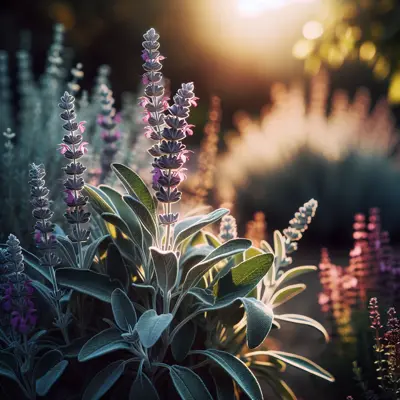
High essential oil content of 1.5-2.0%. Robust, uniform plant. Also known as garden sage. Edible flowers: Use as garnish, or as an ingredient in rice, egg, or cheese dishes.
Harvest
80-90d
Days to harvest
Sun
Full sun to partial shade
Zones
4–8
USDA hardiness
Height
12-24 inches
Planting Timeline
Showing dates for Garden Sage in USDA Zone 7
All Zone 7 herb →Zone Map
Click a state to update dates
Garden Sage · Zones 4–8
Growing Details
Complete Growing Guide
Light: Full sun (6 or more hours of direct sunlight a day), Partial Shade (Direct sunlight only part of the day, 2-6 hours). Soil: Loam (Silt), Sand, Shallow Rocky. Soil pH: Neutral (6.0-8.0). Drainage: Good Drainage, Occasionally Dry. Height: 1 ft. 0 in. - 2 ft. 0 in.. Spread: 2 ft. 0 in. - 3 ft. 0 in.. Spacing: 12 inches-3 feet, 3 feet-6 feet. Growth rate: Medium. Maintenance: Medium. Propagation: Layering, Seed, Stem Cutting. Regions: Coastal, Mountains, Piedmont.
Harvesting
Schizocarp has 4 lobes with 1 seed each. It separates to form 4 nutlets.
Color: Black. Type: Schizocarp. Length: < 1 inch. Width: < 1 inch.
Edibility: Leaves as a flavoring, in tea, seasoning for meat, vegetable and egg dishes and for poultry stuffings.
Storage & Preservation
Fresh garden sage keeps best in a perforated plastic bag in the refrigerator's crisper drawer, maintained at 35-40°F with moderate humidity. Expect a shelf life of 7-10 days before leaves begin to wilt and lose potency. For longer storage, drying is ideal—hang bundles upside down in a warm, dark, well-ventilated space for 1-2 weeks, then strip leaves and store in airtight containers away from light. Alternatively, freeze whole sprigs in ice cube trays with water or oil, or chop fresh leaves and freeze in portions. The camphor-forward notes actually intensify during drying, making sage an excellent candidate for this method; many gardeners prefer dried sage for cooking applications like stuffing and sausage seasoning. For herb butter, blend fresh leaves with softened butter, wrap tightly in plastic, and freeze for up to three months.
History & Origin
Origin: Northern Mediterranean
Advantages
- +Attracts: Bees, Butterflies
- +Edible: Leaves as a flavoring, in tea, seasoning for meat, vegetable and egg dishes and for poultry stuffings.
Companion Plants
Sage earns consistent results near brassicas — cabbage, broccoli — because its volatile oils (primarily thujone and camphor) interfere with the host-finding behavior of cabbage moths and aphids. Rosemary and thyme are sensible neighbors for a different reason: all three share nearly identical site requirements — full sun, pH 6.0–7.0, low water once established — so you're not managing competing irrigation or fertility needs at 18–24 inch spacing. Tomatoes and carrots fit in without friction; sage's root system stays shallow and doesn't undercut either crop.
Cucumbers are a genuine problem. Sage produces allelopathic root compounds that suppress the growth of nearby plants, and cucumbers are sensitive enough that the effect shows up as stunted vines and reduced fruit set. Give them at least 3–4 feet of separation, or just plant them in different beds entirely. Onions are a subtler mismatch — less about chemistry, more about both plants pulling hard on similar soil nutrients without offering anything back to each other.
Plant Together
Tomatoes
Sage repels tomato hornworms and other pests that attack tomatoes
Cabbage
Sage deters cabbage moths, cabbage loopers, and other brassica pests
Carrots
Sage repels carrot flies and other root vegetable pests
Rosemary
Both Mediterranean herbs have similar growing requirements and complement each other
Thyme
Compatible growing conditions and both help repel general garden pests
Strawberries
Sage helps deter slugs and ants that can damage strawberry plants
Broccoli
Sage repels cabbage worms and other pests that attack brassicas
Beans
Sage helps repel bean beetles and Mexican bean beetles
Keep Apart
Cucumber
Sage can inhibit cucumber growth and may affect fruit development
Onions
Both are strong-flavored plants that can compete and potentially stunt each other's growth
Rue
Allelopathic effects can inhibit sage growth and both compete for similar resources
Nutrition Facts
Per 100g serving. % Daily Value based on 2,000 calorie diet. Source: USDA FoodData Central (FDC #170935)
Pests & Disease Resistance
Resistance
Excellent disease resistance
Common Pests
Spider mites, aphids, whiteflies
Diseases
Root rot in wet conditions, powdery mildew
Troubleshooting Garden Sage
What you'll see, why it happens, and what to do about it.
Stems rotting at the base, lower leaves yellowing and wilting despite moist soil
Likely Causes
- Root rot from Pythium or Phytophthora species — both thrive in waterlogged, poorly drained soil
- Planting in heavy clay without amendment, which holds water around the crown
What to Do
- 1.Pull the plant and check the roots — if they're brown and mushy past the crown, the plant is a loss; don't compost it
- 2.Replant sage only in raised beds or well-amended soil with sharp drainage; mix in coarse sand or perlite if your native soil is clay-heavy
- 3.Water deeply but infrequently — sage is drought tolerant once established and does not want consistently wet feet
White powdery coating on upper leaf surfaces, usually appearing in late summer or during humid stretches
Likely Causes
- Powdery mildew — a fungal disease that spreads by airborne spores, not splash, so it hits even in dry weather if humidity climbs
- Plants spaced under 18 inches apart, which cuts airflow between stems
What to Do
- 1.Strip and trash heavily coated leaves — the bin, not the compost pile
- 2.Apply a preventive spray of 1 tablespoon baking soda plus 1 tablespoon summer horticultural oil per gallon of water every 3 to 5 days; NC State Extension's organic gardening guidance lists this as effective against powdery mildew — keep the ratio exact, because higher concentrations cause leaf scorch
- 3.OMRI-listed sulfur is a backup if the baking soda mix isn't holding; skip both when temperatures top 90°F
Frequently Asked Questions
How long does garden sage take to grow from seed?▼
Can you grow garden sage in pots?▼
Is garden sage good for beginners?▼
When should I plant garden sage?▼
What does fresh garden sage taste like?▼
How do you keep garden sage from getting woody?▼
Zone-by-Zone Planting Calendar
Growing Guides from Wind River Greens
Sources & References
External authority sources used in compiling this guide.
- ExtensionNC State Extension
- USDAUSDA FoodData Central
See the Methodology page for how this data is sourced, what's AI-assisted, and known limitations.