French Lavender
Lavandula dentata
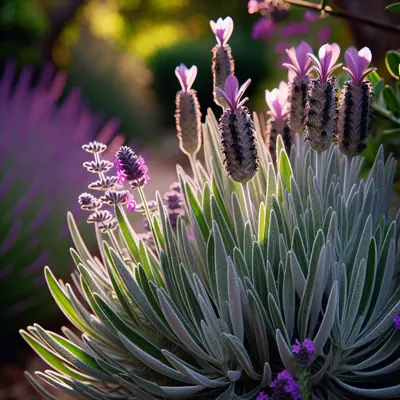
Distinguished by its unique serrated leaves and topped flower spikes crowned with purple bracts, French lavender brings year-round beauty to warm climate gardens. This aromatic herb blooms almost continuously in mild climates and offers a slightly camphor-like fragrance that's perfect for crafts and cooking. More heat and humidity tolerant than English lavender, making it ideal for challenging growing conditions.
Harvest
90-120d
Days to harvest
Sun
Full sun to partial shade
Zones
5–9
USDA hardiness
Height
1-3 feet
Planting Timeline
Showing dates for French Lavender in USDA Zone 7
All Zone 7 herb →Zone Map
Click a state to update dates
French Lavender · Zones 5–9
Growing Details
Complete Growing Guide
Light: Full sun (6 or more hours of direct sunlight a day), Partial Shade (Direct sunlight only part of the day, 2-6 hours). Soil: Loam (Silt), Sand, Shallow Rocky. Soil pH: Alkaline (>8.0), Neutral (6.0-8.0). Drainage: Good Drainage, Occasionally Dry. Height: 1 ft. 0 in. - 3 ft. 0 in.. Spread: 1 ft. 0 in. - 2 ft. 0 in.. Spacing: 12 inches-3 feet. Growth rate: Medium. Maintenance: Medium. Regions: Mountains, Piedmont.
Harvesting
Fruits are non-ornamental dry capsules.
Type: Capsule.
Harvest time: Fall
Edibility: Teas can be made from the plant or used as a spice
Storage & Preservation
Fresh French lavender stems last 7-10 days when placed in water like cut flowers, though the fragrance is best within the first 3-4 days. For culinary use, strip flowers immediately and store in airtight containers in the refrigerator for up to one week.
Drying is the preferred preservation method—bundle 10-15 stems with rubber bands and hang upside down in a dark, well-ventilated area for 2-3 weeks. Properly dried flowers retain their purple color and strong fragrance for up to two years when stored in sealed glass jars away from light.
Freeze-drying preserves the most fragrance: strip fresh flowers and freeze in single layers on baking sheets, then transfer to freezer bags for up to one year. French lavender also makes excellent infused oils—submerge fresh flowers in carrier oil and let sit for 4-6 weeks, straining before use.
History & Origin
Lavandula dentata, commonly known as French lavender, originates from the Mediterranean region, particularly Spain and Portugal, where it grows wild in warm, arid climates. Unlike English lavender, which was extensively cultivated and documented through British horticultural traditions, the specific breeding history and formal introduction date of French lavender remain poorly documented in accessible horticultural records. The variety likely developed through centuries of natural selection and informal cultivation in Mediterranean communities rather than deliberate breeding programs. Its distinction as a separate cultivar became more formalized during the twentieth century as seed companies and gardeners recognized its superior heat and humidity tolerance compared to other lavender species, though comprehensive documentation of its exact origin and early cultivation remains sparse.
Origin: Europe
Advantages
- +Attracts: Pollinators
- +Edible: Teas can be made from the plant or used as a spice
Companion Plants
Lavender's most natural neighbors are the other Mediterranean herbs — rosemary, thyme, oregano, and sage. They want the same things: full sun, lean soil, sharp drainage, and a pH around 6.5–7.5. Put them in the same bed and you're not constantly fighting yourself over watering schedules or fertility. NC State Extension points out that Mediterranean herbs grown with good air circulation and drainage rarely deal with serious pest or disease pressure, and that's even more true when you group plants with identical cultural needs. Packing unrelated plant families together also disrupts pest buildup — a pest that specializes in one crop hits a wall when the next plant in line belongs to a different family entirely.
Marigolds (Tagetes spp.) and alliums are useful additions for a different reason. Both have a reputation for reducing soft-bodied insect pressure nearby, and since aphids are lavender's most common pest visitor, that's a reasonable pairing to try. Roses also do well planted within a few feet of lavender — some growers see less aphid activity on the roses, likely because the habitat diversity makes it harder for a colony to establish and spread.
Mint is a genuine problem, not just an incompatibility. It spreads through underground runners and will physically crowd lavender out within a season or two; it also demands consistent moisture that lavender's roots can't tolerate without rot setting in. Impatiens are a similar mismatch — they're bred for shade and wet soil, conditions that are essentially the opposite of what Lavandula dentata needs. One of the two plants will always be wrong, and it won't be the impatiens.
Plant Together
Rosemary
Similar water and soil requirements, both repel pests like moths and beetles
Thyme
Compatible Mediterranean herb with similar growing conditions, attracts beneficial pollinators
Oregano
Shares drought tolerance and well-draining soil needs, repels harmful insects
Sage
Both prefer alkaline soil and full sun, sage deters cabbage moths and carrot flies
Marigolds
Repel nematodes and aphids while attracting beneficial insects to the garden
Alliums
Natural pest deterrent that repels aphids, spider mites, and cabbage worms
Roses
Lavender repels aphids and ants that commonly attack roses
Cabbage
Lavender deters cabbage moths, flea beetles, and other brassica pests
Keep Apart
Mint
Aggressive spreader that competes for space and has different water requirements
Impatiens
Requires frequent watering and rich, moist soil that lavender cannot tolerate
Camellias
Acid-loving plants that prefer moist, rich soil opposite to lavender's alkaline, dry conditions
Nutrition Facts
Per 100g serving. % Daily Value based on 2,000 calorie diet. Source: USDA FoodData Central (FDC #172232)
Pests & Disease Resistance
Resistance
Generally disease resistant, susceptible to root rot in wet conditions
Common Pests
Aphids, spittlebugs, whiteflies
Diseases
Root rot, fungal issues in humid conditions
Troubleshooting French Lavender
What you'll see, why it happens, and what to do about it.
Stems and crowns turning brown and mushy at soil level, often after a wet stretch
Likely Causes
- Root rot — typically Phytophthora or Pythium spp. — triggered by waterlogged or poorly drained soil
- Planting in heavy clay without amendment, which holds moisture around the crown
What to Do
- 1.Dig the plant and check the roots; brown and slimy rather than white and firm means rot — cut away all affected material and replant in a raised bed or mounded row with gritty, well-drained soil
- 2.Work coarse sand or perlite into the planting hole before transplanting to keep water moving through
- 3.Back off irrigation entirely once the plant is established — lavender handles drought well and suffers far more from overwatering than from drying out
Sticky, distorted new growth with small clusters of soft-bodied insects on shoot tips
Likely Causes
- Aphid infestation — several species feed on lavender, including the green peach aphid (Myzus persicae)
- Overfertilizing with nitrogen, which produces the lush soft growth aphids prefer
What to Do
- 1.Blast shoot tips with a strong stream of water every 2–3 days until populations drop — most aphids don't climb back
- 2.Apply insecticidal soap directly to affected growth for severe outbreaks; NC State Extension notes it's effective against aphids on herbs without the residue concerns of traditional pesticides
- 3.Hold off on high-nitrogen fertilizer — lavender is a lean feeder and pushing it with nitrogen makes aphid pressure worse, not better
White, frothy blobs on stems in early summer, plant looking generally sluggish
Likely Causes
- Spittlebugs (Philaenus spumarius) — the nymph hides inside that foam while feeding on plant sap
- Dense, poorly ventilated plantings that stay humid longer in the morning
What to Do
- 1.Wipe or rinse the spittle masses off by hand or with a hose — the nymphs are soft-bodied and don't survive being dislodged
- 2.Space plants at least 24–30 inches apart to open up airflow and reduce the humid pockets spittlebugs prefer
- 3.Check neighboring weeds and ornamental grasses, which often carry spittlebug populations that move onto garden plants
Frequently Asked Questions
What's the difference between French lavender and English lavender?▼
Can you grow French lavender in containers?▼
How long does French lavender take to bloom from seed?▼
Is French lavender good for cooking like English lavender?▼
Why isn't my French lavender blooming?▼
When should I prune French lavender?▼
Zone-by-Zone Planting Calendar
Growing Guides from Wind River Greens
Sources & References
External authority sources used in compiling this guide.
- ExtensionNC State Extension
- USDAUSDA FoodData Central
See the Methodology page for how this data is sourced, what's AI-assisted, and known limitations.