Moss Phlox
Phlox subulata
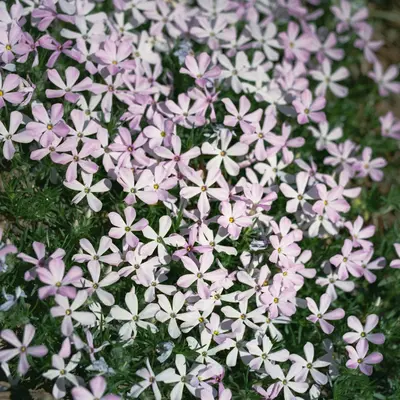
A spectacular spring-flowering ground cover that transforms slopes and rock gardens into sheets of vibrant color. This hardy perennial forms dense mats of needle-like evergreen foliage topped with masses of five-petaled flowers in shades of pink, purple, white, or blue. Extremely drought tolerant and deer resistant, making it perfect for low-maintenance landscapes.
Sun
Full sun to partial shade
Zones
3–9
USDA hardiness
Height
4-6 inches
Planting Timeline
Showing dates for Moss Phlox in USDA Zone 7
All Zone 7 ground-cover →Zone Map
Click a state to update dates
Moss Phlox · Zones 3–9
Growing Details
Complete Growing Guide
Plant moss phlox in fall or early spring to establish strong roots before summer heat, as this cultivar demands excellent drainage and suffers in waterlogged soils more than typical ground covers. Position it in full sun with at least six hours of direct light daily; inadequate light causes the dense mats to stretch and thin rather than remaining compact. This phlox variety is remarkably pest-resistant but prone to powdery mildew in humid conditions with poor air circulation, so space plants adequately and avoid overhead watering. Unlike vigorous spreading ground covers, moss phlox won't aggressively overtake neighboring plants and rarely needs division. For best results, shear lightly after flowering to promote bushier growth and prevent the characteristic leggy appearance that develops when plants get tall and sparse. Water deeply during establishment, then taper off—mature plants thrive on rainfall alone in most climates.
Light: Dappled Sunlight (Shade through upper canopy all day), Full sun (6 or more hours of direct sunlight a day). Soil: High Organic Matter, Loam (Silt), Sand, Shallow Rocky. Soil pH: Acid (<6.0). Drainage: Good Drainage, Moist, Occasionally Dry. Height: 0 ft. 4 in. - 0 ft. 6 in.. Spread: 2 ft. 0 in. - 3 ft. 0 in.. Spacing: 12 inches-3 feet, 3 feet-6 feet. Growth rate: Medium. Maintenance: Low. Propagation: Division, Root Cutting, Stem Cutting. Regions: Coastal, Mountains, Piedmont.
Harvesting
Moss phlox flowers reach peak readiness when petals display fully saturated color intensity and feel papery-dry to the touch, typically four to five days after opening. Harvest individual flower clusters by pinching them just below the flower head to encourage continuous blooming throughout the spring season, rather than cutting the entire plant at once. For longest vase life and maximum garden display, harvest blooms in early morning after dew has dried but before afternoon heat sets in, selecting clusters where all five petals have fully unfurled and show no browning at the edges. Continuous harvesting actually stimulates more flower production, making regular cutting beneficial for both arrangements and garden aesthetics.
The flowers are replaced by an inconspicuous oval seed capsule. The seed capsule is 3-valved, 4 mm long, and contains 3 or more seeds. It spreads by reseeding.
Type: Capsule. Length: < 1 inch. Width: < 1 inch.
Harvest time: Summer
Storage & Preservation
Moss Phlox is an ornamental ground cover and does not require post-harvest storage like food crops. For propagation cuttings, store in a cool, humid environment (60-65°F, 80-90% humidity) in moist media for 2-3 weeks until rooted. Propagation methods include: (1) softwood cuttings taken in spring, rooted in perlite or sand; (2) division of established mats in spring or fall; (3) seed sowing in fall for spring germination. Once established in the garden, no storage needed—plants are perennial and overwinter as living ground cover.
History & Origin
Phlox subulata, commonly known as Moss Phlox, is a native North American species that has been cultivated as an ornamental ground cover for centuries, particularly in rock gardens and alpine settings. The plant's exact breeding history remains largely undocumented, though it descends from wild populations found across the eastern United States, from New York to North Carolina. Rather than resulting from formal breeding programs, Moss Phlox became established in horticulture through traditional garden cultivation and seed selection by gardeners and nurserymen who appreciated its compact habit and prolific flowering. The numerous color variants available today—including pink, purple, white, and blue—likely emerged through both natural variation and informal selection practices spanning generations, though specific cultivar origins are rarely attributed to identifiable breeders.
Origin: Central and Eastern Canada and Central and Eastern United States
Advantages
- +Transforms slopes into vibrant color sheets during spring blooms
- +Extremely drought tolerant, requiring minimal water once established
- +Deer resistant, making it ideal for wildlife-prone landscapes
- +Dense evergreen foliage provides year-round ground coverage
- +Easy to grow with low maintenance requirements
Considerations
- -Spider mites thrive in hot, dry weather conditions
- -Susceptible to root rot if soil drainage is poor
- -Powdery mildew develops in humid or poorly ventilated areas
Companion Plants
Spring bulbs — daffodils and crocuses especially — are the most practical pairing with moss phlox. The bulbs push up through the mat in early spring, bloom alongside it, then die back just as the phlox fills in and covers the yellowing foliage. No bare patches, no awkward gap to explain. Sedum and creeping thyme fit the same logic from the other direction: all three prefer lean, well-drained soil and 6+ hours of sun, so they don't compete at the root zone or crowd each other out as they spread. Catmint (Nepeta spp.) adds some height behind the phlox without shading it, and the blue-violet flowers play well against the pink and lavender tones most Phlox subulata hybrids put out in April.
Hostas, ferns, and impatiens are a mismatch for different reasons than you might expect. In our zone 7 Georgia gardens, the real problem isn't competition above ground — it's what those neighbors need from the soil. Hostas and ferns want consistently moist, organically rich conditions; keeping them happy means keeping the phlox root zone too wet, which is exactly how Phytophthora gets started. Impatiens compound this: they're thirsty enough that frequent irrigation pulls soil moisture toward the planting in a way moss phlox won't tolerate for long.
Plant Together
Spring Bulbs (Daffodils, Crocuses)
Bloom early before moss phlox, creating succession of color and hiding dying bulb foliage
Sedum
Similar growing conditions and drought tolerance, provides textural contrast
Creeping Thyme
Shares preference for well-draining soil and full sun, creates fragrant ground cover mix
Lamb's Ear
Complementary silver foliage contrasts with phlox flowers, similar sun and soil requirements
Ornamental Grasses
Provides vertical structure above low-growing phlox, both tolerate dry conditions
Alliums
Tall flower stems emerge through phlox carpet, both prefer well-draining soil
Catmint
Similar growing requirements and bloom time, creates layered perennial display
Ajuga
Thrives in similar conditions, provides different flower color and foliage texture
Keep Apart
Hostas
Requires more moisture and shade than moss phlox can tolerate
Impatiens
Needs consistent moisture and shade, incompatible with phlox's dry, sunny requirements
Ferns
Requires moist, shaded conditions that conflict with moss phlox's need for sun and drainage
Pests & Disease Resistance
Resistance
Generally disease resistant, good drought tolerance
Common Pests
Spider mites in hot weather, occasional aphids
Diseases
Root rot in wet soils, powdery mildew in humid conditions
Troubleshooting Moss Phlox
What you'll see, why it happens, and what to do about it.
Fine webbing on stems and foliage, leaves looking dull or stippled, especially during dry summer stretches
Likely Causes
- Two-spotted spider mite (Tetranychus urticae) — populations explode when temps stay above 90°F and humidity drops
- Drought stress making the plant more susceptible
What to Do
- 1.Blast the foliage with a strong jet of water two or three mornings in a row — mites hate moisture and don't recover well
- 2.If the infestation is heavy, apply insecticidal soap or neem oil in the evening to avoid leaf scorch
- 3.Water the plant deeply during heat waves; stressed phlox is mite bait
Crowns and roots turning brown and mushy, plant wilting despite wet soil
Likely Causes
- Phytophthora root rot or Pythium spp. — both thrive when soil stays waterlogged for more than a few days
- Planting in low spots where water pools after rain
What to Do
- 1.Pull the affected plant — soggy crowns don't recover, and leaving them spreads the pathogen
- 2.Improve drainage before replanting: work in coarse sand or fine gravel, or raise the bed 4-6 inches
- 3.Choose a site with at least a slight slope; moss phlox planted flat in clay is asking for trouble
White powdery coating on leaves and stems, usually showing up in late summer or early fall
Likely Causes
- Powdery mildew (Erysiphe spp.) — favored by warm days, cool nights, and poor airflow
- Overcrowding from plants that have spread and are matted together
What to Do
- 1.Thin or divide congested clumps to open up airflow — a pair of hand shears and 20 minutes fixes most cases
- 2.Apply a potassium bicarbonate spray (per label) at first sign; it works far better early than once the coating has set in
- 3.Switch to morning irrigation so foliage dries before nightfall; evening overhead watering feeds this problem
Clusters of small soft-bodied insects on new growth, stems sticky or distorted in spring
Likely Causes
- Aphids — commonly green peach aphid (Myzus persicae) or foxglove aphid (Aulacorthum solani) — targeting soft growth as phlox breaks dormancy
- Low populations of beneficial insects like lady beetles or parasitic wasps, often from nearby pesticide use
What to Do
- 1.Knock them off with a firm water spray; repeat every 2-3 days until populations collapse
- 2.Spot-treat with insecticidal soap if the infestation is on multiple stems — coat the undersides of leaves, not just the tops
- 3.Back off high-nitrogen fertilizer in spring; lush, soft new growth draws aphids in