Red Noodle
Vigna unguiculata
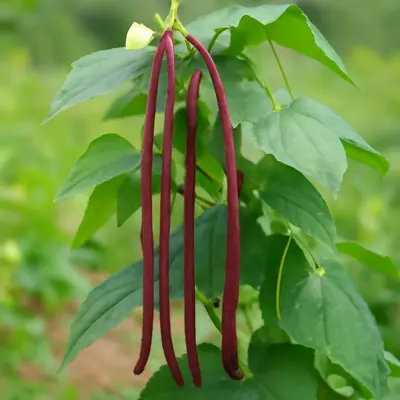
16-20" long beans are borne in clusters of up to four beans each. Healthy, vigorous plants. Sweet flavor. Burgundy color will fade when cooked. Red seeds. Pole bean; requires trellising.
Harvest
85d
Days to harvest
Sun
Full sun
Zones
11–11
USDA hardiness
Height
5-10 feet
Planting Timeline
Showing dates for Red Noodle in USDA Zone 7
All Zone 7 bean →Zone Map
Click a state to update dates
Red Noodle · Zones 11–11
Growing Details
Succession Planting
Direct sow Red Noodle every 3 weeks from late April through early June in zone 7. The UGA Vegetable Garden Calendar puts successive bean plantings through May, and that cadence holds — a late-April sowing, a mid-May sowing, and a first-of-June sowing will stagger your harvest across August and September. Don't push past mid-June: at 85 days to harvest, a late sowing runs straight into the hottest stretch of summer, and bean flowers drop without setting once daytime highs stay consistently above 95°F.
For a fall run, back-calculate from your first frost date — typically mid-October in zone 7 — and sow no later than mid-July. The plants need enough warm weeks to finish before nights drop below 50°F and pod development stalls out.
Complete Growing Guide
16-20" long beans are borne in clusters of up to four beans each. Healthy, vigorous plants. Sweet flavor. Burgundy color will fade when cooked. Red seeds. Pole bean; requires trellising. According to Johnny's Selected Seeds, Red Noodle is 85 days to maturity, annual, open pollinated.
Light: Full sun (6 or more hours of direct sunlight a day). Soil: Clay, High Organic Matter, Loam (Silt), Sand. Soil pH: Acid (<6.0), Neutral (6.0-8.0). Drainage: Good Drainage, Moist, Occasionally Dry. Height: 5 ft. 0 in. - 10 ft. 0 in.. Spread: 1 ft. 0 in. - 3 ft. 0 in.. Spacing: 12 inches-3 feet. Growth rate: Rapid. Maintenance: Low. Regions: Coastal, Mountains, Piedmont.
Harvesting
Red Noodle reaches harvest at 85 days from sowing per Johnny's Selected Seeds. Expect 16-20" at peak. As an annual, harvest continues until frost ends the season.
Fruits are 10 to 18 inches long. Various cultivars are available: some with green fruits and others with purple or burgundy fruits.
Color: Green, Purple/Lavender, Red/Burgundy. Type: Legume. Length: > 3 inches. Width: < 1 inch.
Garden value: Edible
Harvest time: Summer
Edibility: Fruits are edible when immature. The seeds can be harvested for dried beans.
Storage & Preservation
Red Noodle beans are best stored fresh in a perforated plastic bag in the refrigerator at 45–50°F with 85–90% humidity; they'll keep for 5–7 days. For longer storage, freezing is most practical: blanch pods for 3 minutes in boiling water, cool immediately in ice water, drain thoroughly, and freeze in single layers before bagging. Frozen beans retain quality for 8–12 months. Drying is also viable—allow mature pods to dry completely on the vine or indoors, then shell and store seeds in airtight containers at cool temperatures for up to two years. Because Red Noodle varieties are asparagus-type beans with tender, slender pods, avoid aggressive handling during harvest and storage to prevent bruising. For small-scale preservation, blanching and freezing captures the best texture and flavor for later cooking.
History & Origin
Red Noodle is open-pollinated, meaning seed saved from healthy plants will produce true-to-type offspring. Listed in the Johnny's Selected Seeds catalog.
Origin: Tropical Africa
Advantages
- +Impressive 16-20 inch long beans maximize harvest per plant cluster
- +Vigorous growth habit requires minimal fertilizer and pest management input
- +Sweet flavor profile appeals to fresh eating and Asian cuisine
- +Clusters of up to four beans per node increase productivity
Considerations
- -Burgundy color fades during cooking reducing visual appeal of finished dish
- -Requires sturdy trellising structure for 85-day growing season support
- -Red seed color may limit appeal for traditional bean soup recipes
Companion Plants
Marigolds — French marigolds (Tagetes patula) specifically — are the most useful companion here. Their root secretions deter soil nematodes, and the dense flower mass slows aphid movement toward the beans. Nasturtiums work as a trap crop: aphids pile onto nasturtium stems you can cut off and bin, rather than building colonies on your bean foliage. Corn is a practical structural choice — Red Noodle climbs 5-10 feet and will run up corn stalks without you sinking posts and stringing wire. Summer savory has a specific old-time reputation for deterring bean beetles; plant a row within 12 inches of the beans if you want to test it.
Onions and garlic are the ones to pull back from. Alliums appear to inhibit the Rhizobium bacteria that colonize legume roots — those bacteria are the whole reason you rotate beans into a bed in the first place, so planting them together undercuts the nitrogen-fixing benefit before it starts. Fennel is allelopathic to most vegetables and simply doesn't belong inside a productive bed; give it its own container or a far corner.
Plant Together
Marigolds
Repel aphids, whiteflies, and nematodes while attracting beneficial insects
Basil
Deters aphids, spider mites, and thrips while potentially improving bean flavor
Carrots
Improve soil structure and don't compete for nutrients with beans
Lettuce
Benefits from bean's nitrogen fixation and provides ground cover to retain soil moisture
Radishes
Break up compacted soil and mature quickly without competing for space
Nasturtiums
Act as trap crops for aphids and cucumber beetles while repelling bean beetles
Summer Savory
Repels bean beetles and aphids while potentially improving bean growth
Corn
Provides natural trellis support for climbing beans in three sisters planting
Keep Apart
Onions
Can inhibit bean growth and nitrogen fixation through root secretions
Garlic
Releases compounds that can stunt bean growth and reduce yield
Fennel
Produces allelopathic compounds that inhibit growth of most garden plants including beans
Nutrition Facts
Per 100g serving. % Daily Value based on 2,000 calorie diet. Source: USDA FoodData Central (FDC #2346400)
Pests & Disease Resistance
Common Pests
Bean beetles, spider mites, aphids, whiteflies
Diseases
Bean rust, anthracnose, mosaic virus
Troubleshooting Red Noodle
What you'll see, why it happens, and what to do about it.
Leaves with ragged chunks missing, sometimes skeletonized, on plants 5-8 weeks old
Likely Causes
- Mexican bean beetle (Epilachna varivestis) — adults and larvae both feed on leaf tissue from the underside
- Bean leaf beetle (Cerotoma trifurcata) — leaves circular holes, often mistaken for Mexican bean beetle damage
What to Do
- 1.Flip leaves over and look for yellow egg clusters or orange-yellow larvae — hand-pick and drop in soapy water
- 2.Spray neem oil or spinosad on the undersides of leaves early in the morning; repeat every 7 days until pressure drops
- 3.Next season, rotate this bed — NC State Extension notes that planting the same family in the same spot year after year keeps pest populations building
Fine webbing on leaf undersides, leaves looking bronze or stippled, usually in hot dry stretches
Likely Causes
- Two-spotted spider mite (Tetranychus urticae) — thrives when temps stay above 85°F and humidity drops
What to Do
- 1.Blast the undersides of leaves with a strong stream of water every 2-3 days — mites don't reattach easily
- 2.Apply insecticidal soap or neem oil directly to the undersides; spraying the tops accomplishes nothing
- 3.Keep soil moisture consistent — drought-stressed plants draw mite pressure faster than well-watered ones
Reddish-brown powdery pustules on leaf undersides, yellow spots on the tops, appearing mid-season
Likely Causes
- Bean rust (Uromyces appendiculatus) — spreads by windborne spores, worsens with wet nights and warm days
- Overhead watering that keeps foliage wet for extended periods
What to Do
- 1.Remove and trash (not compost) any heavily infected leaves as soon as you spot them
- 2.Switch to drip or soaker irrigation — NC State Extension's vegetable gardening guidelines note soaker hoses keep foliage dry and reduce foliar disease pressure
- 3.If rust is already established, apply sulfur-based fungicide every 7-10 days; it won't cure infected tissue but slows spread to healthy leaves
Stunted plants with puckered, mottled yellow-green leaves; pods may be distorted or fail to set
Likely Causes
- Bean mosaic virus (BCMV or BYMV) — transmitted by aphids, including the green peach aphid (Myzus persicae)
- Infected seed from a diseased lot
What to Do
- 1.Pull and trash any plant showing mosaic symptoms immediately — there's no cure, and aphids will carry the virus to healthy plants within hours
- 2.Control aphid populations with insecticidal soap spray; check new growth tips every few days since aphids colonize there first
- 3.Start with certified disease-free seed — Red Noodle circulates widely as heirloom seed saved by small growers, so source carefully and don't replant saved seed from a symptomatic crop
Frequently Asked Questions
How long do Red Noodle beans take to mature?▼
Are Red Noodle beans good for beginners?▼
Can you grow Red Noodle beans in containers?▼
What does Red Noodle bean taste like?▼
When should I plant Red Noodle beans?▼
Do Red Noodle beans need a trellis?▼
Zone-by-Zone Planting Calendar
| Zone | Indoor Start | Transplant | Direct Sow | Harvest |
|---|---|---|---|---|
| Zone 1 | — | — | July – August | October – August |
| Zone 2 | — | — | June – August | October – September |
| Zone 11 | — | — | January – March | May – June |
| Zone 12 | — | — | January – March | May – June |
| Zone 13 | — | — | January – March | May – June |
| Zone 3 | — | — | June – July | September – October |
| Zone 4 | — | — | June – July | September – October |
| Zone 5 | — | — | May – June | September – October |
| Zone 6 | — | — | May – June | August – October |
| Zone 7 | — | — | April – June | August – September |
| Zone 8 | — | — | April – May | July – September |
| Zone 9 | — | — | March – April | June – August |
| Zone 10 | — | — | February – April | June – July |
Growing Guides from Wind River Greens
Sources & References
External authority sources used in compiling this guide.
- BreederJohnny's Selected Seeds
- USDAUSDA FoodData Central
See the Methodology page for how this data is sourced, what's AI-assisted, and known limitations.