Lithops 'Living Stones'
Lithops species
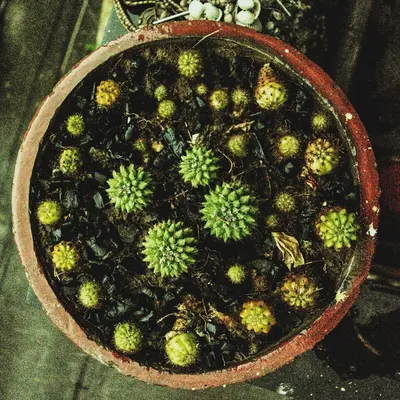
Nature's ultimate camouflage artists, these fascinating succulents perfectly mimic stones and pebbles in their native African habitat. Each plant consists of just two thick, fused leaves with a slit down the middle, and they produce surprising daisy-like flowers in fall. These conversation-starter plants are perfect for collectors who love unique, low-maintenance specimens that challenge everything you know about plants.
Sun
Full sun to partial shade
Zones
10–11
USDA hardiness
Height
1-6 inches
Complete Growing Guide
Light: Full sun (6 or more hours of direct sunlight a day), Partial Shade (Direct sunlight only part of the day, 2-6 hours). Soil: Sand, Shallow Rocky. Drainage: Good Drainage. Height: 0 ft. 1 in. - 0 ft. 6 in.. Spread: 0 ft. 1 in. - 0 ft. 3 in.. Spacing: Less than 12 inches. Growth rate: Slow. Maintenance: Low. Propagation: Division, Seed.
Harvesting
The fruit is a 4 to 8 chambered capsule with tiny seeds inside. When the capsule open the seeds may be dispersed by the rain.
Type: Capsule. Length: < 1 inch. Width: < 1 inch.
Storage & Preservation
Lithops 'Living Stones' are ornamental succulents that don't require traditional food storage. Keep potted specimens in a cool, dry location (50-70°F) with minimal humidity to prevent rot. In winter dormancy, reduce watering significantly and provide cool temperatures (45-50°F). These plants can persist for decades with proper care. Preservation methods include: (1) Propagation from seed or leaf cuttings to create backup specimens; (2) Division of mature plant clusters every 3-4 years; (3) Dry storage of seeds in sealed containers at cool temperatures for future propagation.
History & Origin
Lithops species originated in the arid regions of southern Africa, particularly South Africa and Namibia, where they evolved their remarkable stone-mimicking appearance as a survival adaptation against herbivores. The genus itself was formally described and classified by botanists in the early twentieth century, though European collectors and explorers had documented these unusual succulents earlier during expeditions into the African interior. The specific cultivar designation 'Living Stones' reflects the common name applied to the genus broadly rather than a formally registered cultivar with documented breeder attribution. While comprehensive breeding records for this particular variety are limited in readily available horticultural documentation, the plants currently in cultivation represent selections from wild populations and subsequent propagation by specialty succulent nurseries throughout the twentieth century, with modern availability owing largely to increased commercial interest in unusual houseplants rather than formal breeding programs.
Origin: South Africa
Advantages
- +Extraordinary camouflage appearance makes them true conversation starters and collector showpieces.
- +Produces delightful daisy-like flowers in fall despite minimal care requirements.
- +Extremely drought-tolerant with minimal watering needs once established properly.
- +Compact size perfect for small spaces, shelves, and specialized succulent collections.
Considerations
- -Advanced care requirements demand precise watering timing to avoid fatal root rot.
- -Prone to body rot during molting season if humidity or moisture increases slightly.
- -Requires specific dormancy period and cool temperatures in winter to flower reliably.
Companion Plants
The succulents that pair well with Lithops — Echeveria, Haworthia, Crassula, Gasteria, Sedum, and Aloe — earn their place for one practical reason: they run on the same watering schedule. All of them want infrequent, deep soaks followed by a complete dry-out, and none will suffer if you skip irrigation for weeks. That alignment means a shared tray or dish arrangement won't pit one plant's rot risk against another's thirst. Haworthia and Gasteria also tolerate slightly lower light, which makes them decent neighbors if your windowsill falls short of the 6+ hours Lithops prefer.
Ferns, Impatiens, and Begonias are a mismatch because they want consistently damp soil — realistically, every 2-3 days in warm weather. Put them in the same container as Lithops and you're stuck: enough water to keep the fern alive will rot the Lithops, and a Lithops-appropriate dry spell will crisp the fern. There's no irrigation compromise that satisfies both, so keep them on entirely separate shelves.
Plant Together
Echeveria
Similar water and light requirements, compatible root systems won't compete
Haworthia
Shares identical drought tolerance and well-draining soil needs
Sedum varieties
Complementary growth habits and matching minimal water requirements
Crassula (Jade Plant)
Similar succulent care needs and helps create beneficial microclimate
Aloe varieties
Compatible water schedule and both prefer bright, indirect light
Gasteria
Similar South African origin with matching soil and drainage requirements
Portulacaria afra
Shares drought tolerance and helps provide beneficial shade in intense sun
Kalanchoe
Compatible watering needs and similar preference for sandy, well-draining soil
Keep Apart
Impatiens
Requires frequent watering which can cause root rot in Lithops
Ferns
Need high humidity and moisture which creates fungal problems for Lithops
Begonias
Regular watering schedule conflicts with Lithops' dormancy periods
Pests & Disease Resistance
Resistance
Prone to rot if watered incorrectly or during dormancy
Common Pests
Spider mites, fungus gnats in overly moist conditions
Diseases
Root rot and body rot from overwatering, especially during molting
Troubleshooting Lithops 'Living Stones'
What you'll see, why it happens, and what to do about it.
Plant looks shriveled and deflated but it's NOT the molting season (late fall through winter)
Likely Causes
- Underwatering during the active growing season (fall and early spring)
- Root rot has destroyed the feeder roots, preventing water uptake even when soil is moist
What to Do
- 1.Give a thorough soak and check back in 48 hours — healthy Lithops will plump back up quickly
- 2.If it doesn't recover, unpot and inspect the roots; trim any black or mushy roots with clean scissors and let the plant dry out for 5-7 days before repotting in fresh, gritty mix (at least 50% perlite or coarse sand)
Outer leaf pair turning to mush or going translucent during the molting period (late fall through late winter)
Likely Causes
- Watering during the molt — the single most common Lithops mistake
- High humidity or poor airflow trapping moisture against the plant body
What to Do
- 1.Stop watering completely from the moment you see the old leaf pair splitting until the new pair has fully emerged and the old leaves are papery and dry — this can take 2-4 months, and that's normal
- 2.Move the pot somewhere with better airflow; a small fan on low nearby helps in humid climates
- 3.If rot has started, peel the mushy outer leaves away carefully and let the plant sit dry — sometimes the inner pair pulls through
Tiny webbing on or between leaf pairs, plant surface looking dusty or stippled
Likely Causes
- Spider mite (Tetranychus urticae) infestation — more likely in hot, dry indoor conditions with stagnant air
What to Do
- 1.Dislodge mites with a fine mist of water aimed directly at the leaf surfaces — do this outside or in a sink, and only during the active growing season, never during molting
- 2.Follow up with a diluted neem oil spray (1 tsp neem per quart of water with a drop of dish soap) applied every 7 days for 3 weeks
- 3.Isolate the affected plant immediately so mites don't spread to neighboring succulents
Fungus gnats hovering around the pot, small larvae visible in the top inch of soil
Likely Causes
- Overwatering or soil that stays moist too long — Lithops soil should go completely dry between waterings
- Potting mix with too much organic material (peat, coco coir) retaining moisture at the surface
What to Do
- 1.Let the soil go bone dry for 2-3 weeks — larvae can't complete their life cycle without soil moisture
- 2.Top-dress with a 0.5-inch layer of coarse sand or fine gravel; gnats won't lay eggs in a dry mineral surface
- 3.Re-examine your mix: Lithops do best in a blend that's 50-70% inorganic material — perlite, pumice, or coarse grit all work
Frequently Asked Questions
Are Lithops 'Living Stones' good for beginners?▼
Can you grow Lithops 'Living Stones' in containers?▼
How often should I water Lithops 'Living Stones'?▼
When do Lithops 'Living Stones' flower?▼
What does Lithops 'Living Stones' taste like?▼
How long can Lithops 'Living Stones' live?▼
Growing Guides from Wind River Greens
Sources & References
External authority sources used in compiling this guide.
- ExtensionNC State Extension
See the Methodology page for how this data is sourced, what's AI-assisted, and known limitations.