Agave Americana
Agave americana
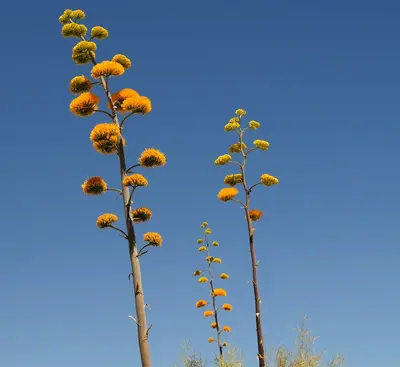
The iconic 'Century Plant' creates a dramatic architectural statement with its massive blue-gray sword-like leaves that can span 6 feet across. Despite its name, it typically blooms after 15-25 years with a spectacular 20-foot tall flower spike before the mother plant dies, leaving behind numerous offsets. This bold succulent is perfect for xeriscaping and adds instant southwestern flair to any landscape.
Sun
Full sun
Zones
8–11
USDA hardiness
Height
6-10 feet
Complete Growing Guide
Agave americana requires full sun and exceptionally well-draining soil to prevent the root rot that commonly claims this species in humid climates. Unlike smaller agaves, this cultivar's massive size demands space—plant at least 8 feet from structures since mature rosettes sprawl considerably. The species exhibits unpredictable blooming timing between 15-25 years, so patience is essential; once flowering occurs and the mother plant senesces, immediately propagate the numerous offsets to preserve your specimen. Agave snout weevil poses the greatest pest threat, particularly in southwestern regions, so inspect the plant's crown regularly for soft spots or sawdust-like frass. A practical strategy is to plant agave americana in raised beds or mounded soil to ensure superior drainage even in areas receiving occasional rainfall, significantly reducing fungal vulnerability and extending the plant's productive lifespan before its dramatic final bloom.
Light: Full sun (6 or more hours of direct sunlight a day). Soil: Sand. Drainage: Good Drainage. Height: 6 ft. 0 in. - 10 ft. 0 in.. Spread: 6 ft. 0 in. - 10 ft. 0 in.. Spacing: 6-feet-12 feet. Growth rate: Slow. Maintenance: Low. Propagation: Division, Seed. Regions: Coastal, Piedmont.
Harvesting
Agave Americana reaches peak harvest readiness when the rosette achieves full maturity, typically 7-10 years of growth, signaled by dense, thick leaves displaying a pronounced blue-gray waxy coating and a diameter of 6 feet or more. The leaves should feel firm and heavy with stored sap, indicating optimal juice content for traditional uses. This is a single-harvest plant—once the mother plant flowers and dies, it cannot be re-harvested, though the numerous pups surrounding the base can be propagated for future crops. Time your harvest in late summer or early fall when sap sugar content peaks, ensuring maximum yield and quality before the plant's inevitable decline.
Bloom time: Summer
Storage & Preservation
Agave Americana is an ornamental succulent and doesn't require traditional storage or preservation. As a living plant, store in a warm, dry location with minimal humidity (30-40% RH) and temperatures between 50-85°F. Outdoor placement in well-draining soil is ideal. If grown in containers indoors, preserve by ensuring excellent drainage and infrequent watering (every 3-4 weeks in winter, monthly in growing season). To preserve specimens for propagation, collect and dry offsets in a cool, shaded location for 1-2 weeks before planting. For sap preservation (tequila production), harvest and ferment according to traditional methods. The plant itself has an indefinite lifespan until blooming maturity.
History & Origin
Agave americana's exact origins remain somewhat obscured, though evidence strongly suggests it originated in central Mexico, likely in the regions of Tamaulipas or San Luis Potosí where agaves have been cultivated for millennia. The species became widely distributed across Mexico long before European contact, where indigenous peoples had already established its importance for fiber, food, and fermented beverages. European explorers introduced it to the Mediterranean and beyond during the 16th and 17th centuries, where it naturalized extensively. While no specific breeder or documented introduction date exists, the plant represents part of agave's deep heritage as a domesticated succulent refined through generations of traditional Mexican cultivation rather than formal scientific breeding.
Origin: Mexico and Southwestern United States
Advantages
- +Creates dramatic architectural focal point with massive 6-foot blue-gray sword-like leaves
- +Extremely low maintenance once established, thriving in drought and poor soil
- +Spectacular 20-foot flower spike provides stunning visual display after 15-25 years
- +Produces numerous offsets after blooming, creating free replacement plants
- +Perfect for xeriscaping and southwestern landscapes requiring minimal water
Considerations
- -Requires excellent drainage or develops fatal root rot and bacterial soft rot
- -Massive size eventually dominates space, difficult to remove or relocate
- -Agave weevil infestations can severely damage or kill the entire plant
- -Mother plant dies after flowering, requiring replacement with offset propagation
Companion Plants
Lavender, Rosemary, and Sage are the companions that actually make sense here — all three want sharp drainage and lean soil, and none will crowd an 8–12 foot spread over time. Prickly Pear and Yucca work for the same reason: matched drought tolerance, no competition in the top 12 inches of soil where Agave americana's feeder roots sit. In Georgia piedmont gardens, people sometimes try to soften an agave planting with Hostas or Ferns, and it goes badly every time — both of those need consistent moisture, and the irrigation they require will rot the agave crown before the plant hits year two. Bermudagrass is the other problem; it creeps into the base, traps humidity against the stem, and is genuinely difficult to remove once it's established in the leaf axils.
Plant Together
Lavender
Thrives in similar dry conditions and repels pests while attracting beneficial pollinators
Rosemary
Shares drought tolerance and Mediterranean climate preferences, deters harmful insects
Prickly Pear Cactus
Similar water and soil requirements, creates complementary xerophytic landscape design
Yucca
Compatible desert plant with matching low-water needs and soil drainage requirements
Sedum
Drought-tolerant groundcover that doesn't compete for water and provides contrasting texture
Sage
Thrives in dry conditions and acts as natural pest deterrent for soft-bodied insects
Desert Marigold
Native desert flower that shares water requirements and attracts beneficial insects
Barrel Cactus
Complementary desert plant with identical drainage and minimal water needs
Keep Apart
Grass Lawn
Requires frequent watering which can cause root rot in agave and creates poor drainage
Hostas
Needs shade and consistent moisture, completely opposite growing conditions
Impatiens
Requires constant moisture and rich soil, creating fungal disease risk for agave
Ferns
Need humid conditions and frequent watering that promotes agave crown rot
Pests & Disease Resistance
Resistance
Excellent disease resistance in dry conditions
Common Pests
Agave weevil, scale insects, occasional rodent damage
Diseases
Root rot in poorly draining soil, bacterial soft rot
Troubleshooting Agave Americana
What you'll see, why it happens, and what to do about it.
Soft, mushy base or crown with a foul smell, often appearing after a wet winter or heavy rain period
Likely Causes
- Root rot caused by Phytophthora or Pythium species in compacted or clay-heavy soil
- Bacterial soft rot (Erwinia species) entering through wounds or insect damage
What to Do
- 1.Dig the plant out and cut away all blackened, mushy tissue with a clean knife — let the wound callous in dry air for several days before replanting
- 2.Replant in a raised bed or berm with at least 50% coarse sand or decomposed granite mixed into native soil
- 3.Skip all irrigation from November through February in zones 8–9; this plant does not need your help in winter
Center leaves collapsing or wilting while outer leaves stay firm, sometimes with a sawdust-like material at the base
Likely Causes
- Agave snout weevil (Scyphophorus acupunctatus) — the adult bores into the crown to lay eggs, larvae feed on interior tissue
- The damage often isn't visible until the plant is already structurally compromised
What to Do
- 1.There's no saving a heavily infested plant — remove and bag the entire crown and larvae before they pupate in the soil
- 2.Apply an imidacloprid drench to surrounding soil in April–May when adult weevils are most active, especially if you've had weevil damage within 20 feet
- 3.Inspect offsets carefully before transplanting — move a clean pup to a new location at least 10 feet from the infested site
White, waxy, or cottony crusts on leaf surfaces or in the crevices between leaves
Likely Causes
- Armored scale insects — most commonly Diaspis echinocacti — which form hard, flat shields directly on leaf tissue
- Mealybugs, which look cottony rather than crusty and tend to cluster at leaf bases
What to Do
- 1.Scrub light infestations off with a stiff brush dipped in 70% isopropyl alcohol — get into the leaf crevices
- 2.For heavier infestations, apply horticultural oil (neem or petroleum-based) directly to affected areas when temperatures are below 90°F to avoid leaf burn
- 3.Pull any grass or dense groundcover back at least 3 feet from the base to cut down on the humid microclimate that scale populations thrive in
Chewed or gnawed leaf tips or base damage with no visible insect presence, sometimes with burrowing near the root zone
Likely Causes
- Rodents — pack rats and ground squirrels are the most common culprits in dryland gardens
- Armadillos in the Southeast, which root around the base and displace shallow offsets without eating them
What to Do
- 1.Place a 1/4-inch hardware cloth collar buried 6 inches deep around the base to stop burrowing rodents from reaching the root crown
- 2.For armadillos, install fencing at least 24 inches high with the bottom edge bent outward underground — they'll dig under a vertical fence in one night
- 3.Don't mulch heavily right against the stem; a 6-inch gap of bare soil gives you early warning and removes the cover rodents prefer