Echeveria Elegans
Echeveria elegans
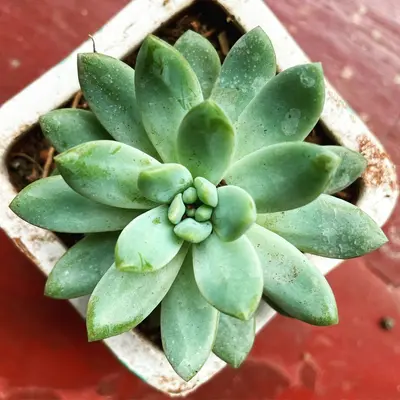
Known as the 'Mexican Snowball' for its perfect pale blue-green rosettes covered in a powdery bloom that gives them an ethereal, frosted appearance. This stunning succulent produces tall spikes of coral-pink bell-shaped flowers that create a beautiful contrast against the silvery foliage. It's one of the most photogenic succulents and forms attractive clusters over time, making it perfect for containers and rock gardens.
Sun
Full sun to partial shade
Zones
9–11
USDA hardiness
Height
6-12 inches
Complete Growing Guide
Light: Full sun (6 or more hours of direct sunlight a day), Partial Shade (Direct sunlight only part of the day, 2-6 hours). Soil: Loam (Silt), Sand, Shallow Rocky. Soil pH: Acid (<6.0), Alkaline (>8.0), Neutral (6.0-8.0). Drainage: Good Drainage, Occasionally Dry. Spacing: Less than 12 inches. Growth rate: Slow. Maintenance: Low. Propagation: Division, Leaf Cutting.
Harvesting
Inconspicuous capsules
Type: Capsule. Length: < 1 inch. Width: < 1 inch.
Storage & Preservation
Echeveria elegans doesn't require traditional storage since it's a living ornamental plant. Keep it in its container at room temperature (65-75°F) in a bright location with low to moderate humidity. The plant can thrive year-round indoors or outdoors in mild climates. For propagation preservation, leaf cuttings can be stored dry at room temperature for several weeks before planting. Propagation methods include: (1) leaf propagation by allowing individual leaves to callus and root in well-draining soil; (2) offsets/pups separated from the mother plant and potted independently; (3) seed propagation from flower spikes, though slower to mature into full rosettes.
History & Origin
Origin: NE Mexico to Veracruz
Advantages
- +Attracts: Bees, Butterflies, Hummingbirds
- +Low maintenance
Companion Plants
Echeveria elegans does best alongside plants that share its core requirements: sharp drainage, infrequent watering, and a soil pH in the 6.0–7.0 range. Sedum varieties, Haworthia species, Hens and Chicks (Sempervivum), and Jade Plant (Crassula ovata) all fit that profile. In a container arrangement they can share the same gritty mix without anyone getting waterlogged. Aloe and Agave are workable too, though Agave can put on 12 or more inches of spread in a single season — give it plenty of clearance or it'll shade the echeveria out before you notice.
Mint, ferns, and impatiens are bad neighbors for a concrete reason: all three want consistent soil moisture, and keeping them happy means watering on a schedule that will rot an echeveria's roots within a season. Ferns in particular need shade and high humidity — nearly the opposite of the bright, dry conditions this plant wants. Separate containers, not just separate corners of the same pot.
Plant Together
Sedum varieties
Similar water and light requirements, complementary textures and colors
Jade Plant (Crassula ovata)
Matching drought tolerance and care needs, creates harmonious succulent display
Hens and Chicks (Sempervivum)
Similar rosette form and water requirements, provides textural contrast
String of Pearls (Senecio rowleyanus)
Complementary trailing habit, same low water needs and bright light preference
Aloe varieties
Shared preference for well-draining soil and infrequent watering
Haworthia species
Similar care requirements and growth habits, creates varied succulent arrangement
Stonecrop (Sedum acre)
Ground cover that shares water and soil preferences, adds textural interest
Agave species
Compatible drought tolerance and sun requirements, provides architectural contrast
Keep Apart
Mint
Requires frequent watering which can cause root rot in drought-adapted Echeveria
Ferns
Need high humidity and consistent moisture, opposite to Echeveria's dry conditions
Impatiens
Require regular watering and partial shade, incompatible with succulent care needs
Pests & Disease Resistance
Resistance
Good resistance when grown in proper conditions
Common Pests
Aphids on flower stalks, mealybugs, slugs and snails
Diseases
Root rot from overwatering, leaf rot from water sitting on leaves
Troubleshooting Echeveria Elegans
What you'll see, why it happens, and what to do about it.
Leaves turning soft, translucent, or mushy at the base, often with a foul smell
Likely Causes
- Root rot (Pythium or Fusarium spp.) from overwatering or poorly draining soil
- Pot sitting in standing water for more than a day or two
What to Do
- 1.Pull the plant out and cut away any black or brown rotted roots with clean scissors; let the roots air-dry for 24 hours before repotting
- 2.Repot into fresh, gritty cactus mix — or cut your own with 50% potting soil and 50% perlite
- 3.Skip watering for 10-14 days after repotting, then resume only when the top inch of soil is completely dry
White cottony clusters in the leaf axils or at the base of the rosette
Likely Causes
- Mealybugs (Pseudococcidae family) — common on succulents, spread easily from nearby infested plants
What to Do
- 1.Dab individual bugs with a cotton swab dipped in 70% isopropyl alcohol — it kills on contact
- 2.Spray the whole plant with a diluted neem oil solution (2 tsp neem per quart of water) every 7 days for 3 weeks
- 3.Quarantine the plant from other succulents immediately; mealybugs move fast in a crowded collection
Leaves stretching out long and pale, rosette losing its tight, compact shape
Likely Causes
- Etiolation — the plant isn't getting enough light and is reaching toward the nearest source
- Fewer than 4 hours of direct sun per day indoors or in a shaded outdoor spot
What to Do
- 1.Move the plant to a south- or east-facing window that gets at least 4-6 hours of direct sun, or set it outside in a bright, unobstructed spot
- 2.Stretched growth won't pull back — if the rosette looks ragged, cut the head off, let the cut end callous for 2-3 days, and reroot it in dry cactus mix
- 3.Leave the original stem in place; it'll push out new offsets within a few weeks
Frequently Asked Questions
How long does it take for Echeveria elegans to mature?▼
Is Echeveria elegans good for beginners?▼
Can you grow Echeveria elegans in containers?▼
What's the difference between Echeveria elegans and Echeveria setosa?▼
How often should I water Echeveria elegans?▼
When does Echeveria elegans flower and what do the flowers look like?▼
Growing Guides from Wind River Greens
Sources & References
External authority sources used in compiling this guide.
- ExtensionNC State Extension
See the Methodology page for how this data is sourced, what's AI-assisted, and known limitations.