Crassula perforata 'String of Buttons'
Crassula perforata
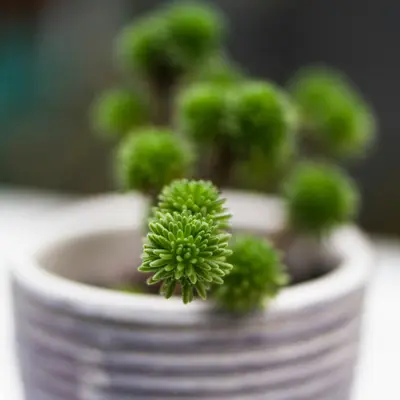
A fascinating architectural succulent where triangular leaves are perfectly stacked and threaded along sturdy stems, creating the illusion of buttons on a string. The blue-green leaves develop striking red edges in bright light, and the plant forms dense, sculptural clusters that add incredible texture to any collection. Its geometric form and reliable growth make it a conversation starter that's surprisingly easy to care for.
Sun
Full sun to partial shade
Zones
9–12
USDA hardiness
Height
12-24 inches
Complete Growing Guide
Light: Full sun (6 or more hours of direct sunlight a day), Partial Shade (Direct sunlight only part of the day, 2-6 hours). Soil: Loam (Silt), Sand. Soil pH: Acid (<6.0), Alkaline (>8.0), Neutral (6.0-8.0). Drainage: Good Drainage, Occasionally Dry. Height: 1 ft. 0 in. - 2 ft. 0 in.. Spread: 2 ft. 0 in. - 3 ft. 0 in.. Spacing: 3 feet-6 feet. Growth rate: Rapid. Maintenance: Low. Propagation: Division, Leaf Cutting, Stem Cutting.
Harvesting
For String of Buttons, harvest readiness appears when leaves develop their characteristic red edges and feel plump and firm to the touch, indicating peak water content and maturity. Unlike many succulents harvested for single large yields, this cultivar responds best to continuous light harvesting of individual rosettes or short stem sections, which encourages bushier, denser growth rather than depleting the plant. Timing your harvests in spring or early summer maximizes the plant's ability to recover and produce new growth before dormancy sets in, while avoiding late-season harvesting prevents stress during cooler months when growth naturally slows.
Bloom time: Spring
Storage & Preservation
Store Crassula perforata 'String of Buttons' in bright indirect light on a counter or shelf at 65-75°F with low humidity (30-40%). As a living succulent, it doesn't require traditional food storage. To preserve the plant long-term: (1) Propagate from leaf or stem cuttings, storing them dry until roots develop, then potting in well-draining mix; (2) Create offsets by separating mature clusters and allowing cut surfaces to callus for 2-3 days before planting; (3) Overwintering involves reducing water during cool months and maintaining bright light to preserve vibrant red edge coloring.
History & Origin
Origin: South Cape Provinces to KwaZulu-Natal
Advantages
- +Attracts: Butterflies, Hummingbirds
- +Fast-growing
- +Low maintenance
Considerations
- -Toxic (Sap/Juice): Low severity
- -Causes contact dermatitis
Companion Plants
String of Buttons does best alongside plants that share its water and light demands, which is why Echeveria, Sedum, and Jade Plant (Crassula ovata) make the most sense in a mixed container. All three want their soil bone-dry between waterings and can handle 4–6 hours of direct sun without complaint. One drink serves the whole pot, and nobody sits in moisture longer than it should. Haworthia is worth adding if part of the arrangement gets afternoon shade — it tolerates lower light than the others without needing a separate watering schedule.
Aloe vera and Portulacaria afra both pull their weight for the same reasons: shallow to medium root depth, genuine drought tolerance, and no chemical interference with their neighbors. Around here in coastal Georgia, that kind of mixed planting spends spring through early October outdoors on a south-facing porch, then comes inside before temperatures drop below 40°F — and the stacked rosettes of String of Buttons against the broader paddle leaves of Portulacaria gives you something worth actually looking at.
The problem companions — Ferns, Impatiens, Hostas — need consistent soil moisture and lean toward shade. Put any of them in the same container and you're stuck: water enough for the fern and the Crassula roots stay wet for two weeks straight, which is how root rot starts. It's not about chemical incompatibility; their basic growing conditions don't overlap.
Plant Together
Echeveria
Similar water and light requirements, creates attractive textural contrast
Sedum varieties
Identical care needs and complementary growth habits for succulent arrangements
Jade Plant (Crassula ovata)
Same genus with matching watering schedules and temperature preferences
Haworthia
Compatible drought tolerance and provides visual interest with different leaf patterns
Aloe vera
Similar succulent care requirements and both prefer bright, indirect light
Portulacaria afra
Matching low-water needs and creates nice cascading companion effect
Kalanchoe
Shared preference for well-draining soil and infrequent watering
String of Pearls
Similar trailing habit and identical drought-resistant care needs
Keep Apart
Ferns
Require consistently moist soil which can cause root rot in succulents
Impatiens
Need frequent watering and high humidity that promotes fungal issues in succulents
Hostas
Prefer shade and regular moisture, opposite of succulent requirements
Pests & Disease Resistance
Resistance
Very good with proper care
Common Pests
Mealybugs, aphids, scale
Diseases
Root rot, fungal issues from overwatering
Troubleshooting Crassula perforata 'String of Buttons'
What you'll see, why it happens, and what to do about it.
White cottony clumps in leaf axils or along stems, sometimes with sticky residue on lower leaves
Likely Causes
- Mealybugs (Pseudococcidae) — common on succulents grown indoors or in crowded containers
- Low airflow and infrequent inspection allowing a small population to establish unnoticed
What to Do
- 1.Dab individual bugs with a cotton swab soaked in 70% isopropyl alcohol — works on contact
- 2.Follow up with a spray of diluted neem oil (2 tsp per quart of water) every 7 days for 3 weeks
- 3.Isolate the affected plant immediately; mealybugs spread fast across a shelf of succulents
Stems soft and mushy at the base, lower leaves dropping with a slight tug, soil staying wet more than 10 days after watering
Likely Causes
- Root rot from Pythium or Phytophthora — almost always triggered by overwatering or a pot without drainage holes
- Heavy potting mix retaining moisture too long (standard houseplant soil instead of a cactus/succulent blend)
What to Do
- 1.Unpot the plant, cut away any black or brown mushy roots with clean scissors, and let the root ball air-dry for 24 hours before repotting
- 2.Repot into a well-draining cactus mix — or cut 40% perlite into standard potting soil — in a terracotta pot with a drainage hole
- 3.Hold off watering for at least 7-10 days after repotting to let the roots recover
Frequently Asked Questions
Is String of Buttons succulent good for beginners?▼
Can I grow String of Buttons indoors?▼
How do I propagate String of Buttons?▼
What light conditions bring out the red coloring?▼
How often should I water String of Buttons?▼
Is String of Buttons toxic to pets?▼
Growing Guides from Wind River Greens
Sources & References
External authority sources used in compiling this guide.
- ExtensionNC State Extension
See the Methodology page for how this data is sourced, what's AI-assisted, and known limitations.