Star Magnolia
Magnolia stellata
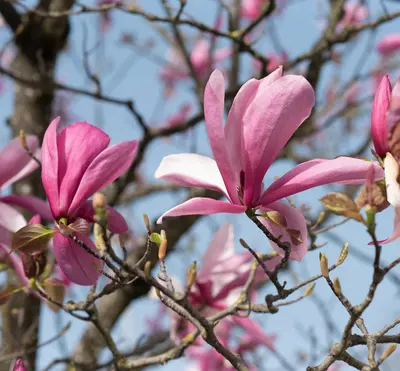
An early-blooming magnolia that signals spring's arrival with masses of fragrant, star-shaped white flowers that appear before the leaves emerge. This compact magnolia is perfect for smaller gardens and consistently ranks as one of the most reliable and beautiful spring-flowering trees for home landscapes.
Sun
Full sun to partial shade
Zones
4–8
USDA hardiness
Height
15-20 feet
Planting Timeline
Showing dates for Star Magnolia in USDA Zone 7
All Zone 7 ornamental-tree →Zone Map
Click a state to update dates
Star Magnolia · Zones 4–8
Growing Details
Complete Growing Guide
Light: Full sun (6 or more hours of direct sunlight a day), Partial Shade (Direct sunlight only part of the day, 2-6 hours). Soil: High Organic Matter, Loam (Silt). Soil pH: Acid (<6.0), Neutral (6.0-8.0). Drainage: Good Drainage, Moist, Occasionally Wet. Height: 15 ft. 0 in. - 20 ft. 6 in.. Spread: 10 ft. 0 in. - 15 ft. 0 in.. Spacing: 12-24 feet. Growth rate: Slow. Maintenance: Medium. Propagation: Seed, Stem Cutting. Regions: Coastal, Mountains, Piedmont.
Harvesting
The fruit is cone-like and has an aggregate of follicles. It measures 2 to 2.5 inches long. It will mature in late summer, and the cone-like fruit will burst open and reveal the orange seeds.
Color: Brown/Copper, Orange. Type: Aggregate, Follicle. Length: 1-3 inches. Width: 1-3 inches.
Garden value: Edible, Showy
Harvest time: Fall
Storage & Preservation
Star Magnolia is an ornamental tree; flowers are not stored for culinary use. If you've cut flowers for arrangements, place stems in cool (60-65°F) water immediately after cutting. Indoor arrangements last 5-7 days in standard conditions; mist petals lightly and keep away from ripening fruit and direct heat sources, which accelerate petal drop. For longer-term preservation, press individual petals between parchment paper under heavy books for 2-3 weeks to create decorative dried elements. Alternatively, dry small flower sprays by hanging upside-down in a cool, dark, well-ventilated space for 2-3 weeks—dried flowers remain beautiful for several months and can be used in floral crafts or potpourri.
History & Origin
Origin: South Central Honshu, Japan
Advantages
- +Attracts: Butterflies, Songbirds
Companion Plants
The best companions for Star Magnolia share its need for acidic soil in the pH 5.0–6.5 range and steady moisture that drains rather than pools. Azaleas, rhododendrons, and camellias sit in that same chemistry — all three respond well to pine bark mulch and periodic sulfur applications, so you're maintaining one soil regime instead of two. In our zone 7 Georgia gardens, pairing a Star Magnolia with a fall-blooming camellia like 'Survivor' or 'Winter's Interlude' extends the ornamental season from late February well into November; the magnolia opens things up, the camellia closes them out.
Hostas, Japanese painted fern, and astilbe are worth planting under the canopy once the tree matures past about 8 feet and starts throwing real shade. Their fibrous, shallow roots don't put much pressure on the magnolia's own surface root system, and they fill in ground that would otherwise just grow weeds or dry out. Coral bells hold up through Georgia summers without needing much fuss.
Black walnut is the one to keep off the same property entirely if you can manage it. Juglone — the compound it produces through root exudates and decomposing hulls — is documented to cause decline in many ornamentals, and Star Magnolia is sensitive enough that proximity isn't worth testing. Pine trees present a different problem: aggressive surface roots and dense needle drop acidify the soil faster than you want while pulling moisture away from anything planted nearby. Eucalyptus releases allelopathic compounds through both root exudates and leaf litter that suppress neighboring plants in much the same way, and its water demand in summer is punishing to anything growing within its drip line.
Plant Together
Azalea
Shares similar acidic soil preferences and blooms complement magnolia's early spring flowers
Rhododendron
Thrives in same acidic, well-draining soil conditions and provides complementary foliage texture
Hosta
Tolerates partial shade created by magnolia canopy and adds contrasting foliage texture
Japanese Painted Fern
Thrives in dappled shade under magnolia and adds silvery foliage contrast
Camellia
Prefers similar acidic soil and partial shade, extends flowering season
Coral Bells
Tolerates shade and adds colorful foliage that complements magnolia's green leaves
Astilbe
Thrives in partial shade and moist conditions, provides feathery texture contrast
Japanese Maple
Compatible growth habits and provides autumn color when magnolia foliage fades
Keep Apart
Black Walnut
Produces juglone toxin that can inhibit magnolia root development and overall health
Pine Trees
Creates overly acidic soil conditions and dense shade that can stress magnolia
Eucalyptus
Releases allelopathic compounds that inhibit growth of nearby plants including magnolias
Pests & Disease Resistance
Resistance
Good disease resistance, occasional leaf spot issues
Common Pests
Scale insects, magnolia scale, thrips
Diseases
Leaf spot, canker, root rot in poorly drained soils
Troubleshooting Star Magnolia
What you'll see, why it happens, and what to do about it.
Brown, water-soaked patches on bark near the base or main crotch, sometimes with weeping or oozing sap
Likely Causes
- Canker disease (Nectria or Botryosphaeria spp.) — often enters through pruning wounds or winter injury
- Wounds from string trimmers or lawn equipment nicking the bark
What to Do
- 1.Prune out infected wood at least 6 inches below the discolored tissue and dispose of it — don't compost it
- 2.Sterilize your pruning tools between cuts with 70% isopropyl alcohol
- 3.Keep mulch 3-4 inches away from the trunk to reduce moisture against the bark; a 3-foot mulch ring is plenty
Raised, waxy, brownish-gray bumps clustered on branches, sometimes accompanied by sticky residue or black sooty mold on leaves below
Likely Causes
- Magnolia scale (Neolecanium cornuparvum) — one of the largest soft scales in North America, overwinters as nymphs on young stems
- Sooty mold is secondary, growing on the honeydew the scale excretes
What to Do
- 1.In late July through August, when crawlers are active, spray with horticultural oil — coverage on the undersides of stems matters
- 2.In late winter while the tree is dormant, apply a dormant oil spray to smother overwintering nymphs
- 3.Prune out heavily encrusted branches if the infestation is localized; bag and trash the material
Yellowing leaves with wilting that doesn't recover after watering, or roots that look brown and mushy when you probe the soil
Likely Causes
- Phytophthora root rot — a water mold that thrives in waterlogged, poorly drained soil
- Planting too deep, which keeps the root flare constantly wet
What to Do
- 1.If the tree is newly planted and small enough, dig it up, let the roots air out, and replant on a slight berm so the root flare sits 1-2 inches above grade
- 2.Improve drainage before planting — incorporate pine bark fines into heavy clay at a ratio of roughly 1:2 by volume
- 3.Don't plant Star Magnolia in any spot where water pools for more than an hour after a heavy rain
Frequently Asked Questions
How long does it take for a Star Magnolia to bloom after planting?▼
Can Star Magnolia grow in a pot or container?▼
What is the difference between Star Magnolia and Saucer Magnolia?▼
When is the best time to plant Star Magnolia?▼
Why aren't my Star Magnolia flowers blooming, or why did buds drop?▼
Is Star Magnolia good for beginners?▼
Zone-by-Zone Planting Calendar
Growing Guides from Wind River Greens
Sources & References
External authority sources used in compiling this guide.
- ExtensionNC State Extension
See the Methodology page for how this data is sourced, what's AI-assisted, and known limitations.