Japanese Maple Crimson Queen
Acer palmatum 'Crimson Queen'
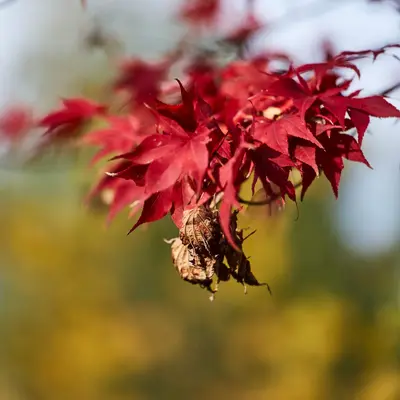
A stunning weeping Japanese maple with cascading branches that create a natural waterfall effect in the landscape. The deeply dissected red-purple foliage maintains its vibrant color throughout the growing season, making it one of the most sought-after ornamental trees for adding dramatic focal points to gardens.
Sun
Dappled Sunlight
Zones
5–8
USDA hardiness
Height
15-25 feet
Planting Timeline
Showing dates for Japanese Maple Crimson Queen in USDA Zone 7
All Zone 7 ornamental-tree →Zone Map
Click a state to update dates
Japanese Maple Crimson Queen · Zones 5–8
Growing Details
Complete Growing Guide
This weeping cultivar thrives in partial shade with afternoon protection in hot climates, as intense sun can scorch its delicate foliage and diminish the signature deep crimson coloring. Unlike upright maples, Crimson Queen's naturally cascading form requires minimal pruning beyond removing dead wood and crossing branches in late winter while the tree is dormant. The shallow root system demands consistently moist, well-draining soil rich in organic matter—avoid waterlogged conditions that invite root rot, a primary concern in poorly drained sites. Watch for Japanese beetles and spider mites during summer stress; these pests exploit weakened trees more readily than they attack vigorous specimens. A practical approach: mulch generously around the base with 2-3 inches of compost to regulate soil moisture and temperature while keeping mulch several inches from the trunk to prevent fungal issues. This cultivar rarely experiences the stretching or weak growth common to some ornamentals when planted in appropriate light and soil conditions.
Light: Dappled Sunlight (Shade through upper canopy all day). Soil: High Organic Matter. Drainage: Good Drainage, Moist. Height: 15 ft. 0 in. - 25 ft. 0 in.. Spread: 10 ft. 0 in. - 25 ft. 0 in.. Growth rate: Slow. Maintenance: High. Propagation: Grafting.
Harvesting
The Crimson Queen Japanese Maple is not harvested for fruit or seeds in the traditional sense, but rather pruned selectively to maintain its weeping form and vibrant foliage display. The best time to harvest or prune branches is in late winter or early spring before new growth emerges, when you can clearly see the tree's structure and the red-purple color begins intensifying. Watch for branches that have grown beyond the desired cascading silhouette or show signs of crossing, and remove these individually rather than performing a single heavy harvest. Prune when stems snap cleanly without shredding, indicating healthy wood ready for cutting. Make strategic cuts just above outward-facing buds to encourage the graceful weeping habit this cultivar is prized for, removing no more than one-third of growth annually to preserve the tree's architectural beauty and vigor.
A schizocarp of two samaras, wings incurved forming an arch, becoming reddish.
Color: Brown/Copper, Red/Burgundy. Type: Samara, Schizocarp.
Harvest time: Fall
Storage & Preservation
Japanese Maple Crimson Queen is an ornamental specimen tree—there is no harvest or storage protocol. However, if you cut branches for floral arrangements, condition them immediately by plunging cut stems into cool water for 2-4 hours before arranging. Place arrangements in indirect light away from heating vents or ripening fruit, which produces ethylene gas that shortens vase life. Change water every 2-3 days and re-cut stems at an angle. Branches typically last 1-2 weeks indoors. To preserve the beauty of the living tree year-round, apply dormant oil spray in late winter to control overwintering pest eggs, and maintain consistent watering and mulching to prevent stress-related disease.
History & Origin
The 'Crimson Queen' cultivar emerged from the extensive Japanese maple breeding programs that gained momentum in the mid-20th century, though specific breeder attribution and introduction year remain somewhat obscured in readily available documentation. This variety belongs to the dissectum group of Acer palmatum, characterized by deeply cut foliage and weeping form, a lineage refined through both Japanese horticultural tradition and Western ornamental nursery development. The cultivar likely arose through selective breeding for enhanced red coloration and consistent weeping architecture, though definitive records of its original creator and exact date of introduction are not well-documented in standard horticultural references. Its popularity in contemporary landscapes reflects the broader Western appreciation for Japanese maples that accelerated during the latter twentieth century.
Origin: Asia: Japan, China, Korea, eastern Mongolia, southeastern Russia
Advantages
- +Striking red-purple foliage maintains vibrant color throughout the entire growing season.
- +Elegant weeping form creates a natural waterfall effect as dramatic focal point.
- +Deeply dissected leaves provide fine texture and refined aesthetic appeal to landscapes.
- +Moderate difficulty makes it accessible for gardeners with some horticultural experience.
Considerations
- -Susceptible to multiple diseases including verticillium wilt, anthracnose, and root rot.
- -Vulnerable to common pests like aphids, scale insects, and spider mites.
- -Prone to leaf scorch in hot, dry conditions or harsh sunlight exposure.
- -Requires consistently moist, well-draining soil to prevent stress and disease.
Companion Plants
Shade-tolerant perennials are Crimson Queen's best neighbors because they share the same need for dappled light and acidic soil (pH 5.5-6.5) without competing hard for root space. Hostas and Japanese Painted Fern fill the dry-shade zone under the canopy where little else wants to grow — their wide leaves suppress weeds, and neither sends roots deep enough to muscle out the maple. Astilbe and Coral Bells add bloom color in spring before the canopy fills in, then quietly coexist through summer. Azaleas pull double duty: same acidic pH preference, same organic mulch requirement, and their spring bloom timing pairs well with the maple's emerging foliage color.
Black Walnut is the plant to site far away from — it produces juglone (5-hydroxy-1,4-naphthoquinone) through its roots and decomposing leaf litter, and Acer palmatum is documented as sensitive to it, showing wilting and branch dieback. Large conifers present a different problem: their shallow, wide-spreading root mats compete directly with the maple's feeder roots for the consistent moisture Crimson Queen needs, and heavy needle drop can push soil pH below the 5.5 floor it tolerates. Mint isn't chemically harmful, but it spreads by underground stolons and will quietly colonize the root zone in a single season if you let it get started.
Plant Together
Hostas
Thrive in similar partial shade conditions and complement the maple's delicate foliage with contrasting textures
Astilbe
Shares preference for moist, well-draining soil and partial shade while adding colorful plumes that enhance the maple's form
Japanese Painted Fern
Creates beautiful understory layer with silvery foliage that complements red maple leaves and tolerates similar growing conditions
Coral Bells
Provides ground-level color coordination with burgundy and red foliage varieties that echo the maple's crimson tones
Azaleas
Share acidic soil preferences and shallow root systems that won't compete aggressively with the maple's roots
Ajuga
Forms attractive groundcover that helps retain soil moisture and suppress weeds without competing for nutrients
Caladiums
Provide seasonal color with heart-shaped leaves that complement the maple's delicate structure in shaded areas
Begonias
Thrive in the filtered light beneath the maple canopy and add continuous blooms without root competition
Keep Apart
Black Walnut
Produces juglone toxin that can cause leaf yellowing, stunted growth, and potential death in Japanese maples
Eucalyptus
Releases allelopathic compounds that inhibit growth and can cause stress to nearby Japanese maples
Large Conifers
Create excessive shade and compete aggressively for water and nutrients, stunting the maple's growth
Mint
Highly invasive spreading habit can overwhelm the maple's shallow root zone and compete for moisture and nutrients
Pests & Disease Resistance
Resistance
Moderate resistance, susceptible to verticillium wilt and leaf scorch
Common Pests
Aphids, scale insects, spider mites
Diseases
Verticillium wilt, anthracnose, leaf scorch, root rot
Troubleshooting Japanese Maple Crimson Queen
What you'll see, why it happens, and what to do about it.
Leaves curling or stippled with fine webbing on the undersides, especially during hot, dry spells in summer
Likely Causes
- Spider mites (Tetranychus urticae) — thrive in hot, dusty, low-humidity conditions
- Water stress that weakens the tree's defenses
What to Do
- 1.Blast the undersides of foliage with a strong stream of water every 2-3 days — mites hate moisture
- 2.Apply insecticidal soap or neem oil, covering leaf undersides thoroughly; repeat every 7 days for 3 applications
- 3.Mulch the root zone 3-4 inches deep to hold soil moisture and reduce heat stress at the base
Leaves show brown, scorched edges spreading inward from the margin starting in mid-summer — not a spot pattern, not a lesion, just a crispy border
Likely Causes
- Leaf scorch — a physiological response to hot afternoon sun combined with dry soil or low humidity, not a pathogen
- Planting in too much direct sun (Crimson Queen is bred for dappled light, not 6-8 hours of full afternoon exposure)
- Inconsistent watering, especially missing the 1 inch per week threshold during heat
What to Do
- 1.Water deeply and consistently — 1 inch per week, more during drought; a soaker hose on a timer takes the guesswork out
- 2.If the tree is getting more than 4-5 hours of direct afternoon sun, add a shade structure or relocate young specimens while they're still movable
- 3.Repeated scorch years weaken the tree over time; fix the site conditions, not the leaves
One or more branches wilting and dying back while the rest of the canopy looks fine; wood cut near the affected branch shows greenish-brown streaking in the sapwood
Likely Causes
- Verticillium wilt (Verticillium dahliae or V. albo-atrum) — a soil-borne fungus that colonizes and blocks the vascular system
- Prior planting in soil where susceptible crops (tomatoes, strawberries, potatoes) grew recently
What to Do
- 1.Prune out wilted branches 6-8 inches below the discolored wood; sterilize pruners with 70% isopropyl alcohol between every cut
- 2.No chemical cure exists — keep the tree as vigorous as possible with consistent water and a balanced slow-release fertilizer so it can compartmentalize the infection
- 3.If the tree dies, don't replant another Verticillium-susceptible species (smoke tree, redbud, another Japanese maple) in that spot; the fungus persists in soil for years