Chestnut (Colossal)
Castanea sativa 'Colossal'
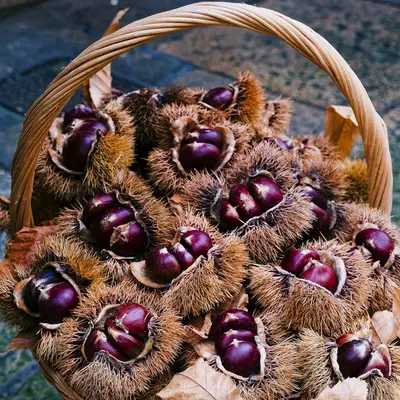
True to its name, Colossal produces enormous chestnuts that can reach the size of small plums, making it a showstopper in any home orchard. This European variety combines impressive size with excellent sweet flavor and meaty texture that's perfect for roasting. The nuts are much larger than typical American varieties while maintaining the rich, starchy sweetness that makes chestnuts a beloved fall treat.
Harvest
120-150d
Days to harvest
Sun
Full sun
Zones
5–7
USDA hardiness
Height
80-100 feet
Planting Timeline
Showing dates for Chestnut (Colossal) in USDA Zone 7
All Zone 7 nut-tree →Zone Map
Click a state to update dates
Chestnut (Colossal) · Zones 5–7
Growing Details
Complete Growing Guide
Light: Full sun (6 or more hours of direct sunlight a day). Soil: Clay, Loam (Silt), Sand. Soil pH: Acid (<6.0), Neutral (6.0-8.0). Drainage: Good Drainage. Height: 80 ft. 0 in. - 100 ft. 0 in.. Spread: 30 ft. 0 in. - 50 ft. 0 in.. Spacing: more than 60 feet. Growth rate: Medium. Maintenance: High. Propagation: Seed. Regions: Mountains, Piedmont.
Harvesting
Edible fruit in the form of nuts held in spiny protective husks called cupules. This prickly outer layer deters squirrels and other seed predators from getting to the nuts within them, before they are shed in October.
Type: Nut.
Harvest time: Fall
Edibility: Once a staple food in Europe but now enjoyed as a delicacy. Historically, chestnuts were ground into flour or coarse meal.
Storage & Preservation
Store freshly harvested Colossal chestnuts in a cool, humid environment between 32–50°F with 85–95% relative humidity; sealed plastic bags or wooden crates lined with damp burlap work well. Under these conditions, chestnuts remain fresh for 2–4 months, though quality declines gradually. For longer storage, freeze shelled nuts in airtight containers for up to one year, or dry them completely and store in cool, dark conditions for extended pantry life. Roasting and freezing the kernels preserves both texture and flavor effectively for winter soups and stuffings. Drying whole nuts in a dehydrator or low oven creates a shelf-stable product suitable for grinding into flour. Unlike most nuts, chestnuts contain significantly less oil, making them less prone to rancidity during storage but more susceptible to mold in damp conditions—ensure good air circulation and monitor regularly for spoilage.
History & Origin
Origin: Western Asia and Southeastern Europe.
Advantages
- +Attracts: Bees, Small Mammals
- +Edible: Once a staple food in Europe but now enjoyed as a delicacy. Historically, chestnuts were ground into flour or coarse meal.
Considerations
- -High maintenance
Companion Plants
Comfrey is the most practical companion for a chestnut planting. Its taproots — sometimes 6 feet down — mine calcium and potassium from subsoil layers and deposit them at the surface when you chop and drop the leaves several times a season. White clover fixes atmospheric nitrogen and keeps the understory covered, so you're not running a mower around a 40-foot drip line every two weeks. Daffodils planted in a ring around the trunk won't do anything for fertility, but they deter voles that would otherwise chew the bark on a young tree — a real problem in years 1 through 4. Yarrow attracts parasitic wasps that prey on some of the same caterpillar pests that feed on chestnut foliage in early summer.
Black walnut needs to stay off the same acre entirely. Juglone, the allelopathic compound it produces in roots and decomposing leaf litter, stunts or kills a wide range of trees — chestnuts included — and the affected radius extends well past what most people expect. Apple trees are the other one to keep separated; they share several Phytophthora diseases with chestnut, and planting them nearby raises your ink disease pressure without any upside.
Plant Together
Comfrey
Deep taproot brings up nutrients, leaves provide excellent mulch and compost material
White Clover
Fixes nitrogen in soil, provides ground cover, and attracts beneficial pollinators
Daffodils
Bulbs help deter rodents that might damage chestnut roots and fallen nuts
Elderberry
Attracts beneficial insects, provides wildlife habitat, and thrives in similar soil conditions
Hazelnut
Compatible nut tree that shares similar growing requirements and harvest timing
Yarrow
Attracts beneficial insects, improves soil health, and has deep roots that don't compete
Wild Ginger
Thrives in partial shade under canopy, provides ground cover, and doesn't compete for nutrients
Serviceberry
Compatible understory shrub that attracts pollinators and provides wildlife food
Keep Apart
Black Walnut
Produces juglone which is toxic to chestnuts and can stunt growth or kill young trees
Apple Trees
Can share common pests like aphids and diseases, creating increased pest pressure
Roses
Compete heavily for nutrients and water, may harbor pests that can spread to chestnuts
Nutrition Facts
Per 100g serving. % Daily Value based on 2,000 calorie diet. Source: USDA FoodData Central (FDC #170575)
Pests & Disease Resistance
Resistance
Moderate resistance to chestnut blight
Common Pests
Chestnut weevil, gall wasps, Asian ambrosia beetle
Diseases
Chestnut blight, ink disease, root rot
Troubleshooting Chestnut (Colossal)
What you'll see, why it happens, and what to do about it.
Nuts harvested in fall are hollow, shriveled, or have a small exit hole bored through the shell
Likely Causes
- Chestnut weevil (Curculio elephas or C. sayi) — larvae feed inside the developing nut before dropping to the soil to pupate
- Chestnut weevil eggs laid in July–August, damage isn't visible until harvest
What to Do
- 1.Collect and process fallen nuts within 24–48 hours; weevil larvae exit the nut quickly after drop
- 2.Heat-treat nuts at 120°F for 30 minutes to kill any larvae before storage
- 3.Tarp the ground under the canopy at harvest time to catch fallen nuts before larvae escape into the soil
Orange-to-rust-colored cankers girdling branches or the main trunk, with dying wood above the infection point
Likely Causes
- Chestnut blight (Cryphonectria parasitica) — an introduced fungal pathogen that killed most American chestnuts in the 20th century; 'Colossal' (a hybrid with Chinese chestnut genetics) has partial resistance but isn't immune
- Bark wounds from equipment, deer rubbing, or winter cracking that give the fungus an entry point
What to Do
- 1.Cut infected branches at least 12 inches below the visible canker margin and dispose of them away from the orchard — don't chip or compost them on site
- 2.Protect young bark with a tree guard during the first 5 years to prevent the mechanical wounds Cryphonectria needs to get started
- 3.If the canker is fully girdling the main trunk, the tree is unlikely to recover — contact your county extension office before removing, as hypovirulence biocontrol programs are active in several states
Leaves yellowing and wilting from the shoot tips down, with sudden dieback of whole branches in early summer and sawdust-like frass visible at the base of the trunk
Likely Causes
- Asian ambrosia beetle (Xylosandrus crassiusculus) — bores into the sapwood of stressed trees, most commonly attacking during the first 2–3 years after transplant
- Drought stress or transplant shock lowering the tree's defenses and making it attractive to borers
What to Do
- 1.Keep the tree consistently watered — 1 to 2 inches per week — during the first 3 years; ambrosia beetles key in on ethanol emissions from stressed wood
- 2.Check for toothpick-like frass tubes protruding from entry holes; once a beetle has bored in, there's no reliable fix for that entry point, but a healthy tree limits how far the damage spreads
- 3.Permethrin-based trunk sprays applied in early spring before adult flight can reduce new attacks on young trees — NC State Extension has published timing data specific to this pest
Tree declines slowly over 2–4 years: leaves smaller than normal each spring, branch tips dying back, roots blackened and rotting when examined
Likely Causes
- Ink disease (Phytophthora cinnamomi or P. cambivora) — a water mold that thrives in poorly drained or compacted soils, particularly active at pH above 6.5
- Planting in a low spot or heavy clay that holds water after rain
What to Do
- 1.Plant on a slope or raised area with genuine drainage; 'Colossal' is more susceptible to ink disease than to blight, and soil drainage is the biggest variable you actually control at planting time
- 2.Keep soil pH between 4.5 and 6.0 — Phytophthora activity increases as pH climbs toward neutral, and a $15 soil test is cheaper than losing a 10-year-old tree
- 3.There's no chemical fix once ink disease is established in the root zone; remove the tree, correct the drainage problem, and wait at least 3 years before replanting in the same spot
Frequently Asked Questions
How long does it take for Colossal chestnut trees to produce nuts?▼
What does Colossal chestnut taste like?▼
Can you grow Colossal chestnut trees in containers?▼
Is the Colossal chestnut variety good for beginners?▼
What sun and soil requirements does Colossal chestnut need?▼
When should I plant Colossal chestnut trees?▼
Zone-by-Zone Planting Calendar
Growing Guides from Wind River Greens
Sources & References
External authority sources used in compiling this guide.
See the Methodology page for how this data is sourced, what's AI-assisted, and known limitations.