Chestnut (Bouche de Betizac)
Castanea sativa × C. crenata 'Bouche de Betizac'
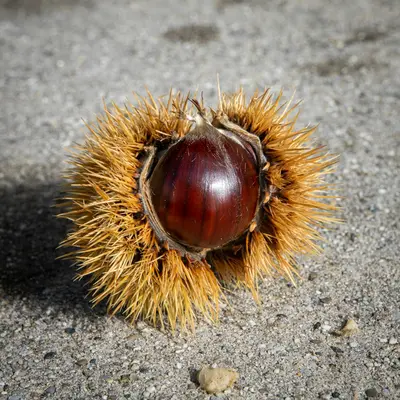
A remarkable hybrid chestnut that produces exceptionally large nuts rivaling the famous European chestnuts while maintaining blight resistance from its Japanese heritage. Bouche de Betizac yields nuts so large they're often called 'marrons' and are prized for roasting, with a sweet, creamy texture that's perfect for holiday traditions. This vigorous tree combines the best qualities of both parent species, making it ideal for home orchards seeking premium chestnuts.
Harvest
120-150d
Days to harvest
Sun
Full sun
Zones
5–7
USDA hardiness
Height
80-100 feet
Planting Timeline
Showing dates for Chestnut (Bouche de Betizac) in USDA Zone 7
All Zone 7 nut-tree →Zone Map
Click a state to update dates
Chestnut (Bouche de Betizac) · Zones 5–7
Growing Details
Complete Growing Guide
This hybrid requires cross-pollination for optimal nut set, so plant at least two compatible chestnut varieties nearby rather than relying on a single tree. Bouche de Betizac thrives in well-draining soil with pH 5.5–7.0 and needs full sun with protection from harsh winds that can damage developing catkins. While the Japanese parentage provides strong blight resistance, monitor for chestnut weevil damage in late summer by collecting and destroying fallen nuts promptly. This cultivar's vigorous growth habit means it needs structural pruning in its first five years to develop a strong central leader; without early intervention, it tends toward multiple competing stems. Plant in early spring in cool climates to establish roots before summer stress, and provide consistent moisture during the first two growing seasons to encourage establishment.
Light: Full sun (6 or more hours of direct sunlight a day). Soil: Clay, Loam (Silt), Sand. Soil pH: Acid (<6.0), Neutral (6.0-8.0). Drainage: Good Drainage. Height: 80 ft. 0 in. - 100 ft. 0 in.. Spread: 30 ft. 0 in. - 50 ft. 0 in.. Spacing: more than 60 feet. Growth rate: Medium. Maintenance: High. Propagation: Seed. Regions: Mountains, Piedmont.
Harvesting
Bouche de Betizac chestnuts reach peak harvest readiness when the spiky burrs turn from green to golden-brown and begin splitting naturally along the seams, revealing glossy, mahogany-colored nuts inside. The nuts themselves should feel heavy and firm with minimal give when gently squeezed. Rather than a single harvest, these trees produce nuts over a 2-3 week window as burrs mature progressively, so multiple collection passes through late September and October yield the best results. Time your main harvest for early morning after light frost, as cooler temperatures cause burrs to open more readily and nuts separate cleanly from their shells, making collection more efficient and reducing splitting damage.
Edible fruit in the form of nuts held in spiny protective husks called cupules. This prickly outer layer deters squirrels and other seed predators from getting to the nuts within them, before they are shed in October.
Type: Nut.
Harvest time: Fall
Edibility: Once a staple food in Europe but now enjoyed as a delicacy. Historically, chestnuts were ground into flour or coarse meal.
Storage & Preservation
Store freshly harvested Bouche de Betizac chestnuts in a cool, humid environment between 32–50°F with 85–90% relative humidity; burlap sacks or mesh bags work well to allow air circulation. Under these conditions, nuts remain fresh for 2–4 weeks. For longer storage, cure them first by spreading in a single layer at 50–60°F for 7–10 days to reduce moisture slightly, then pack in slightly damp sand or peat moss in sealed containers at 35–40°F, where they'll keep 2–3 months.
Freezing is highly effective: blanch whole nuts briefly, shell and peel if desired, then freeze in airtight containers for up to eight months. Drying works too—shell, halve, and dry in a warm, low-humidity space until brittle. This variety's creamy texture makes it particularly suited to candying; simmer shelled nuts in sugar syrup and dry for a shelf-stable confection lasting several months in an airtight jar.
History & Origin
A hybrid selection combining European chestnut (Castanea sativa) with Japanese chestnut (C. crenata), Bouche de Betizac emerged from French breeding traditions focused on producing large nuts while incorporating blight resistance from Asian genetic lines. The variety name reflects French horticultural heritage, though detailed documentation of its specific breeder and introduction date remains limited in English-language sources. The cultivar represents the broader mid-to-late 20th-century breeding efforts by European nurseries to develop chestnut varieties that could withstand disease pressures while maintaining the large nut size and sweet flavor prized in European markets. Its establishment in home orchards demonstrates the practical success of this hybridization approach.
Origin: Western Asia and Southeastern Europe.
Advantages
- +Exceptionally large nuts rival premium European chestnuts for market appeal
- +Hybrid vigor ensures vigorous growth and reliable production in home orchards
- +Blight resistance from Japanese parentage solves major chestnut cultivation problems
- +Sweet, creamy texture makes nuts ideal for roasting and holiday traditions
- +Combines European nut quality with Asian disease resistance for best traits
Considerations
- -Susceptible to chestnut weevil and gall wasp requiring active pest management
- -Requires moderate care and knowledge to prevent root rot and ink disease
- -Needs cross-pollination with compatible chestnut variety for reliable nut set
Companion Plants
Comfrey is the most useful plant you can establish under a chestnut. Its taproot reaches 6 feet or more, pulling calcium and potassium up from below the chestnut's primary feeding zone. Cut it back a few times a season and leave the leaves in place — that mineral load breaks down right where the surface roots can use it. Clover and fescue grass make a practical living mulch between trees: clover fixes nitrogen at roughly 80–200 lbs per acre per year, and fescue holds the soil without pushing aggressively into the root zone. Daffodils planted around the drip line deter voles and other burrowing rodents that cache fallen nuts and rarely come back for them. Yarrow and wild bergamot attract parasitic wasps and predatory beetles that prey on chestnut weevil at various life stages.
Black walnut needs 50–60 feet of clearance at minimum. Juglone — the compound black walnut exudes through its roots and decomposing leaf litter — is well documented as toxic to many broadleaf trees, and chestnuts are not an exception. Pine trees are a subtler problem: their needle drop acidifies the soil over time, and if your pH dips below 5.5, you're creating conditions that favor Phytophthora root rot. Eucalyptus has its own allelopathic compounds and brings no practical benefit to a chestnut planting.
Plant Together
Comfrey
Deep roots bring nutrients to surface, provides mulch and improves soil structure
Clover
Fixes nitrogen in soil, provides ground cover and prevents erosion
Daffodils
Deters rodents and deer that may damage chestnut roots and bark
Lavender
Attracts beneficial pollinators and repels harmful insects
Yarrow
Accumulates potassium and phosphorus, attracts beneficial insects
Wild Bergamot
Attracts native pollinators essential for chestnut flower pollination
Elderberry
Compatible understory plant that attracts beneficial insects and birds
Fescue Grass
Provides erosion control without competing heavily for nutrients
Keep Apart
Black Walnut
Produces juglone toxin that inhibits growth and can kill chestnut trees
Pine Trees
Acidifies soil excessively and competes for similar nutrients
Eucalyptus
Allelopathic compounds inhibit growth of nearby trees and plants
Nutrition Facts
Per 100g serving. % Daily Value based on 2,000 calorie diet. Source: USDA FoodData Central (FDC #170575)
Pests & Disease Resistance
Resistance
Excellent resistance to chestnut blight
Common Pests
Chestnut weevil, gall wasp, aphids, scale insects
Diseases
Root rot, ink disease, twig cankers (rare)
Troubleshooting Chestnut (Bouche de Betizac)
What you'll see, why it happens, and what to do about it.
Small, round holes drilled into harvested nuts; grubs found inside
Likely Causes
- Chestnut weevil (Curculio spp.) — adult females puncture developing nuts in late summer to lay eggs
- Late harvest leaving nuts on the ground too long, giving larvae time to exit and overwinter in soil
What to Do
- 1.Harvest nuts within 2–3 days of drop; don't let them sit on the ground
- 2.Hot-water treat harvested nuts at 120°F for 30 minutes to kill any eggs or larvae inside before storage
- 3.In badly infested orchards, apply beneficial nematodes (Steinernema carpocapsae) to the soil under the canopy in early spring to target overwintering larvae
Galls — small, round, spiky structures — appearing on buds, shoots, or leaves in spring
Likely Causes
- Chestnut gall wasp (Dryocosmus kuriphilus) — an invasive pest that lays eggs in buds the previous summer; galls form when eggs hatch in spring
- Bouche de Betizac has moderate susceptibility compared to some other hybrids, but is not immune
What to Do
- 1.Prune out and destroy galled shoots in early spring before adult wasps emerge — typically before May
- 2.Check with your county extension office about availability of Torymus sinensis, a biological control parasitoid released in some states
- 3.Don't move wood or plant material from infested sites; gall wasp spreads that way
Leaves wilting and yellowing on one or more branches; dark discoloration in the wood just below the bark at the root crown
Likely Causes
- Ink disease (Phytophthora cinnamomi or P. cambivora) — a water-mold pathogen that attacks roots and the root crown, most destructive in poorly drained or compacted soils
- Planting in a low spot or clay-heavy site where water pools after rain
What to Do
- 1.Do not plant Bouche de Betizac anywhere water pools for more than 30 minutes after rain — the pathogen thrives in saturated soil
- 2.If ink disease is confirmed, improve drainage around the root zone immediately; there is no curative fungicide for established infections
- 3.Remove and destroy severely affected trees; hold off replanting chestnuts in that spot for at least 5 years
Sticky residue on leaves and branches; black sooty mold coating leaf surfaces later in the season
Likely Causes
- Aphid colonies (often woolly or brown soft-bodied aphids) feeding on new growth and excreting honeydew
- Scale insects (armored or soft scale species) doing the same on bark and stems
- Sooty mold (Capnodium spp.) is secondary — it colonizes the honeydew, not the plant tissue directly
What to Do
- 1.Knock aphid colonies off young shoots with a firm stream of water; repeat every 3–4 days for two weeks
- 2.Apply horticultural oil at a 2% dilution to affected branches in early spring before bud break to smother overwintering scale
- 3.Encourage or introduce ladybugs and lacewings — they'll work through an aphid population faster than any spray
Frequently Asked Questions
How long does it take Bouche de Betizac chestnuts to mature?▼
Is Bouche de Betizac a good chestnut variety for beginners?▼
What do Bouche de Betizac chestnuts taste like?▼
Can I grow Bouche de Betizac in a container?▼
When should I plant Bouche de Betizac chestnuts?▼
What pests affect Bouche de Betizac chestnuts?▼
Zone-by-Zone Planting Calendar
Growing Guides from Wind River Greens
Sources & References
External authority sources used in compiling this guide.
- ExtensionNC State Extension
- USDAUSDA FoodData Central
See the Methodology page for how this data is sourced, what's AI-assisted, and known limitations.