Tommy Atkins Mango
Mangifera indica 'Tommy Atkins'
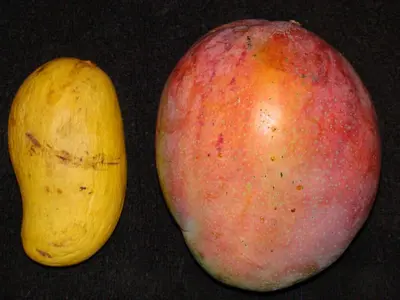
The most widely recognized mango variety in North America, prized for its reliable production and excellent shipping qualities. This vigorous grower produces large, colorful fruits with a classic mango flavor that appeals to both beginners and mango enthusiasts. Tommy Atkins is the perfect introduction to homegrown tropical fruit with its forgiving nature and consistent harvests.
Harvest
100-130d
Days to harvest
Sun
Full sun
Zones
8–11
USDA hardiness
Height
65 feet
Planting Timeline
Showing dates for Tommy Atkins Mango in USDA Zone 11
All Zone 11 tropical →Zone Map
Click a state to update dates
Tommy Atkins Mango · Zones 8–11
Growing Details
Complete Growing Guide
Mango trees thrive in tropical and subtropical areas. Mature trees can withstand air temperatures as low as 25°F for a few hours with leaf damage, while young trees may be killed at 29-30°F. Plant in full sun in well-drained soil. Mangos adapt to many soil types including light sand and limestone but perform poorly in poorly drained soils. In flood-prone areas, plant on a large mound 2-3 ft high by 4-6 ft in diameter. Water new trees every other day for the first week, then 1-2 times weekly for a couple months. Mature trees do not need frequent watering — overwatering may cause poor quality fruit and trees to decline. Apply fertilizer every 2-3 months for young trees (6-6-6-2 formulation). Mature trees need reduced nitrogen and increased potash (6-3-16 formulation). On calcareous soils, apply annual foliar sprays of copper, zinc, manganese, and boron. Maintain a grass-free area 2-5 ft around trunk. Apply 2-6 inches of mulch, kept 8-12 inches from the trunk. Source: UF/IFAS Extension. Tommy Atkins is a high-vigor Indian-type variety maturing June-July, producing 16-24 oz red-yellow fruit with good production. Moderately resistant to anthracnose. Source: UF/IFAS Extension.
Harvesting
Flowering to maturity takes 100-150 days. Peak production occurs June-July, with fruits generally available May through September. Fruits ripen on the tree but are typically picked when firm and mature. Maturity indicators include: shoulders and nose broaden, slight color development, and flesh near seed changes from white to yellow. Mature fruits ripen 3-8 days after harvest at room temperature. Average yields of 4-6 bushels (220-330 lb) from mature grafted trees. Grafted trees begin bearing in 3-5 years. Source: UF/IFAS Extension. Tommy Atkins produces 16-24 oz fruit, maturing June-July. Source: UF/IFAS Extension.
Storage & Preservation
The best temperatures for ripening mangos are 70-75°F. Higher temperatures cause shriveling and off-flavors. Refrigerate only after ripening — chilling unripe fruit causes brown/gray discoloration, pitting, uneven ripening, and off-flavors. Source: UF/IFAS Extension.
History & Origin
Mangos originated in the Indo-Burma region and have been cultivated in India for over 4,000 years. They reached Florida in 1833 at Cape Sable. Indian-type mangos (monoembryonic seeds, highly colored, anthracnose-susceptible) include Haden, Tommy Atkins, and Kent. Indochinese types (polyembryonic seeds, green/yellow, anthracnose-resistant) include Nam Doc Mai and Carabao. Trees are propagated via veneer-grafting, cleft-grafting, or chip-budding. Common rootstocks include 'Turpentine' and unnamed criollo-types. Source: UF/IFAS Extension.
Advantages
- +Adapts to many soil types including sand and limestone
- +Mature trees are drought-tolerant
- +Average yields 220-330 lb per tree
- +Good source of vitamins A, C, B-6, and E
- +Long harvest window (May-September)
Considerations
- -Young trees killed at 29-30°F
- -Susceptible to anthracnose disease (especially Indian types)
- -Overwatering causes fruit quality decline
- -Vigorous varieties need 25-30 ft spacing
- -Severe pruning reduces production for 1+ seasons
Companion Plants
Lemongrass planted around the drip line does real work — its volatile oils confuse thrips and fruit flies at close range, and it stays low enough (3–5 feet) that it doesn't compete with the canopy. Marigolds (Tagetes erecta) fill a similar role at ground level. Comfrey is worth planting on the south side of the tree: its taproot pulls calcium and potassium up from 6 feet down, and when you cut it back every few weeks it drops that material as surface mulch. That's a meaningful input on a tree that takes 3–5 years to hit first fruit and needs consistent nutrition to get there.
Black walnut is the one to keep off the property entirely if you can — it produces juglone, a compound that leaches through the soil and interferes with root function in many species. Eucalyptus and pine are a different problem: both shed allelopathic litter that acidifies the soil fast, and a Tommy Atkins already wants pH between 5.5 and 7.5. Around here in the southeast, where pine trees are everywhere along fence lines, that's a more practical concern than most people expect.
Plant Together
Coconut Palm
Creates beneficial microclimate, shares similar water needs, and provides wind protection
Papaya
Compatible root systems and growth habits, attracts beneficial insects
Lemongrass
Repels mosquitoes and other pests, aromatic deterrent for insects
Marigold
Repels nematodes and aphids, attracts beneficial predatory insects
Comfrey
Deep taproot brings nutrients to surface, excellent mulch and compost material
Banana
Provides windbreak and shade, creates humid microclimate mangoes prefer
Sweet Potato
Ground cover that suppresses weeds, fixes nitrogen, compatible shallow roots
Moringa
Attracts pollinators, provides wind protection, minimal root competition
Keep Apart
Black Walnut
Produces juglone which is toxic to mango trees and inhibits root development
Eucalyptus
Allelopathic compounds inhibit growth, competes aggressively for water and nutrients
Pine Trees
Acidifies soil through needle drop, mango prefers neutral to slightly alkaline conditions
Nutrition Facts
Per 100g serving. % Daily Value based on 2,000 calorie diet. Source: USDA FoodData Central (FDC #169910)
Pests & Disease Resistance
Resistance
Good resistance to anthracnose and bacterial black spot
Common Pests
Mango seed weevil, scale insects, thrips, fruit flies
Diseases
Anthracnose, powdery mildew, bacterial black spot
Troubleshooting Tommy Atkins Mango
What you'll see, why it happens, and what to do about it.
Dark, sunken black lesions on fruit skin and brown tip dieback on young leaves and flowers
Likely Causes
- Anthracnose (Colletotrichum gloeosporioides) — a fungal disease that thrives in humid conditions and overwinters in dead plant tissue
- Poor airflow through the canopy on a densely branched tree
What to Do
- 1.Prune out dead and crossing branches to open the canopy — on a 65-foot tree you'll need a pole saw or an arborist for the upper third
- 2.Apply copper-based fungicide at bloom and again 14 days later; repeat after heavy rain
- 3.Rake and dispose of fallen fruit and leaf litter — don't compost it
White powdery coating on new shoots, flower panicles, and young fruitlets, often appearing in late winter or early spring
Likely Causes
- Powdery mildew (Oidium mangiferae) — spores spread during dry, warm days with cool nights, typically when daytime temps sit between 68–77°F
- Flush of tender new growth during flowering, which is highly susceptible
What to Do
- 1.Spray sulfur-based fungicide on affected shoots and panicles; apply in the early morning so the sulfur doesn't burn foliage in afternoon heat
- 2.Avoid overhead irrigation during flowering — switch to drip or basin watering to keep foliage dry
- 3.Time fertilizer applications to avoid pushing excessive tender growth right before bloom
Sticky residue on leaves and fruit with clusters of small armored bumps on stems and leaf undersides
Likely Causes
- Scale insects (commonly mango scale, Aulacaspis tubercularis) — they pierce the bark and secrete honeydew, which then feeds sooty mold
- Ant activity around the tree, which actively shields scale colonies from beneficial predators like parasitic wasps
What to Do
- 1.Scrub light infestations off stems with a soft brush dipped in diluted neem oil (2 tablespoons neem per gallon of water)
- 2.Apply horticultural oil at a 2% dilution in cooler morning temperatures, covering stems and leaf undersides thoroughly
- 3.Wrap the trunk at about 3 feet high with a sticky barrier (Tanglefoot or similar) to cut off ant access to the canopy
Frequently Asked Questions
How long does it take Tommy Atkins mango to produce fruit?▼
Is Tommy Atkins mango good for beginners?▼
Can you grow Tommy Atkins mango in containers?▼
What does Tommy Atkins mango taste like?▼
How much sun does Tommy Atkins mango need?▼
What pests affect Tommy Atkins mango trees?▼
Zone-by-Zone Planting Calendar
Growing Guides from Wind River Greens
Sources & References
External authority sources used in compiling this guide.
See the Methodology page for how this data is sourced, what's AI-assisted, and known limitations.