Pink Pokers
Limonium suworowii
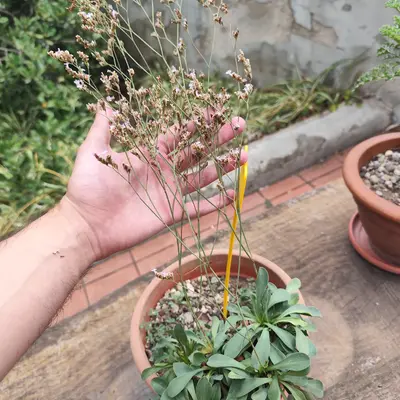
Whimsical and wild statice looks to be a thing of fairytales or a sea-dwelling creature. Compared to L. sinuatum types, this statice has a very different look but is also earlier and easier to harvest. Plants have mostly basal leaves, which makes the stems easy to locate for cutting, and there are almost no leaves to strip away. Low-growing plants produced 2-3 flushes of harvestable stems in our trials. Excellent for dried flowers or fresh cuts. Flowers dry beautifully, holding their color well. Early statice. Also commonly known as Russian statice and rat tail statice.
Harvest
80-95d
Days to harvest
Sun
Full sun
Zones
4–9
USDA hardiness
Height
18-24 inches
Planting Timeline
Showing dates for Pink Pokers in USDA Zone 7
All Zone 7 flower →Zone Map
Click a state to update dates
Pink Pokers · Zones 4–9
Growing Details
Succession Planting
Pink Pokers is a warm-season annual that blooms once per plant — it doesn't keep flushing new spikes the way a cut-and-come-again zinnia does, so staggered sowings are worth doing if you want continuous cut flowers through summer. In zone 7, start seeds indoors under lights in late February or early March, then make a second indoor sowing around mid-March for transplanting in early May. That gives you two waves of bloom roughly 3–4 weeks apart, which covers most of your summer vase needs.
Don't push a third sowing past mid-April for zone 7 — transplants that go in after late May are racing against the worst of summer heat, and Pink Pokers started under heat stress tends to bolt to flower fast on short, weak stems without building much basal foliage first. Days to bloom run 80–95 from transplant, so count backward from when you want flowers and give yourself a little buffer.
Complete Growing Guide
Pink Pokers thrives on neglect more than pampering, but a few setup choices will dramatically improve your stem count and quality.
Choose a site with full sun — at least 6 hours, ideally 8 — and excellent drainage. Statice species evolved in Mediterranean and Central Asian steppes, so they resent wet feet. If your soil is heavy clay, build a raised row 4-6 inches high or amend generously with coarse sand and compost. A neutral to slightly alkaline pH (6.5-7.5) suits them best. Skip the rich compost-heavy beds you'd use for tomatoes; overly fertile soil produces lush leaves at the expense of flower spikes.
Start seeds indoors 6-8 weeks before your last frost date. Surface-sow on moist seed-starting mix and press in gently — they need light to germinate. Keep at 65-70°F; expect germination in 10-20 days, sometimes uneven. Don't overwater; damping off is the main seedling threat. Harden off for a week before transplanting outdoors after your last frost, spacing plants 9-12 inches apart in rows 18 inches apart. You can also direct sow once soil reaches 60°F, though indoor starts give you a meaningful head start on that first flush.
At transplanting, water in well, then back off. Pink Pokers prefers consistent but moderate moisture — about an inch per week including rainfall. Overhead watering invites foliar issues; drip or soaker hoses are ideal. A single light feeding of balanced fertilizer (10-10-10 or fish emulsion) about three weeks after transplant is plenty for the season. Heavy nitrogen weakens stems and delays flowering.
No staking is required; the wiry stems are self-supporting. Mulch lightly with straw to suppress weeds and conserve moisture, but keep mulch off the basal crown to prevent rot.
The most common mistake is planting too closely or in shade — both lead to floppy, sparse spikes. The second is overwatering, which causes basal crown rot and can kill plants overnight in humid weather. If you garden in zones 7 and warmer with mild winters, plants may behave as short-lived perennials; in zones 6 and colder, treat as an annual.
To maximize yield, harvest the first flush promptly and consistently. Plants respond by pushing a second and often third flush of stems within 3-4 weeks. Removing spent stems back to the basal rosette signals the plant to keep producing. Avoid letting any flowers go fully to seed mid-season, as that shifts energy away from new spike production.
Harvesting
Harvest Pink Pokers when roughly 50-75% of the tiny florets along a spike have opened — the spike should feel firm and the color fully developed, not pale or papery. Stems cut too early will wilt and fail to dry properly; stems cut too late lose color and shatter. Cut in the cool of early morning after dew has dried, when stems are fully hydrated. Use sharp snips and reach down to the base of each stem, cutting just above the basal rosette. Because foliage is concentrated at the crown, you'll find the stems easy to locate — one of this variety's best traits for cut-flower growers. Strip any incidental lower leaves immediately and place stems in a clean bucket of cool water if using fresh. For drying, you can skip the water and head straight to your drying area. Harvest every 3-5 days during peak flush to encourage continued production.
Storage & Preservation
For fresh use, condition stems in cool water for several hours, then arrange. Pink Pokers holds 7-10 days in a vase with clean water changed every 2-3 days. Refrigerate at 36-40°F for short-term storage if you're staging a market harvest.
Drying is where this variety truly shines. Bundle 8-12 stems with a rubber band (which tightens as stems shrink) and hang upside down in a warm, dark, well-ventilated space — a closet, attic, or barn loft works well. Stems dry fully in 2-3 weeks and retain their pink coloring for a year or more if kept out of direct sunlight. You can also dry them upright in an empty vase for a more naturally curved shape. Avoid silica gel or pressing; air-drying produces the best texture and color retention for this species.
History & Origin
Pink Pokers is a selection of Limonium suworowii (sometimes classified as Psylliostachys suworowii), a species native to the dry steppes and semi-deserts of Central Asia, particularly Iran, Afghanistan, and the former Soviet republics. It was named in honor of Russian botanist Ivan Petrovich Suworow in the 19th century, which is why it's still widely sold as Russian statice. The common name 'rat tail statice' refers to the curving, tapered, fuzzy-textured flower spikes that resemble slender tails — a feature so distinctive it sets the species apart from the more familiar papery clusters of L. sinuatum. Cultivated in European and American flower gardens since the late 1800s, it became a staple of the everlasting flower trade alongside strawflower and globe amaranth. Today it remains a favorite among small-scale cut-flower growers and dried-arrangement designers for its sculptural, almost otherworldly form and reliable color retention.
Advantages
- +Produces 2-3 distinct flushes of harvestable stems per season with prompt cutting
- +Basal-leaf habit means almost no stripping required at harvest — huge time-saver for cut-flower growers
- +Dries beautifully with excellent color retention for over a year
- +Earlier to harvest than L. sinuatum statice types
- +Drought-tolerant once established and thrives in poor, lean soils
- +Distinctive sculptural form that commands attention in bouquets and dried arrangements
- +No staking required despite tall flower spikes
Considerations
- -Highly susceptible to crown rot in heavy or poorly drained soils
- -Germination can be slow and uneven, requiring patience with seed starting
- -Short vase life compared to many cut flowers if not harvested at the right stage
- -Treated as an annual in zones 6 and colder
- -Overhead watering and humid conditions invite foliar problems
Companion Plants
Pink Pokers pairs well with drought-tolerant Mediterranean-style companions because they share the same two core needs: sharp drainage and full sun. Lavender, Russian Sage, and Salvia are the strongest fits — none of them are heavy feeders or big drinkers, so they won't outcompete Pink Pokers for the lean, dry conditions it prefers. Catmint works for the same reason and pulls in parasitic wasps that knock back aphid populations before they get established on your flower spikes. Ornamental grasses and Sedum round out the list safely — grasses won't shade the Limonium at 9–12 inch spacing, and Sedum's shallow roots stay out of the same soil zone entirely.
The harmful companions are a different problem. Black Walnut produces juglone, a root-zone toxin that accumulates in the soil and hits a wide range of plants hard — site Pink Pokers well clear of any walnut canopy. Hostas and Impatiens are the opposite issue: both want consistent moisture and filtered shade, conditions that will rot Pink Pokers out from the crown before midsummer. In our zone 7 Georgia garden, where July humidity already strains drainage in any bed with organic matter, putting this plant next to moisture-lovers accelerates that timeline considerably. Stack the dry-side companions together and you sidestep most of the disease pressure without doing anything else.
Plant Together
Lavender
Attracts pollinators and repels deer, shares similar drought tolerance
Salvia
Complementary bloom times and attracts beneficial insects
Ornamental Grasses
Provides structural contrast and wind protection
Catmint
Repels rodents and rabbits while attracting pollinators
Sedum
Similar water requirements and provides late season interest
Echinacea
Attracts butterflies and beneficial insects, similar growing conditions
Russian Sage
Drought tolerant companion with complementary silver foliage
Agapanthus
Similar architectural form and water needs
Keep Apart
Black Walnut
Produces juglone which is toxic to many plants including Red Hot Pokers
Hostas
Requires consistently moist soil while Pink Pokers prefer well-draining conditions
Impatiens
Needs shade and constant moisture, opposite of Pink Poker requirements
Pests & Disease Resistance
Common Pests
Aphids, occasional thrips
Diseases
Crown rot, root rot, botrytis (gray mold) in humid conditions
Troubleshooting Pink Pokers
What you'll see, why it happens, and what to do about it.
Seedlings collapse at soil level, stem looks pinched or water-soaked just below the crown
Likely Causes
- Damping off — typically Pythium or Rhizoctonia fungi thriving in cold, wet, poorly drained seedling mix
- Overwatering during germination, which Pink Pokers is particularly sensitive to given its drought-tolerant nature
What to Do
- 1.Toss the affected seedlings — there's no saving them once the stem collapses
- 2.Switch to a well-draining seed-starting mix and water only when the top half-inch is dry
- 3.Bottom-water your trays instead of overhead watering to keep the crown and stem dry
Established plant crown turns brown and mushy at soil level, lower leaves yellowing and dying, plant pulls out of the ground too easily
Likely Causes
- Crown rot or root rot — usually Phytophthora or Fusarium — almost always triggered by heavy clay soil or overwatering
- Planting too deep so the crown sits below the soil line and stays wet
What to Do
- 1.Pull the plant — crown rot at this stage won't reverse, and leaving it spreads the pathogen to neighbors
- 2.Amend your bed with coarse sand or perlite before replanting; Pink Pokers needs drainage first, fertility second
- 3.Set transplants so the crown sits right at or just above the soil surface, never below it
Flower spikes and buds covered in gray fuzzy coating, stems going soft and brown in humid weather
Likely Causes
- Botrytis cinerea (gray mold) — spores land on spent flowers and move fast in humid, still air above 70°F
- Plants crowded closer than 9 inches, blocking airflow through the foliage
What to Do
- 1.Remove and bag infected flower spikes immediately — don't compost them
- 2.Cut back any spent blooms before they sit on the plant and give Botrytis a foothold
- 3.Space plants at a full 12 inches if your site tends to stay humid; airflow does more work here than any spray
Leaves and flower stems stippled with tiny pale flecks, sticky residue on foliage, small clusters of soft-bodied insects visible on new growth
Likely Causes
- Aphids — most commonly green peach aphid (Myzus persicae) or melon aphid (Aphis gossypii), both common on ornamentals in warm weather
- Occasional thrips feeding, which produces similar silvery stippling but without the sticky honeydew
What to Do
- 1.Knock aphids off with a firm stream of water from a hose — do it in the morning so the foliage dries by evening
- 2.If populations persist after 3–4 days, apply insecticidal soap directly to the colonies, covering undersides of leaves
- 3.Check for ants farming the aphid colonies; if ants are present, use a sticky barrier around stems to break that cycle
Frequently Asked Questions
How long does Pink Pokers statice take to grow?▼
Is Pink Pokers good for beginners?▼
Can you grow Pink Pokers in containers?▼
How do you dry Pink Pokers statice?▼
What is the difference between Pink Pokers and regular statice?▼
When should I plant Pink Pokers seeds?▼
Zone-by-Zone Planting Calendar
| Zone | Indoor Start | Transplant | Direct Sow | Harvest |
|---|---|---|---|---|
| Zone 1 | May – June | July – August | July – September | — |
| Zone 2 | April – May | June – July | June – August | — |
| Zone 11 | January – January | January – February | January – March | — |
| Zone 12 | January – January | January – February | January – March | — |
| Zone 13 | January – January | January – February | January – March | — |
| Zone 3 | April – May | June – July | June – August | — |
| Zone 4 | March – April | June – June | June – July | — |
| Zone 5 | March – April | May – June | May – July | — |
| Zone 6 | March – April | May – June | May – July | — |
| Zone 7 | February – March | April – May | April – June | — |
| Zone 8 | February – March | April – May | April – June | — |
| Zone 9 | January – February | March – April | March – May | — |
| Zone 10 | January – January | February – March | February – April | — |
Growing Guides from Wind River Greens
Sources & References
External authority sources used in compiling this guide.
- ExtensionNC State Extension
- BreederJohnny's Selected Seeds
See the Methodology page for how this data is sourced, what's AI-assisted, and known limitations.