Mountain Snow
Euphorbia marginata
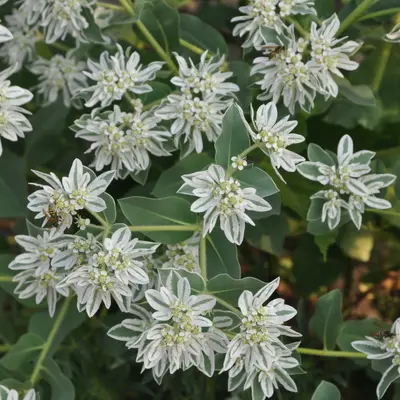
Pure white bracts contrast well with green foliage. Foliage variegation occurs when days begin to shorten. Strong stems. Long vase life.
Harvest
110-120d
Days to harvest
Sun
Full sun to partial shade
Zones
2–11
USDA hardiness
Height
1-3 feet
Planting Timeline
Showing dates for Mountain Snow in USDA Zone 7
All Zone 7 flower →Zone Map
Click a state to update dates
Mountain Snow · Zones 2–11
Growing Details
Succession Planting
Mountain Snow is a warm-season annual grown primarily for its foliage, and a single direct sowing gives you most of the display you're going to get — it doesn't produce a cut-and-come-again crop the way basil or lettuce does. If you want a staggered show for cutting or mixed borders, direct sow a first round in April and a second in late May to early June, roughly 4–6 weeks apart. Plants reach ornamental maturity around 110–120 days, so a May sowing carries into September without trouble.
Don't push a third sowing past mid-June in most climates. Seeds need soil temps above 65°F to germinate reliably, but plants started too late won't have time to develop before first frost. Two rounds is enough.
Complete Growing Guide
Light: Full sun (6 or more hours of direct sunlight a day), Partial Shade (Direct sunlight only part of the day, 2-6 hours). Soil: Clay, Loam (Silt), Sand, Shallow Rocky. Soil pH: Acid (<6.0), Alkaline (>8.0), Neutral (6.0-8.0). Drainage: Good Drainage, Occasionally Dry. Height: 1 ft. 0 in. - 3 ft. 0 in.. Spread: 1 ft. 0 in. - 2 ft. 0 in.. Spacing: 12 inches-3 feet. Growth rate: Medium. Maintenance: Low. Propagation: Seed. Regions: Coastal, Mountains, Piedmont.
Harvesting
The fruit is three-parted capsule that measures 6-8 mm across and is round to egg-shaped. It is covered with dense white hairs. The capsule is green that matures to dark gray and contains three ridged seeds that measure 3-4 mm long.
Color: Gray/Silver, Green. Type: Capsule. Length: < 1 inch. Width: < 1 inch.
Storage & Preservation
Mountain Snow flowers are best stored in a cool environment to maximize vase life. Keep fresh-cut stems in a clean vase with room-temperature water in a cool room away from direct sunlight and ripening fruit. Maintain water temperature around 65-70°F with moderate humidity for optimal longevity. The flowers can last 7-14 days in a vase with regular water changes. For preservation, air-dry complete stems in a dark, well-ventilated space; press individual bracts between heavy books for botanical preservation; or freeze-dry for longer-term storage of the distinctive white bracts.
History & Origin
Origin: West Central & Central U.S.A. to East & South Mexico
Advantages
- +Attracts: Bees, Butterflies
- +Low maintenance
Considerations
- -Toxic (Bark, Flowers, Fruits, Leaves, Roots, Seeds, Stems): Low severity
- -Causes contact dermatitis
Companion Plants
The herbaceous companions that work best with Mountain Snow are ones that attract beneficial insects without competing hard for water or light. Marigolds (Tagetes spp.) planted 12–18 inches away draw in hoverflies and parasitic wasps that keep soft-bodied pests in check — and their root secretions suppress certain soil nematodes. Sweet Alyssum is another solid choice; it blooms fast, stays low, and feeds predatory insects across a long season without shading Mountain Snow's base. Yarrow pulls similar duty and tolerates the same dry-to-moderate moisture conditions, so you're not fighting yourself over irrigation.
Lavender and Rosemary earn their spot on the beneficial list mostly for practical reasons: they share Mountain Snow's preference for sharp drainage and 6-plus hours of sun, so they don't drag the bed in a different cultural direction or introduce new pest pressure. Catmint and Chives are compatible for the same reasons — not doing anything dramatic, just pulling in pollinators without making demands.
The three to keep at a distance are Black Walnut (Juglans nigra), Eucalyptus, and Sunflower. Black Walnut produces juglone, a compound that leaches through soil and inhibits growth in many annuals — stay at least 50–80 feet from the drip line of the trunk, not just the trunk itself. Eucalyptus releases allelopathic oils from its leaves and roots both. Sunflowers also produce allelopathic compounds, particularly from decomposing roots and seed hulls; if a bed ran a heavy sunflower crop last season, give it a year before planting Mountain Snow there.
Plant Together
Lavender
Attracts beneficial pollinators and repels pests with aromatic oils
Marigold
Deters nematodes and aphids while attracting beneficial insects
Catmint
Repels ants, aphids, and rodents while attracting pollinators
Sweet Alyssum
Attracts beneficial insects and provides ground cover protection
Rosemary
Deters cabbage moths, carrot flies, and other pests with strong scent
Nasturtium
Acts as trap crop for aphids and cucumber beetles
Yarrow
Improves soil health and attracts predatory insects
Chives
Repels aphids and Japanese beetles with sulfur compounds
Keep Apart
Black Walnut
Produces juglone toxin that inhibits growth of many flowering plants
Eucalyptus
Releases allelopathic chemicals that suppress nearby plant growth
Sunflower
Competes aggressively for nutrients and may release growth-inhibiting compounds
Troubleshooting Mountain Snow
What you'll see, why it happens, and what to do about it.
Stems and leaves wilting or rotting at the soil line, especially after a wet stretch
Likely Causes
- Root rot from Pythium or Rhizoctonia — both thrive when soil stays waterlogged
- Planting too deep or in low spots where water pools after rain
What to Do
- 1.Pull the affected plant — it won't recover once the crown is gone — and improve drainage before replanting
- 2.Work in coarse compost or perlite to loosen compacted beds; Mountain Snow does not want wet feet
- 3.Space plants at least 12 inches apart so air moves through the base
White, powdery coating spreading across upper leaf surfaces in midsummer heat
Likely Causes
- Powdery mildew (Erysiphe euphorbiarum) — common on Euphorbia in humid conditions with poor airflow
- Overcrowding or planting against a wall that traps moisture overnight
What to Do
- 1.Strip and bin the worst-affected leaves; don't compost them
- 2.Spray with a diluted neem oil solution (2 tsp per quart of water) every 7 days until symptoms stop spreading
- 3.Next season, give plants the full 18-inch spacing and skip overhead irrigation after 4 p.m.
Frequently Asked Questions
How long does Mountain Snow last in a vase?▼
Is Mountain Snow a good choice for beginner flower growers?▼
Can you grow Mountain Snow in containers?▼
When should I plant Mountain Snow flowers?▼
What makes Mountain Snow's white bracts stand out in the garden?▼
How do I encourage the foliage variegation in Mountain Snow?▼
Zone-by-Zone Planting Calendar
| Zone | Indoor Start | Transplant | Direct Sow | Harvest |
|---|---|---|---|---|
| Zone 3 | April – May | June – July | June – August | — |
| Zone 4 | March – April | June – June | June – July | — |
| Zone 5 | March – April | May – June | May – July | — |
| Zone 6 | March – April | May – June | May – July | — |
| Zone 7 | February – March | April – May | April – June | — |
| Zone 8 | February – March | April – May | April – June | — |
| Zone 9 | January – February | March – April | March – May | — |
| Zone 10 | January – January | February – March | February – April | — |
| Zone 1 | May – June | July – August | July – September | — |
| Zone 2 | April – May | June – July | June – August | — |
| Zone 11 | January – January | January – February | January – March | — |
| Zone 12 | January – January | January – February | January – March | — |
| Zone 13 | January – January | January – February | January – March | — |
Growing Guides from Wind River Greens
Sources & References
External authority sources used in compiling this guide.
- ExtensionNC State Extension
- BreederJohnny's Selected Seeds
See the Methodology page for how this data is sourced, what's AI-assisted, and known limitations.