Listada de Gandia
Solanum melongena 'Listada de Gandia'
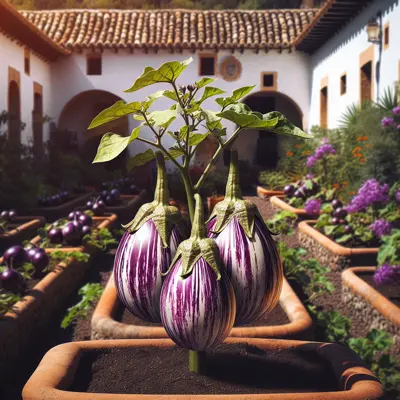
This stunning Spanish heirloom showcases purple and white striped fruits that look almost too beautiful to eat. The oval fruits have incredibly creamy flesh with a mild, sweet flavor and the eye-catching striped pattern makes them conversation starters in any garden. A productive variety that brings both beauty and exceptional taste to the kitchen.
Harvest
75-85d
Days to harvest
Sun
Full sun
Zones
9–12
USDA hardiness
Height
2-4 feet
Planting Timeline
Showing dates for Listada de Gandia in USDA Zone 7
All Zone 7 eggplant →Zone Map
Click a state to update dates
Listada de Gandia · Zones 9–12
Growing Details
Succession Planting
Listada de Gandia is a single-season fruiting crop — once a plant is in the ground and producing, it keeps going until frost or disease takes it. There's no meaningful cadence to stagger. Start seeds indoors 8–10 weeks before your last frost date, transplant once soil temps are reliably above 60°F, and that's your window for the year.
The one succession-adjacent move worth making: if your summers run long, start a second flat of seeds 4–6 weeks after your first transplant date. If your first planting gets hit with bacterial wilt or a bad flea beetle year, you'll have backup transplants ready rather than losing the whole season.
Complete Growing Guide
This heirloom demands warmth more insistently than standard eggplant varieties—start seeds 8–10 weeks before your last frost and don't transplant until soil reaches 70°F, as Listada de Gandia struggles significantly in cool conditions and will stall rather than establish. Plant in full sun with consistently warm, well-draining soil enriched with compost, maintaining even moisture to prevent the stress that triggers premature flowering and smaller striped fruits. This cultivar shows particular susceptibility to spider mites in hot, dry environments, so monitor leaf undersides closely and increase humidity through strategic watering or overhead misting early in the day. The plants tend toward moderate vigor rather than vigorous growth, so avoid aggressive pruning—instead, remove only lower leaves and non-productive suckers to improve air circulation. One essential practice: harvest fruits when the skin still has a slight give to pressure and the stripes remain vivid, as waiting for full firmness results in seedy, less creamy flesh that compromises the variety's signature mild, sweet character.
Light: Full sun (6 or more hours of direct sunlight a day). Soil: Loam (Silt), Sand. Soil pH: Acid (<6.0). Drainage: Good Drainage, Moist. Height: 2 ft. 0 in. - 4 ft. 0 in.. Spread: 1 ft. 0 in. - 3 ft. 0 in.. Spacing: 3 feet-6 feet. Growth rate: Medium. Maintenance: Medium. Propagation: Seed.
Harvesting
Harvest Listada de Gandia eggplants when the striped pattern becomes vivid and distinct, the skin develops a subtle glossy sheen, and fruits reach 4 to 6 inches in length. Gently squeeze the eggplant—ripe fruits yield slightly to pressure but spring back, indicating tender, creamy flesh inside. Rather than waiting for a single mature harvest, pick fruits continuously as they reach peak size, which encourages the plant to produce more blooms throughout the season. Harvest in the early morning when temperatures are cooler, as this preserves the fruit's firmness and flavor quality during transport and storage.
The fruit is a berry that is egg-shaped, smooth and has glossy skin. The fruit may measure 4 to 8 inches long. It ranges in color from green to white, to purple-black when immature and when it should be eaten. As the fruit matures it gets stringy and bitter. Fruit contains numerous small, flat, pale yellow to brown seeds.
Color: Black, Gold/Yellow, Green, Purple/Lavender, White. Type: Berry. Length: > 3 inches.
Garden value: Edible, Showy
Harvest time: Fall, Summer
Edibility: The immature fruit is edible and best used in food preparation. As the fruit matures, it becomes stringy and bitter. The fruits are usually cooked and served as a vegetable. They may be prepared and eaten by frying, steaming, grilling, roasting, or stewing. They may also be stir-fried, pickled, stuffed, and fried with a light breading.
Storage & Preservation
Fresh Listada de Gandia eggplants store best at room temperature for 2-3 days or refrigerated for up to one week. Wrap individually in paper towels and store in the crisper drawer—plastic bags cause condensation and rapid deterioration. Unlike many vegetables, eggplants are sensitive to cold and develop brown spots when stored below 50°F.
For longer preservation, slice and salt eggplant for 30 minutes to draw out moisture, then freeze the salted, drained slices on baking sheets before transferring to freezer bags. This method preserves texture better than freezing fresh. Alternatively, roast or grill slices until tender, then freeze in portions perfect for adding to winter stews and sauces.
Pickling is excellent for this striped variety—the beautiful pattern remains visible in the jar. Cut into spears, salt briefly, then pack in vinegar brine with garlic and herbs for Mediterranean-style preserved eggplant that keeps for months.
History & Origin
This Spanish heirloom originates from the Gandia region of Valencia, where it has been cultivated for generations as part of the region's rich eggplant-growing tradition. While specific breeder names and introduction dates are not well documented in readily available sources, "Listada de Gandia" represents a heritage variety preserved and maintained through traditional seed-saving practices among Spanish gardeners and local farmers. The variety's distinctive striped phenotype and creamy texture suggest careful selection over many cultivation cycles, though detailed breeding records from its development have not been widely published in modern agricultural literature. It has been perpetuated primarily through seed companies and heritage seed organizations that specialize in preserving Mediterranean and Spanish heirloom vegetables.
Origin: China South-Central, Laos, Malaya, Myanmar, Thailand, Vietnam
Advantages
- +Stunning purple and white striped fruits are visually striking conversation starters
- +Mild, sweet, creamy flesh with zero bitterness appeals to diverse palates
- +Moderate difficulty makes it accessible for intermediate gardeners seeking heirloom varieties
- +Productive variety yields abundant striped fruits within 75-85 days
- +Beautiful ornamental appearance adds aesthetic value beyond culinary use
Considerations
- -Vulnerable to multiple pests including flea beetles, spider mites, and whiteflies
- -Susceptible to serious diseases like bacterial wilt and anthracnose infections
- -Requires consistent warm temperatures and careful disease management throughout season
Companion Plants
Basil is the standard pairing here, and the volatile compounds it produces — linalool and estragole — are thought to confuse thrips and aphids before they land. Whether that effect is as strong as claimed is debatable, but a row of basil every 4–5 feet between eggplants costs nothing. French marigolds (Tagetes patula) are the more defensible choice: their root secretions suppress soil nematodes, and their flowers pull in parasitic wasps that hit whitefly larvae hard. Nasturtiums work as a trap crop for aphids — the colonies pile onto the nasturtium flowers where you can spot and remove them in one pass rather than hunting across the whole bed.
Keep fennel well away from this planting. It produces allelopathic compounds that stunt most vegetables within 18–24 inches, and eggplant is no exception. Black walnut is a harder problem — the roots release juglone, which is toxic to Solanaceae at concentrations that can extend 50–60 feet from the trunk. If walnut trees are on your property, don't try to work around it; plant somewhere else entirely.
Plant Together
Basil
Repels aphids, spider mites, and hornworms while potentially improving eggplant flavor
Tomatoes
Share similar growing conditions and pest management strategies as fellow nightshades
Peppers
Compatible nightshade family members with similar nutrient and water requirements
Marigolds
Repel nematodes, aphids, and whiteflies while attracting beneficial insects
Oregano
Deters aphids, spider mites, and cabbage moths with its strong aromatic oils
Thyme
Repels hornworms, whiteflies, and flea beetles while attracting pollinators
Hot Peppers
Natural pest deterrent that repels aphids and other soft-bodied insects
Nasturtiums
Act as trap crop for aphids and cucumber beetles while repelling whiteflies
Keep Apart
Black Walnut
Produces juglone toxin that severely stunts or kills eggplants and other nightshades
Fennel
Releases allelopathic compounds that inhibit growth of most vegetables including eggplant
Corn
Competes heavily for nutrients and attracts corn earworms that also damage eggplant
Nutrition Facts
Per 100g serving. % Daily Value based on 2,000 calorie diet. Source: USDA FoodData Central (FDC #169228)
Pests & Disease Resistance
Resistance
Moderate disease resistance typical of heirloom varieties
Common Pests
Flea beetles, spider mites, whiteflies, Colorado potato beetle
Diseases
Bacterial wilt, phomopsis blight, anthracnose
Troubleshooting Listada de Gandia
What you'll see, why it happens, and what to do about it.
Tiny round holes scattered across young leaves, especially on seedlings and newly transplanted starts
Likely Causes
- Flea beetles (Epitrix spp.) — adults overwinter in soil and debris, jump to tender foliage immediately after transplant
- Plants stressed from transplant shock, making them slower to outgrow the damage
What to Do
- 1.Cover transplants with row cover for the first 2–3 weeks after setting out — flea beetles can't do much if they can't land
- 2.Apply a thick layer of straw mulch around the base; it disrupts the beetles' movement from soil to plant
- 3.Once plants hit 18 inches and are actively growing, most will outpace flea beetle damage without intervention
Plant wilts suddenly during the day, doesn't recover overnight, and collapses within a few days — no visible rot on stem or leaves
Likely Causes
- Bacterial wilt (Ralstonia solanacearum) — soil-borne, spreads via infected soil, water, and contaminated tools
- Colorado potato beetle feeding damage that weakened the plant, making it more susceptible to secondary infection
What to Do
- 1.Dig up and destroy the affected plant including as much root mass as possible — do not compost it
- 2.Per NC State Extension guidance, Ralstonia solanacearum persists in soil for years, so rotate that bed out of all nightshades (tomatoes, peppers, potatoes) for at least 3 seasons
- 3.Disinfect any tools that touched the infected plant with a 10% bleach solution before using them elsewhere
Dark, sunken lesions on fruit — sometimes with concentric rings — appearing as fruit approaches maturity around day 75–85
Likely Causes
- Anthracnose (Colletotrichum melongenae) — fungal, thrives in warm humid conditions and spreads by rain splash
- Phomopsis blight (Phomopsis vexans) — produces similar lesions, also favors wet summer conditions
What to Do
- 1.Pick fruit as soon as it reaches size — Listada de Gandia sitting on the plant past maturity is when fungal rots accelerate fastest
- 2.Mulch with straw to cut rain splash from the soil surface up to the fruit
- 3.Next season, rotate this bed out of nightshades and switch to drip irrigation; keeping water off the foliage and fruit makes a real difference
Stippled, bronzed leaves with fine webbing on the undersides, worst during dry stretches in July and August
Likely Causes
- Two-spotted spider mites (Tetranychus urticae) — populations explode in hot, dry weather above 85°F
- Dusty conditions along paths or field edges, which mites prefer for movement and reproduction
What to Do
- 1.Blast the undersides of leaves with a strong stream of water — knocks mites off and disrupts colonies without any product
- 2.Keep soil moisture consistent; plants under drought stress are significantly more susceptible to mite outbreaks
- 3.If populations are heavy, apply insecticidal soap or neem oil directly to leaf undersides in the early morning, and repeat every 5–7 days for 2–3 applications
Frequently Asked Questions
How long does Listada de Gandia take to grow from seed?▼
Can you grow Listada de Gandia in containers?▼
What does Listada de Gandia eggplant taste like?▼
Is Listada de Gandia good for beginners?▼
When should I plant Listada de Gandia seeds?▼
Why are my Listada de Gandia eggplants not striped?▼
Zone-by-Zone Planting Calendar
| Zone | Indoor Start | Transplant | Direct Sow | Harvest |
|---|---|---|---|---|
| Zone 1 | May – May | July – August | — | October – August |
| Zone 2 | April – May | June – July | — | September – September |
| Zone 11 | January – January | January – February | — | April – June |
| Zone 12 | January – January | January – February | — | April – June |
| Zone 13 | January – January | January – February | — | April – June |
| Zone 3 | April – April | June – July | — | September – October |
| Zone 4 | March – April | June – June | — | August – October |
| Zone 5 | March – March | May – June | — | August – October |
| Zone 6 | March – March | May – June | — | August – October |
| Zone 7 | February – March | April – May | — | July – September |
| Zone 8 | February – February | April – May | — | July – September |
| Zone 9 | January – January | March – April | — | June – August |
| Zone 10 | January – January | February – March | — | May – July |
Growing Guides from Wind River Greens
Sources & References
External authority sources used in compiling this guide.
See the Methodology page for how this data is sourced, what's AI-assisted, and known limitations.