Japanese Long Purple
Solanum melongena 'Japanese Long Purple'
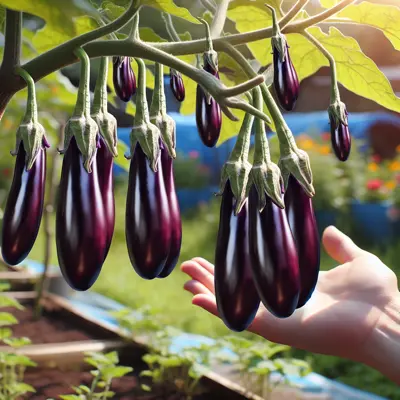
A stunning Japanese heirloom variety producing glossy, deep purple fruits that can reach 10 inches in length. The slender, curved eggplants have tender skin and mild, sweet flesh with minimal seeds, making them perfect for Asian cuisine. This productive plant delivers an abundant harvest of beautiful fruits that are as ornamental as they are delicious.
Harvest
70-80d
Days to harvest
Sun
Full sun
Zones
9–12
USDA hardiness
Height
2-4 feet
Planting Timeline
Showing dates for Japanese Long Purple in USDA Zone 7
All Zone 7 eggplant →Zone Map
Click a state to update dates
Japanese Long Purple · Zones 9–12
Growing Details
Succession Planting
Japanese Long Purple keeps setting fruit from first harvest through frost, so a single planting is enough for most gardens — no need to stagger starts the way you would with lettuce or radishes. Start seeds indoors 8-10 weeks before your last frost date, transplant once soil temps hit 60°F, and that planting will carry you through the season. In zones 9-12 where the calendar allows year-round growing, a second round started in late summer and transplanted out in September takes advantage of the fact that eggplant sets fruit more reliably once daytime highs drop back below 90°F.
Complete Growing Guide
Japanese Long Purple demands consistent warmth—start seeds 8-10 weeks before your last frost and maintain soil temperatures above 70°F for reliable germination and growth. This cultivar's slender fruit architecture makes it susceptible to sun scald and splitting if watered inconsistently, so mulch heavily and maintain even moisture throughout the season. Unlike stockier eggplant varieties, these elongated fruits can become heavy and benefit from gentle staking or plant supports to prevent branch breakage under their abundant yield. Watch closely for spider mites, which particularly trouble this thin-skinned variety in hot, dry conditions—misting foliage in early morning and ensuring adequate spacing for air circulation are critical preventative measures. The variety rarely experiences the bolting issues common in other eggplants, but it does stretch leggy if light is insufficient indoors, so provide robust fluorescent lighting during the seedling stage to ensure compact transplants.
Light: Full sun (6 or more hours of direct sunlight a day). Soil: Loam (Silt), Sand. Soil pH: Acid (<6.0). Drainage: Good Drainage, Moist. Height: 2 ft. 0 in. - 4 ft. 0 in.. Spread: 1 ft. 0 in. - 3 ft. 0 in.. Spacing: 3 feet-6 feet. Growth rate: Medium. Maintenance: Medium. Propagation: Seed.
Harvesting
Harvest Japanese Long Purple eggplants when they reach 8-10 inches in length and display a glossy, deep purple skin that feels slightly yielding to gentle pressure—this tenderness indicates peak maturity and optimal flavor. The fruits are ready when their skin loses any dull appearance and becomes uniformly vibrant, a visual cue specific to this variety's quality. Practice continuous harvesting by picking mature fruits regularly throughout the season rather than waiting for a single mass harvest; this stimulates the plant to produce more prolifically. Importantly, harvest in early morning when temperatures are cool to preserve the fruit's delicate texture and prevent stress to the plant, as these slender eggplants are sensitive to heat during peak picking times.
The fruit is a berry that is egg-shaped, smooth and has glossy skin. The fruit may measure 4 to 8 inches long. It ranges in color from green to white, to purple-black when immature and when it should be eaten. As the fruit matures it gets stringy and bitter. Fruit contains numerous small, flat, pale yellow to brown seeds.
Color: Black, Gold/Yellow, Green, Purple/Lavender, White. Type: Berry. Length: > 3 inches.
Garden value: Edible, Showy
Harvest time: Fall, Summer
Edibility: The immature fruit is edible and best used in food preparation. As the fruit matures, it becomes stringy and bitter. The fruits are usually cooked and served as a vegetable. They may be prepared and eaten by frying, steaming, grilling, roasting, or stewing. They may also be stir-fried, pickled, stuffed, and fried with a light breading.
Storage & Preservation
Fresh Japanese Long Purple eggplants store best at room temperature for 2-3 days or in the refrigerator crisper drawer wrapped in paper towels for up to one week. Avoid storing below 50°F, which causes chilling injury and bitter flavor development.
For longer preservation, slice eggplants into rounds, salt lightly to draw out moisture, then freeze on baking sheets before transferring to freezer bags. This variety's mild flavor makes it excellent for pickling in rice vinegar with ginger and garlic, following traditional Japanese preservation methods. You can also roast slices until tender, then freeze in portions for adding to winter stews and curries.
Dehydrating works well for this thin-skinned variety—slice into strips and dry at 135°F until leathery for use in soups and broths. The high moisture content means proper preparation is essential for all preservation methods.
History & Origin
Japanese Long Purple eggplant emerges from Japan's rich tradition of heirloom vegetable cultivation, though specific breeder credits and introduction dates remain sparsely documented in Western sources. This variety represents a longstanding Japanese selection within the broader Solanum melongena species, refined over generations for the culinary preferences of East Asian cooking. The variety's characteristics—notably its slender form, tender skin, and minimal seed content—reflect deliberate selection practices favored in Japanese agriculture for dishes like tempura and stir-fries. While seed companies have commercialized Japanese Long Purple since at least the late twentieth century, its origins trace to unnamed farmers and seed savers whose careful propagation preserved these traits through traditional heritage gardening practices rather than formal institutional breeding programs.
Origin: China South-Central, Laos, Malaya, Myanmar, Thailand, Vietnam
Advantages
- +Produces stunning 10-inch glossy purple fruits that are ornamentally beautiful
- +Minimal seeds and tender skin make preparation easier for cooking
- +Mild, sweet, creamy flavor is superior to many common eggplant varieties
- +Moderate difficulty and 70-80 day maturity fit most growing seasons
- +Abundant harvests reward gardeners with prolific fruit production
Considerations
- -Susceptible to multiple diseases including verticillium wilt and bacterial wilt
- -Vulnerable to several pests like flea beetles and spider mites
- -Curved slender shape makes fruits more fragile during handling and storage
- -Requires consistent warmth and moisture for optimal growth and productivity
Companion Plants
Basil planted 12-18 inches away may disrupt thrips and aphid navigation with its volatile oils — though the real argument for it is that you'll harvest eggplant and basil at the same time and want them close together anyway. Marigolds (Tagetes spp.) are doing something more concrete: their root secretions suppress soil nematodes over a full growing season, and the flowers pull aphid and spider mite pressure away from eggplant foliage. Nasturtium works best treated as a sacrificial trap crop — let aphids pile onto it, then pull the whole plant and bin it before they move on. Keep fennel well away; its allelopathic root compounds stunt most vegetables, and there's no threshold where a little fennel becomes acceptable.
Plant Together
Basil
Repels aphids, spider mites, and hornworms while potentially improving eggplant flavor
Marigold
Deters nematodes, whiteflies, and other harmful insects with strong scent
Peppers
Similar growing requirements and both benefit from same pest deterrents
Tomatoes
Share similar nutrient needs and growing conditions as fellow nightshades
Nasturtium
Acts as trap crop for aphids and cucumber beetles, draws pests away
Catnip
Repels flea beetles, ants, and aphids that commonly attack eggplant
Oregano
Natural pest deterrent that repels aphids and provides ground cover
Borage
Attracts beneficial insects and may improve growth and pest resistance
Keep Apart
Fennel
Allelopathic properties inhibit growth of most vegetables including eggplant
Black Walnut
Produces juglone toxin that causes wilt and stunted growth in nightshades
Corn
Competes for nutrients and attracts corn earworms that also damage eggplant
Nutrition Facts
Per 100g serving. % Daily Value based on 2,000 calorie diet. Source: USDA FoodData Central (FDC #169228)
Pests & Disease Resistance
Resistance
Moderate resistance to common eggplant diseases
Common Pests
Flea beetles, Colorado potato beetle, aphids, spider mites
Diseases
Verticillium wilt, bacterial wilt, anthracnose, phomopsis blight
Troubleshooting Japanese Long Purple
What you'll see, why it happens, and what to do about it.
Tiny, irregular shothole damage on leaves — especially on young transplants within the first 2-3 weeks in the ground
Likely Causes
- Flea beetles (Epitrix spp.) — small, jumping beetles that overwinter in soil and leaf litter and go straight for young nightshades
- Plants stressed from transplant shock or inconsistent watering, which makes them slower to outgrow the damage
What to Do
- 1.Cover transplants immediately with floating row cover and leave it on until plants are 12-18 inches tall and actively growing
- 2.Apply diatomaceous earth around the base of plants and along the soil surface — reapply after rain
- 3.Get plants in the ground as healthy as possible; a well-watered transplant at 70°F soil temp will outpace flea beetle damage faster than a stressed one
Plant collapses suddenly — leaves wilt and don't recover even after watering, stem looks fine on the outside
Likely Causes
- Bacterial wilt caused by Ralstonia solanacearum — NC State Extension notes this pathogen persists in soil indefinitely once introduced
- Verticillium wilt (Verticillium dahliae) — a soil-borne fungus that blocks vascular tissue, more gradual than bacterial wilt but similarly fatal
What to Do
- 1.Pull and bag the entire plant — don't compost it; neither Ralstonia nor Verticillium dahliae breaks down in a home compost pile
- 2.Don't replant eggplant, tomatoes, peppers, or potatoes in that bed for at least 3-4 years — all share nightshade family susceptibility
- 3.If bacterial wilt has hit before, solarize the bed for 6-8 weeks in midsummer: clear plastic laid tight to the soil surface, edges buried
Dark, sunken spots on fruit — often circular, sometimes with concentric rings, appearing as fruit approaches maturity
Likely Causes
- Anthracnose (Colletotrichum spp.) — fungal, spreads in warm wet weather, often latent until fruit ripens
- Phomopsis blight (Phomopsis vexans) — produces similar fruit lesions and also attacks stems and seedlings
What to Do
- 1.Harvest Japanese Long Purple at 6-8 inches and don't let fruit linger on the plant — overripe eggplant is far more vulnerable to both pathogens
- 2.Lay 2-3 inches of straw mulch under the plants to cut down rain splash from soil to lower leaves and fruit
- 3.Move eggplant to a different bed each season; Colletotrichum and Phomopsis vexans both persist in crop debris
Frequently Asked Questions
How long does Japanese Long Purple eggplant take to grow?▼
Can you grow Japanese Long Purple eggplant in containers?▼
What does Japanese Long Purple eggplant taste like?▼
Is Japanese Long Purple eggplant good for beginners?▼
When should I plant Japanese Long Purple eggplant?▼
Japanese Long Purple vs regular eggplant - what's the difference?▼
Zone-by-Zone Planting Calendar
| Zone | Indoor Start | Transplant | Direct Sow | Harvest |
|---|---|---|---|---|
| Zone 1 | May – May | July – August | — | October – August |
| Zone 2 | April – May | June – July | — | September – September |
| Zone 11 | January – January | January – February | — | April – June |
| Zone 12 | January – January | January – February | — | April – June |
| Zone 13 | January – January | January – February | — | April – June |
| Zone 3 | April – April | June – July | — | September – October |
| Zone 4 | March – April | June – June | — | August – October |
| Zone 5 | March – March | May – June | — | August – October |
| Zone 6 | March – March | May – June | — | August – October |
| Zone 7 | February – March | April – May | — | July – September |
| Zone 8 | February – February | April – May | — | July – September |
| Zone 9 | January – January | March – April | — | June – August |
| Zone 10 | January – January | February – March | — | May – July |
Growing Guides from Wind River Greens
Sources & References
External authority sources used in compiling this guide.
See the Methodology page for how this data is sourced, what's AI-assisted, and known limitations.