Bambino F1
Solanum melongena 'Bambino F1'
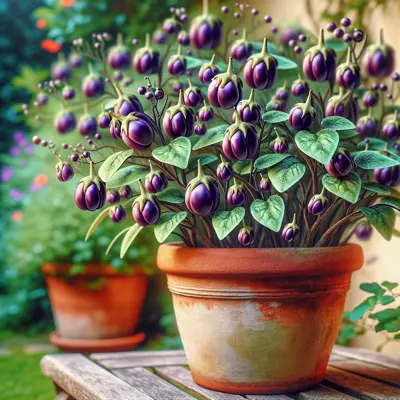
A delightful mini eggplant hybrid that produces clusters of grape-sized purple fruits perfect for cocktail appetizers and gourmet cooking. The compact 12-inch plants are ideal for containers and small spaces, yet produce an abundance of tender, non-bitter fruits. This variety has won over gardeners with its ornamental beauty and gourmet appeal.
Harvest
45-55d
Days to harvest
Sun
Full sun
Zones
9–12
USDA hardiness
Height
2-4 feet
Planting Timeline
Showing dates for Bambino F1 in USDA Zone 7
All Zone 7 eggplant →Zone Map
Click a state to update dates
Bambino F1 · Zones 9–12
Growing Details
Succession Planting
Bambino F1 is a continuously producing hybrid — once it starts fruiting at around 45–55 days, it keeps going until frost or disease ends the run. One planting per season is the standard approach; there's no need to stagger sowings the way you would with a bolt-prone crop like lettuce. Get transplants in the ground after soil temps are reliably above 60°F, and that planting will carry you through the full summer window.
In zones 9–12 where summers run long, a second round started indoors in late July can go in the ground in September for a fall harvest. Most gardeners won't need it, but it's a straightforward way to use the season if your spring planting runs out of steam by August.
Complete Growing Guide
Bambino F1's compact 12-inch frame and rapid 45-55 day maturity require consistent warmth—maintain soil temperatures above 70°F and provide 6-8 hours of direct sunlight daily to prevent stunted growth and flower drop. Unlike larger eggplant varieties, these mini fruits set prolifically in clusters, demanding regular feeding every two weeks with balanced fertilizer to sustain production without excessive vegetative growth that crowds the canopy. The plants' density makes them susceptible to powdery mildew and spider mites in humid conditions; improve air circulation by pruning lower leaves and avoid overhead watering. While Bambino F1 rarely bolts like some heat-stressed varieties, container-grown plants dry out quickly and need consistent moisture—allow soil to dry slightly between waterings but never completely. A practical strategy: pinch out the first flowers when plants reach 6 inches tall to encourage a stronger root system and bushier structure, which maximizes the prolific fruit production this cultivar is bred to deliver.
Light: Full sun (6 or more hours of direct sunlight a day). Soil: Loam (Silt), Sand. Soil pH: Acid (<6.0). Drainage: Good Drainage, Moist. Height: 2 ft. 0 in. - 4 ft. 0 in.. Spread: 1 ft. 0 in. - 3 ft. 0 in.. Spacing: 3 feet-6 feet. Growth rate: Medium. Maintenance: Medium. Propagation: Seed.
Harvesting
Harvest Bambino F1 eggplants when fruits reach their characteristic grape-sized dimensions—typically 2 to 3 inches long—and display a deep, glossy purple skin with a slight give when gently pressed. At this peak stage, the flesh remains tender and sweet without the bitterness that develops in overripe fruits. Unlike single-harvest varieties, Bambino F1 produces continuously throughout the season when you pick regularly, encouraging the plant to set new flower clusters. Harvest every 2 to 3 days by snipping fruits with pruning shears rather than pulling, which protects the delicate stems and promotes sustained productivity. Begin picking when the first clusters mature, typically 45 to 55 days from transplant, and maintain consistent harvesting to maximize your gourmet yield from these compact, prolific plants.
The fruit is a berry that is egg-shaped, smooth and has glossy skin. The fruit may measure 4 to 8 inches long. It ranges in color from green to white, to purple-black when immature and when it should be eaten. As the fruit matures it gets stringy and bitter. Fruit contains numerous small, flat, pale yellow to brown seeds.
Color: Black, Gold/Yellow, Green, Purple/Lavender, White. Type: Berry. Length: > 3 inches.
Garden value: Edible, Showy
Harvest time: Fall, Summer
Edibility: The immature fruit is edible and best used in food preparation. As the fruit matures, it becomes stringy and bitter. The fruits are usually cooked and served as a vegetable. They may be prepared and eaten by frying, steaming, grilling, roasting, or stewing. They may also be stir-fried, pickled, stuffed, and fried with a light breading.
Storage & Preservation
Fresh Bambino F1 eggplants store best at room temperature for 2-3 days, developing better flavor than refrigerated fruits. If you must refrigerate, place in a perforated plastic bag in the crisper drawer and use within a week – longer storage leads to brown, bitter flesh.
For preservation, blanch whole fruits for 3-4 minutes before freezing in single layers. Their small size makes them perfect for pickling whole in Mediterranean-style brine with garlic, herbs, and olive oil. The grape-sized fruits also excel when roasted with olive oil and salt, then frozen in portion-sized containers for winter use in pasta dishes.
Dehydrating works well too – slice lengthwise and dry at 135°F until leathery. These concentrated fruits rehydrate beautifully in soups and stews, maintaining their sweet, non-bitter flavor profile that makes Bambino F1 special.
History & Origin
The origins of Bambino F1 are rooted in modern hybrid breeding aimed at producing compact, ornamental eggplants suited to container cultivation. While specific breeder attribution and introduction year remain undocumented in widely available sources, the variety exemplifies the late-twentieth-century trend toward miniaturized vegetables for urban and small-space gardening. The "F1" designation indicates a first-generation hybrid cross, likely developed by a commercial seed company to combine vigor with the dwarf plant habit and prolific fruiting characteristic of mini eggplant lines. The variety's genetic lineage draws from Solanum melongena's Asian heritage and selective breeding for non-bitter, tender fruits, though definitive documentation of its exact parentage and breeding program origin is limited in public records.
Origin: China South-Central, Laos, Malaya, Myanmar, Thailand, Vietnam
Advantages
- +Compact 12-inch plants fit perfectly in containers and small spaces.
- +Grape-sized fruits are ideal for gourmet appetizers and cocktail presentations.
- +Sweet, tender flavor never develops bitterness unlike standard eggplant varieties.
- +Fast 45-55 day maturity means quicker harvests from seed to fruit.
- +Ornamental purple fruits add decorative appeal alongside culinary value.
Considerations
- -Susceptible to flea beetles, aphids, and spider mites requiring vigilant monitoring.
- -Verticillium wilt and bacterial wilt can devastate plants in contaminated soil.
- -Mini fruit size means lower total yield per plant compared to standard eggplants.
Companion Plants
Marigolds (Tagetes spp.) are worth the real estate near Bambino F1 — their roots release thiophenes that suppress root-knot nematodes in the surrounding soil, which matters for eggplant specifically. Beans pull their weight too: as NC State Extension notes, legumes fix nitrogen through root bacteria, which means less fertilizer hauled in mid-season for a crop that's already a heavy feeder. Basil is a reasonable pest-confusion planting, and the culinary overlap with eggplant is reason enough to put them near each other regardless.
Fennel releases allelopathic compounds that stunt most vegetable crops — keep it well away from Bambino F1, or just out of the garden entirely if you're tight on space. Corn is a worse neighbor than it looks: it competes hard for both water and nitrogen, casts enough shade to cut into the 6+ daily sun hours eggplant needs, and draws some overlapping pest pressure. Black walnut produces juglone, which is toxic to Solanaceae; don't site this crop within 50 feet of an established tree.
Plant Together
Basil
Repels aphids and whiteflies, may improve flavor and growth
Tomatoes
Share similar growing requirements and can be grown together efficiently
Peppers
Compatible nightshade family members with similar care needs
Marigolds
Repel nematodes and other soil pests that damage eggplant roots
Nasturtiums
Act as trap crops for aphids and cucumber beetles
Oregano
Repels spider mites and aphids while attracting beneficial insects
Parsley
Attracts beneficial insects and doesn't compete for nutrients
Beans
Fix nitrogen in soil which benefits heavy-feeding eggplants
Keep Apart
Black Walnut
Produces juglone toxin that causes wilting and stunted growth in nightshades
Fennel
Inhibits growth through allelopathic compounds and attracts harmful insects
Corn
Creates too much shade and competes heavily for nutrients
Nutrition Facts
Per 100g serving. % Daily Value based on 2,000 calorie diet. Source: USDA FoodData Central (FDC #169228)
Pests & Disease Resistance
Resistance
Good hybrid vigor with moderate disease resistance
Common Pests
Flea beetles, aphids, spider mites
Diseases
Verticillium wilt, bacterial wilt, early blight
Troubleshooting Bambino F1
What you'll see, why it happens, and what to do about it.
Tiny round holes shotgunned across young leaves, seedlings look ragged within days of transplant
Likely Causes
- Flea beetles (Epitrix spp.) — adults overwinter in soil and leaf litter, hit transplants hard before plants establish
- Transplanting too early into cool soil, which slows plant growth and extends the window beetles can do real damage
What to Do
- 1.Cover transplants immediately with row cover (Agribon AG-19 or similar) and seal the edges; remove once plants are 12+ inches tall and flowering
- 2.Side-dress with a balanced fertilizer to push fast early growth — a plant sizing up quickly outpaces flea beetle damage faster than one that's stalling
- 3.If pressure is severe, NC State Extension recommends a foliar insecticide at the cotyledon/early transplant stage; check the current NC Agricultural Chemicals Manual for labeled rates
Plant wilts suddenly and completely, doesn't recover overnight — even with adequate soil moisture
Likely Causes
- Bacterial wilt (Ralstonia solanacearum) — soil-borne, no cure once a plant is infected
- Verticillium wilt (Verticillium dahliae) — also soil-borne, persists in the soil for years
What to Do
- 1.Dig up and destroy the entire plant including as much root mass as you can — don't compost it
- 2.Do not replant any nightshade (tomatoes, peppers, eggplant, potatoes) in that bed for at least 3 seasons; NC State Extension's disease guidance recommends rotation or relocating the plot entirely
- 3.If you're in a spot with a known wilt history, grow Bambino F1 in containers with fresh potting mix and keep container soil from contacting native garden soil
Dark, sunken dry spot on the blossom end of the fruit — sometimes with mold growing on the rotted area
Likely Causes
- Blossom-end rot — calcium deficiency in the developing fruit, triggered by uneven soil moisture rather than a true lack of calcium in the soil
- Overfertilization with high-nitrogen fertilizers, or soil pH outside the 6.5–6.8 range, both of which interfere with calcium uptake
What to Do
- 1.Mulch heavily around plants — straw works fine — to even out soil moisture swings; get it down by the time plants are blooming, as the UGA Vegetable Garden Calendar recommends
- 2.Water consistently; Bambino F1 is a high-water crop and calcium transport stalls the moment the soil dries out between irrigations
- 3.Test your soil pH and lime to 6.5–6.8 if needed; NC State Extension notes that correcting pH is more effective than spraying calcium chloride on the fruit after the fact
Frequently Asked Questions
How long does Bambino F1 eggplant take to grow from seed?▼
Can you grow Bambino F1 eggplant in containers?▼
Is Bambino F1 eggplant good for beginners?▼
What does Bambino F1 eggplant taste like?▼
When should I plant Bambino F1 eggplant seeds?▼
How many Bambino F1 eggplants does one plant produce?▼
Zone-by-Zone Planting Calendar
| Zone | Indoor Start | Transplant | Direct Sow | Harvest |
|---|---|---|---|---|
| Zone 1 | May – May | July – August | — | September – August |
| Zone 2 | April – May | June – July | — | August – September |
| Zone 11 | January – January | January – February | — | March – May |
| Zone 12 | January – January | January – February | — | March – May |
| Zone 13 | January – January | January – February | — | March – May |
| Zone 3 | April – April | June – July | — | August – October |
| Zone 4 | March – April | June – June | — | July – September |
| Zone 5 | March – March | May – June | — | July – September |
| Zone 6 | March – March | May – June | — | July – September |
| Zone 7 | February – March | April – May | — | June – August |
| Zone 8 | February – February | April – May | — | June – August |
| Zone 9 | January – January | March – April | — | May – July |
| Zone 10 | January – January | February – March | — | April – June |
Growing Guides from Wind River Greens
Sources & References
External authority sources used in compiling this guide.
See the Methodology page for how this data is sourced, what's AI-assisted, and known limitations.