San Marzano
Solanum lycopersicum
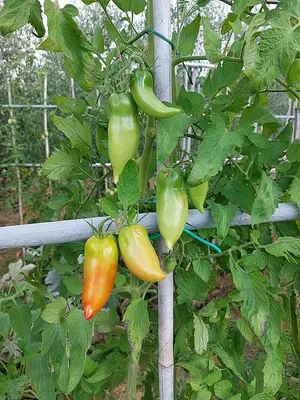
San Marzano tomatoes are a heritage Italian plum variety prized for sauce production. These elongated, deep red fruits mature in approximately 60 days and feature distinctly few seeds and thin walls—ideal characteristics for canning and paste-making. Known for their sweet flavor profile with notably low acidity and intense, concentrated tomato taste, San Marzanos are the traditional choice for authentic Italian sauces. While classified as hybrid here, true San Marzano varieties are often open-pollinated heirlooms. The plants require full sun and rich, well-drained soil, with moderate to difficult cultivation demands.
Harvest
60d
Days to harvest
Sun
Full sun
Zones
10–11
USDA hardiness
Height
1-10 feet
Planting Timeline
Showing dates for San Marzano in USDA Zone 7
All Zone 7 tomato →Zone Map
Click a state to update dates
San Marzano · Zones 10–11
Growing Details
Complete Growing Guide
San Marzano tomatoes demand consistent warmth and deep, fertile soil to reach their full potential, requiring at least 70-75°F for optimal growth and fruiting. While the 60-day maturity is competitive, these plants typically need 75-80 days from transplant to first harvest due to their indeterminate growth habit and heavy fruit load. Plant deeply—burying two-thirds of the stem encourages robust root development critical for supporting the characteristic 12-18 fruit clusters. Disease resistance is a standout feature, but monitor for early blight in humid conditions and provide excellent air circulation through strategic pruning. These vigorous vines stretch aggressively and require sturdy support systems; a practical tip is to use Florida weave or professional tomato cages rather than stakes, as single supports collapse under the weight of successive fruit clusters. Feed consistently every two weeks once flowering begins to maintain vine vigor without triggering excessive foliage at the expense of fruit production.
Light: Full sun (6 or more hours of direct sunlight a day). Soil: Clay, High Organic Matter, Loam (Silt), Sand. Soil pH: Acid (<6.0), Neutral (6.0-8.0). Drainage: Good Drainage, Moist. Height: 1 ft. 0 in. - 10 ft. 0 in.. Spread: 1 ft. 0 in. - 4 ft. 0 in.. Spacing: 3 feet-6 feet. Growth rate: Rapid. Maintenance: High. Propagation: Seed. Regions: Coastal, Mountains, Piedmont.
Harvesting
San Marzano tomatoes reach peak harvest readiness when they achieve their characteristic deep red color with a slight gloss and measure approximately 2 to 2¼ inches in length. The fruits should feel slightly yielding to gentle pressure but still maintain firmness, indicating optimal ripeness without overmaturity. These indeterminate vines produce prolifically, supporting 12–18 fruits per cluster, so plan for continuous harvesting rather than a single picking. Begin harvesting when the first fruits in each cluster fully color, as this encourages subsequent clusters to develop and mature. Morning picking, after dew dries but before afternoon heat, preserves flavor intensity and shelf life, making it ideal for this variety's excellent storage capabilities.
The fruits are smooth, shiny, glossy, and are classified as berries. The size, shape, and color will vary depending on the variety or cultivar. The color of the fruits may be red, yellow, orange, green, purple, or pink. The fruits may contain over 100 yellow to light brown seeds.
Color: Gold/Yellow, Green, Orange, Pink, Purple/Lavender, Red/Burgundy, Variegated. Type: Berry. Length: > 3 inches. Width: > 3 inches.
Garden value: Edible, Showy
Harvest time: Fall, Summer
Edibility: The fruits or berries of the tomato are edible. They may be eaten raw, cooked, dried, or processed. They are a rich source of Vitamin A, Vitamin C, folic acid, and antioxidants. Lycopene is an antioxidant that gives the tomato its rich red color. Many plants will drop fruit when ripe or the fruit will come off easily. Tomatoes will continue to ripen once picked. Store them at room temperature.
Storage & Preservation
Store freshly harvested San Marzano tomatoes at 55–70°F in a well-ventilated container, away from direct sunlight. Maintain moderate humidity around 85–90% to prevent shriveling. Avoid refrigeration below 55°F, which damages flavor and texture. Ripe fruit keeps 5–7 days at room temperature; slightly underripe tomatoes last 10–14 days.
For preservation, San Marzanos excel in hot water bath canning—their low acidity and minimal seed content make them ideal for sauce and paste. Blanch, peel, and can whole or crushed with lemon juice added for safety. Freezing works well: core and quarter, then pack in freezer bags for up to eight months. For concentrated paste, halve lengthwise, remove seeds, and oven-dry at 200°F until leathery, then blend and freeze in ice cube trays.
Because San Marzanos have thicker flesh and fewer seeds than most varieties, you'll lose less liquid during sauce reduction—expect a higher yield and faster cooking times than standard slicing tomatoes.
History & Origin
San Marzano tomatoes originated in the Campania region of Italy, near Mount Vesuvius, where they have been cultivated since at least the 18th century as part of Italian horticultural heritage. The variety became particularly associated with the town of San Marzano sul Sarno and gained prominence for its suitability in traditional Italian paste production. While precise breeder documentation remains limited, San Marzano represents a longstanding landrace selection rather than a modern hybrid creation, developed through generations of Italian farmers selecting for paste-making qualities. The variety's protected designation in Italy reflects its deep cultural significance to regional food traditions and tomato breeding history.
Origin: Peru
Advantages
- +Excellent flavor profile with sweet taste and low acidity for sauces
- +High disease resistance including late blight and fusarium wilt protection
- +Good crack resistance and extended shelf life for storage and transport
- +Produces 12-18 fruits per cluster for abundant harvests
- +AAS Award winner with proven performance in diverse growing conditions
Considerations
- -Moderate to difficult growing difficulty requires experienced gardener attention
- -Susceptible to multiple pests including hornworms, aphids, and spider mites
- -Relatively short 60-day maturity means compressed production window
- -Indeterminate growth requires consistent pruning and staking throughout season
Companion Plants
Marigolds (Tagetes patula specifically) earn their spot here because their roots produce thiophene compounds that suppress root-knot nematodes (Meloidogyne spp.) in the surrounding soil — and for a long-season paste tomato that stays in the ground 60+ days, nematode pressure is a real concern. Basil planted 12-18 inches away is useful for the harvest alone; the pest-confusion claim doesn't have much hard data behind it for San Marzano specifically, but you'll use every bit of it. Carrots and parsley fill the understory without pulling the deep moisture a heavy-fruiting indeterminate needs. Keep fennel at least 10-15 feet away — it produces anethole, an allelopathic compound that stunts nearby plants, and tomatoes are among the most sensitive. Brassicas share soilborne pathogens with nightshades and will undermine any bed rotation you've tried to build.
Plant Together
Basil
Repels aphids and whiteflies, may improve tomato flavor
Marigold
Deters nematodes and repels tomato hornworms
Carrots
Loosens soil for tomato roots and doesn't compete for nutrients
Parsley
Attracts beneficial insects that prey on tomato pests
Chives
Repels aphids and may improve tomato growth
Nasturtium
Acts as trap crop for aphids and repels cucumber beetles
Oregano
Repels pests and may enhance tomato flavor
Borage
Deters tomato hornworms and attracts pollinators
Keep Apart
Black Walnut
Releases juglone which causes tomato wilt and stunted growth
Fennel
Inhibits tomato growth through allelopathic compounds
Brassicas
Compete for nutrients and may stunt tomato growth
Nutrition Facts
Per 100g serving. % Daily Value based on 2,000 calorie diet. Source: USDA FoodData Central (FDC #321360)
Pests & Disease Resistance
Resistance
Early Blight (Intermediate); Late Blight (Intermediate)
Common Pests
Tomato hornworm, aphids, spider mites, whiteflies
Diseases
Late blight, early blight, fusarium wilt, bacterial canker
Troubleshooting San Marzano
What you'll see, why it happens, and what to do about it.
Large gray-green patches spreading across foliage fast — within 48-72 hours — plus dark, water-soaked rotted spots on fruit
Likely Causes
- Late blight (Phytophthora infestans) — a water mold that spreads rapidly in cool, wet conditions and can wipe out a planting in days
- Infected transplants or nearby infected potato plants introducing the pathogen
What to Do
- 1.Pull and bag affected plants immediately — do not compost them; late blight spreads by spores
- 2.Alert neighbors with tomatoes or potatoes, since P. infestans travels on wind
- 3.Next season, rotate out of nightshades for at least 3-4 years in that bed; NC State Extension notes the rotation window for some tomato diseases may stretch to 5-7 years
Plant wilts during the day even with adequate soil moisture, with no obvious stem lesion or caterpillar damage above ground
Likely Causes
- Fusarium wilt (Fusarium oxysporum f. sp. lycopersici) — vascular fungus that blocks water uptake; cutting the stem reveals brown discoloration inside
- Southern bacterial wilt (Ralstonia solanacearum) — soil-borne bacterium; a cut stem placed in water will show milky bacterial ooze
- Root-knot nematodes (Meloidogyne spp.) weakening the root system
What to Do
- 1.Dig up and destroy the affected plant including as much root mass as you can recover — don't leave it to break down in the bed
- 2.Do not replant tomatoes, peppers, or eggplant in that spot; NC State Extension recommends rotating nightshades out of a site for 3-4 years minimum, longer if bacterial wilt is confirmed
- 3.Consider growing next year's San Marzanos in containers with fresh potting mix, keeping container soil from contacting native soil
Sunken, leathery brown-black rot on the blossom end of fruit, appearing once fruit is about half-sized
Likely Causes
- Blossom end rot — calcium deficiency in the developing fruit, caused by inconsistent watering that interrupts Ca uptake even when soil calcium levels are adequate
- Overly aggressive fertilization with high-nitrogen inputs early in fruit set, which pushes vegetative growth at the expense of calcium distribution
What to Do
- 1.Water deeply and consistently — San Marzano needs high, even moisture; wide swings between wet and dry are the main trigger
- 2.Mulch with 3-4 inches of straw to buffer soil moisture between rain events
- 3.Pull affected fruit off the plant so it stops directing energy to them; once you stabilize watering, new fruit usually sets clean
Frequently Asked Questions
How long do San Marzano tomatoes take to grow from seed?▼
Are San Marzano tomatoes good for beginners?▼
Can you grow San Marzano tomatoes in containers?▼
What do San Marzano tomatoes taste like fresh?▼
San Marzano vs Roma tomatoes - what's the difference?▼
When should I plant San Marzano tomato seeds?▼
Zone-by-Zone Planting Calendar
| Zone | Indoor Start | Transplant | Direct Sow | Harvest |
|---|---|---|---|---|
| Zone 3 | April – April | June – July | — | September – October |
| Zone 4 | March – April | June – June | — | September – October |
| Zone 5 | March – March | May – June | — | August – October |
| Zone 6 | March – March | May – June | — | August – October |
| Zone 7 | February – March | April – May | — | July – September |
| Zone 8 | February – February | April – May | — | July – September |
| Zone 9 | January – January | March – April | — | June – August |
| Zone 10 | January – January | February – March | — | May – July |
| Zone 1 | May – May | July – August | — | September – August |
| Zone 2 | April – May | June – July | — | September – September |
| Zone 11 | January – January | January – February | — | April – June |
| Zone 12 | January – January | January – February | — | April – June |
| Zone 13 | January – January | January – February | — | April – June |
Growing Guides from Wind River Greens
Sources & References
External authority sources used in compiling this guide.
See the Methodology page for how this data is sourced, what's AI-assisted, and known limitations.