Rutgers
Solanum lycopersicum 'Rutgers'
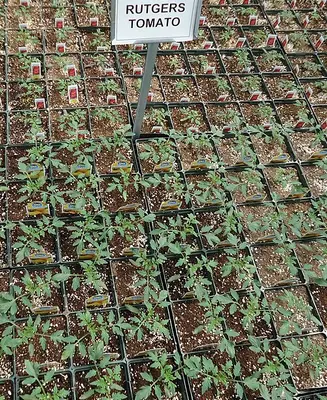
A legendary heirloom variety developed at Rutgers University in 1934 that became the standard for tomato flavor in America. This reliable producer delivers perfectly balanced, old-fashioned tomato taste in medium-sized fruits that are ideal for both fresh eating and processing. Rutgers represents the classic American tomato that many gardeners remember from their childhood.
Harvest
75-85d
Days to harvest
Sun
Full sun
Zones
10–11
USDA hardiness
Height
1-10 feet
Planting Timeline
Showing dates for Rutgers in USDA Zone 7
All Zone 7 tomato →Zone Map
Click a state to update dates
Rutgers · Zones 10–11
Growing Details
Succession Planting
Rutgers is an indeterminate heirloom that keeps setting fruit until frost cuts it down, so staggered plantings don't buy you anything. One transplant round per bed — late April to early May in zone 7, once nighttime lows hold above 50°F — and the plants carry through July into September on their own. Use the bed space you'd otherwise spend on a second round of tomatoes for a fall brassica succession instead; you'll get more out of it.
Complete Growing Guide
Plant Rutgers seedlings after your last frost date, as this 1934 heirloom requires consistent warmth to reach its 75–85 day maturity and won't tolerate cold snaps that stall growth. This determinate variety tops out around 3–4 feet, so stake or cage it early to prevent sprawling and improve air circulation—crucial since Rutgers shows moderate susceptibility to early blight and septoria leaf spot in humid conditions. Position plants in full sun with rich, well-draining soil amended with compost; Rutgers rewards consistent moisture and won't perform well under stress from drought or erratic watering, which cracks the fruit and concentrates flavor unevenly. Prune lower foliage once plants are established to further reduce fungal disease pressure. A practical tip: harvest when fruits show full color but still have slight give; unlike modern varieties, Rutgers develops peak sweetness only on the vine, so pulling them green won't improve flavor.
Light: Full sun (6 or more hours of direct sunlight a day). Soil: Clay, High Organic Matter, Loam (Silt), Sand. Soil pH: Acid (<6.0), Neutral (6.0-8.0). Drainage: Good Drainage, Moist. Height: 1 ft. 0 in. - 10 ft. 0 in.. Spread: 1 ft. 0 in. - 4 ft. 0 in.. Spacing: 3 feet-6 feet. Growth rate: Rapid. Maintenance: High. Propagation: Seed. Regions: Coastal, Mountains, Piedmont.
Harvesting
Rutgers tomatoes reach peak harvest readiness when they display a deep, uniform red color throughout the fruit with no green shoulders, accompanied by a slight give when gently squeezed. The medium-sized fruits typically measure 2.5 to 3 inches in diameter and feel slightly soft but still firm enough to handle without bruising. This variety produces fruit in waves rather than all at once, so practice continuous harvesting by picking ripe tomatoes every two to three days to encourage the plant to set more fruit and extend your season well into fall. A crucial timing tip: harvest Rutgers tomatoes in early morning after the dew dries but before midday heat intensifies, as this preserves their flavor complexity and reduces post-harvest stress on the fruit.
The fruits are smooth, shiny, glossy, and are classified as berries. The size, shape, and color will vary depending on the variety or cultivar. The color of the fruits may be red, yellow, orange, green, purple, or pink. The fruits may contain over 100 yellow to light brown seeds.
Color: Gold/Yellow, Green, Orange, Pink, Purple/Lavender, Red/Burgundy, Variegated. Type: Berry. Length: > 3 inches. Width: > 3 inches.
Garden value: Edible, Showy
Harvest time: Fall, Summer
Edibility: The fruits or berries of the tomato are edible. They may be eaten raw, cooked, dried, or processed. They are a rich source of Vitamin A, Vitamin C, folic acid, and antioxidants. Lycopene is an antioxidant that gives the tomato its rich red color. Many plants will drop fruit when ripe or the fruit will come off easily. Tomatoes will continue to ripen once picked. Store them at room temperature.
Storage & Preservation
Rutgers tomatoes keep best at room temperature away from direct sunlight; refrigeration can dull their classic flavor, so reserve chilling only for fully ripe fruit you won't use within two days. Store them stem-side down on a counter or in a cardboard box, maintaining air circulation to prevent soft spots. Fresh tomatoes typically last 5-7 days at room temperature, depending on ripeness at harvest.
For preservation, Rutgers excel across multiple methods. Their balanced acidity and moderate seed content make them ideal for water bath canning—whole, crushed, or as sauce. Freezing works well for cooking applications; simply core and freeze whole, or blanch and skin first. Drying concentrates their flavor beautifully, whether oven or sun-dried. Their lower water content compared to some modern varieties means sauces and pastes reduce efficiently without requiring extended cooking times.
History & Origin
Developed at Rutgers University in New Jersey during the 1930s, this variety emerged from the university's ambitious tomato breeding program aimed at creating a superior commercial and home-garden tomato. The exact parentage and specific breeder name remain poorly documented in readily available sources, reflecting the era's inconsistent record-keeping for agricultural development. What is well-established is that Rutgers became a flagship cultivar of American horticulture, widely adopted by commercial canners and home gardeners alike. Its success stemmed from deliberately breeding for balanced flavor, disease resistance, and reliable productivity—qualities that distinguished it from many contemporaries and cemented its legacy as a defining tomato of mid-twentieth-century American agriculture.
Origin: Peru
Advantages
- +Legendary heirloom status makes Rutgers a nostalgic, iconic American tomato variety.
- +Perfectly balanced flavor profile delivers classic tomato taste ideal for fresh eating.
- +Medium fruit size suits both home gardeners and small-scale processing applications well.
- +Reliable, consistent producer with moderate 75-85 day maturity and easy cultivation.
- +Versatile dual-purpose variety works equally well for slicing and sauce making.
Considerations
- -Highly susceptible to early and late blight, requiring careful disease management.
- -Vulnerable to fusarium wilt, limiting planting options in contaminated soil areas.
- -Prone to bacterial spot infection in humid or wet growing conditions.
- -Susceptible to multiple common pests including hornworms and aphids regularly.
Companion Plants
Basil belongs within arm's reach of Rutgers — less for any proven pest-repellent effect and more because you'll be harvesting both at the same time all August anyway. French marigolds (Tagetes patula specifically) pull real weight: their roots release alpha-terthienyl, a compound shown to suppress root-knot nematodes in surrounding soil — and nematodes in Georgia clay are not a theoretical concern. Carrots and parsley sit comfortably at 12–18 inches out because their root zones don't compete with tomato's deeper draw, and parsley reliably attracts parasitic wasps that target hornworm eggs. Fennel is the one to keep on the other side of the garden entirely — it's broadly allelopathic and will slow Rutgers down — and tucking brassicas nearby in our zone 7 Georgia summers just doubles the whitefly and aphid load on both crops at once.
Plant Together
Basil
Repels aphids and whiteflies, may improve flavor
Marigold
Deters nematodes and aphids with natural compounds
Carrots
Loosens soil for tomato roots, doesn't compete for space
Parsley
Attracts beneficial insects like hoverflies that eat aphids
Chives
Repels aphids and may improve tomato flavor
Nasturtiums
Acts as trap crop for aphids and cucumber beetles
Oregano
Repels pests and may enhance tomato growth
Borage
Attracts pollinators and may repel hornworms
Keep Apart
Black Walnut
Produces juglone toxin that causes tomato wilt and death
Fennel
Inhibits growth of most garden plants through allelopathy
Brassicas
Heavy feeders that compete for nutrients, may stunt tomato growth
Corn
Both attract corn earworm, creating concentrated pest problems
Nutrition Facts
Per 100g serving. % Daily Value based on 2,000 calorie diet. Source: USDA FoodData Central (FDC #321360)
Pests & Disease Resistance
Resistance
Good overall disease resistance for an heirloom variety
Common Pests
Tomato hornworm, aphids, whiteflies, cutworms
Diseases
Early blight, late blight, fusarium wilt, bacterial spot
Troubleshooting Rutgers
What you'll see, why it happens, and what to do about it.
Lower leaves developing dark brown bullseye-patterned spots, sometimes with a yellow halo, starting around day 45–50 after transplant
Likely Causes
- Early blight (Alternaria solani) — a soil-borne fungus that splashes up onto lower foliage during rain or overhead irrigation
- Crowded spacing under 24 inches that traps humidity and slows leaf drying
What to Do
- 1.Strip the affected leaves and trash them — don't compost them
- 2.Lay 3–4 inches of straw mulch at the base of the plant to stop soil splash
- 3.NC State Extension recommends rotating nightshades out of the same bed for at least 3–4 years, and up to 5–7 years if blight pressure has been heavy
Entire plant wilts suddenly during hot weather even when soil moisture is adequate, with no visible leaf spots or stem lesions
Likely Causes
- Fusarium wilt (Fusarium oxysporum f. sp. lycopersici) — a soil-borne fungus that colonizes the vascular system; cutting the stem near the base will show brown discoloration inside
- Southern bacterial wilt (Ralstonia solanacearum) — once this bacterium is in the soil, NC State Extension notes it will remain there indefinitely and hit plants hard as soon as hot weather arrives
What to Do
- 1.Dig up and remove the entire plant including the root ball; bag it and put it in the trash, not the compost pile
- 2.Do not replant tomatoes or any other Solanaceae in that spot — growing tomatoes in containers with fresh potting mix kept well away from native soil is a practical workaround NC State Extension specifically recommends for persistent soilborne disease
- 3.Rutgers carries no built-in Fusarium resistance (unlike modern hybrids marked 'F' on the tag), so if wilt has taken plants in this bed before, grafted tomato transplants are worth budgeting for next season
Frequently Asked Questions
How long does Rutgers tomato take to grow?▼
Is Rutgers tomato good for beginners?▼
Can you grow Rutgers tomatoes in containers?▼
What does Rutgers tomato taste like?▼
When should I plant Rutgers tomato seeds?▼
Rutgers vs Roma tomato - what's the difference?▼
Zone-by-Zone Planting Calendar
| Zone | Indoor Start | Transplant | Direct Sow | Harvest |
|---|---|---|---|---|
| Zone 3 | April – April | June – July | — | September – October |
| Zone 4 | March – April | June – June | — | August – October |
| Zone 5 | March – March | May – June | — | August – October |
| Zone 6 | March – March | May – June | — | August – October |
| Zone 7 | February – March | April – May | — | July – September |
| Zone 8 | February – February | April – May | — | July – September |
| Zone 9 | January – January | March – April | — | June – August |
| Zone 10 | January – January | February – March | — | May – July |
| Zone 1 | May – May | July – August | — | October – August |
| Zone 2 | April – May | June – July | — | September – September |
| Zone 11 | January – January | January – February | — | April – June |
| Zone 12 | January – January | January – February | — | April – June |
| Zone 13 | January – January | January – February | — | April – June |
Growing Guides from Wind River Greens
Sources & References
External authority sources used in compiling this guide.
See the Methodology page for how this data is sourced, what's AI-assisted, and known limitations.