Painted Serpent Cucumber
Cucumis melo var. flexuosus 'Painted Serpent'
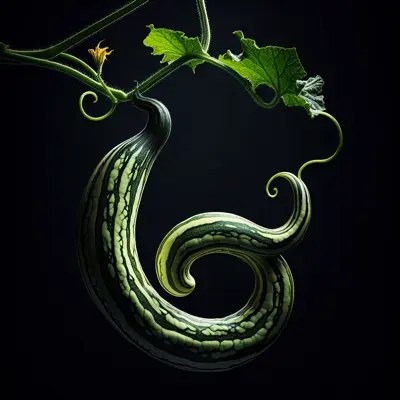
A stunning Armenian-type cucumber that's as beautiful as it is delicious, featuring distinctive light and dark green striped skin that looks hand-painted. These long, curved fruits can reach up to 20 inches and have incredibly sweet, crisp flesh with no hint of bitterness. This eye-catching variety is perfect for gardeners who want something truly unique that tastes as good as it looks.
Harvest
65-75d
Days to harvest
Sun
Full sun
Zones
2–11
USDA hardiness
Height
6-9 feet
Planting Timeline
Showing dates for Painted Serpent Cucumber in USDA Zone 7
All Zone 7 cucumber →Zone Map
Click a state to update dates
Painted Serpent Cucumber · Zones 2–11
Growing Details
Succession Planting
Painted Serpent is a warm-season annual that keeps producing as long as you keep picking — let one fruit reach full size and the vine slows down noticeably. A single planting in May can carry you through July, August, and into September in most zones without any need to stagger sowings the way you would with lettuce or radishes.
If you want a second wave for fall, direct sow again in late June to early July so the vines are established before peak heat and have time to produce before frost. Don't push past early July — this variety needs 65-75 days to harvest, and a July 1 sowing gets you to fruit by mid-September, which leaves a reasonable buffer before the first frost in most zone 7 areas (typically late October).
Complete Growing Guide
Armenian-type cucumbers like Painted Serpent mature rapidly at 65-75 days, so succession plant every two weeks for continuous harvest rather than a single planting. These vigorous vines demand sturdy vertical support to prevent the long fruits from snapping under their own weight and to maximize air circulation, which is critical since Armenian cucumbers are more susceptible to powdery mildew than slicing types. Plant in full sun with consistently moist, well-draining soil rich in organic matter, as inconsistent watering causes the striped skin to crack and flesh to become spongy. Unlike standard cucumbers, Painted Serpent rarely bolts prematurely and actually improves in flavor with warm temperatures, so don't rush spring planting—wait until soil reaches 70°F. A practical approach: harvest fruits at 12-16 inches rather than waiting for full maturity, as younger specimens maintain superior crispness and encourage extended production throughout the season.
Light: Full sun (6 or more hours of direct sunlight a day). Soil: Clay, High Organic Matter, Loam (Silt). Soil pH: Acid (<6.0), Neutral (6.0-8.0). Drainage: Good Drainage, Moist. Height: 6 ft. 0 in. - 9 ft. 0 in.. Spread: 1 ft. 0 in. - 3 ft. 0 in.. Spacing: 12 inches-3 feet. Growth rate: Medium. Maintenance: Medium. Propagation: Seed. Regions: Coastal, Mountains, Piedmont.
Harvesting
Harvest Painted Serpent cucumbers when the distinctive striped pattern becomes fully pronounced, transitioning from pale green to deeper emerald stripes, and fruits reach 12-18 inches for optimal sweetness and crisp texture. The skin should feel firm yet slightly yielding to gentle pressure, never soft or wrinkled. This variety produces continuously throughout the season, so pick every two to three days once flowering begins to encourage prolific fruiting and prevent oversized fruits from becoming tough and seedy. A crucial timing tip: harvest in early morning when temperatures are coolest, as this preserves the maximum crispness and natural sugars that make this Armenian type exceptional, and always use pruning shears rather than pulling to avoid damaging the delicate vine.
Musky-scented, spherical to oblong berry with a rind (pepo), often furrowed with yellow, white or green flesh and many seeds. The rind may be green, yellow, tan, beige or white and the surface may be smooth, rough, warty, scaly, or netted. Seeds white, about 1/2 inch long, narrow. Seeds ripen in August and September.
Color: Gold/Yellow, Green, White. Type: Berry. Length: < 1 inch. Width: < 1 inch.
Garden value: Edible, Showy
Harvest time: Fall
Edibility: Eaten fresh, wrapped in prosciutto, in salads, or as a dessert. Watery, but delicate, flavor. Avoid the seeds as the sprouting seed produces a toxic substance in its embryo.
Storage & Preservation
Fresh Painted Serpent cucumbers store best in the refrigerator wrapped in paper towels and placed in a perforated plastic bag, maintaining quality for 7-10 days. Unlike standard cucumbers, these Armenian types can handle slightly warmer storage (45-50°F) and may last up to 2 weeks in a cool basement or garage.
For preservation, their mild, sweet flavor makes them excellent for refrigerator pickles – slice and quick-pickle in rice vinegar with herbs for a Mediterranean-style condiment. They also freeze well when cut into chunks for later use in cold soups or smoothies, though texture becomes soft after thawing. Dehydrate thin slices for crispy snacks, or ferment chunks with salt brine for probiotic-rich additions to salads. Their low bitterness means they require minimal pre-treatment before preserving.
History & Origin
The Painted Serpent represents the Armenian cucumber lineage, a distinct culinary type botanically classified as Cucumis melo var. flexuosus rather than the common slicing cucumber. Armenian cucumbers have been cultivated for centuries across the Caucasus and Middle East regions, prized for their sweet flavor and smooth digestion. While specific documentation of the Painted Serpent's breeder and introduction year remains limited in publicly available records, this variety exemplifies the modern seed industry's focus on reviving and selecting heirloom Armenian types for their exceptional taste and ornamental striped characteristics. Contemporary seed companies have championed these varieties among home gardeners seeking distinctive, flavorful alternatives to standard cucumber cultivars.
Origin: Africa, Arabian Peninsula, India, Australia
Advantages
- +Striking hand-painted striped skin makes this cucumber incredibly ornamental and garden-worthy.
- +Exceptionally sweet and crisp flesh with zero bitterness appeals to fresh-eating preferences.
- +Relatively quick maturation at 65-75 days provides timely harvests for most growing seasons.
- +Long curved fruits reaching 20 inches offer impressive yields from compact vine space.
- +Easy to moderate difficulty makes this variety accessible to beginning and experienced gardeners.
Considerations
- -Susceptible to powdery and downy mildew requiring consistent fungal disease management.
- -Vulnerable to multiple pest pressures including cucumber beetles, aphids, and spider mites.
- -High moisture needs and bacterial wilt risk demands careful watering and soil management.
- -Curved shape complicates harvesting and storage compared to straighter cucumber varieties.
Companion Plants
Radishes and nasturtiums are worth planting at the bed edge. Radishes act as a trap crop for flea beetles and can pull aphid pressure away from your cucumbers — you sacrifice a few radishes, the cucumbers grow without the attention. Nasturtiums do something similar for aphids, and their sprawling habit covers bare soil that would otherwise stay open and weedy. Direct-sow both right alongside your cucumber transplants in May and they'll be established before pest pressure picks up.
French marigolds (Tagetes patula specifically, not the big African types) have documented nematode suppression in the root zone — not just garden lore. That matters here because root knot nematodes are a real problem in warm-season beds, and Painted Serpent's long vines mean a lot of root territory to protect. Bush beans fix a modest amount of nitrogen that cucumbers will use, and corn or sunflowers pull double duty as a ready-made vertical structure — this variety climbs 6-9 feet, so anything that gets it off the ground earns its place. Dill is worth letting flower nearby; it draws predatory wasps that feed on aphids, and you'll see them working the blooms within a week of the flowers opening.
Potatoes and melons are the two to keep out. Potatoes share several soil-borne diseases with cucumbers and compete at the same root depth. Melons are fellow cucurbits, so planting them adjacent concentrates cucumber beetle pressure in one spot — NC State Extension recommends rotating away from the entire cucurbit family for 3 years as the best cultural control for beetles, and crowding two cucurbits together works against that logic entirely. Tight-planted aromatic herbs like rosemary or sage are mostly harmless elsewhere in the garden, but pressed right up against cucumber roots they can slow young transplants through allelopathic compounds in the root zone.
Plant Together
Radishes
Repel cucumber beetles and squash bugs while improving soil structure
Nasturtiums
Act as trap crop for cucumber beetles and aphids, repel squash bugs
Marigolds
Deter nematodes, aphids, and cucumber beetles with strong scent
Bush Beans
Fix nitrogen in soil and provide ground cover without competing for space
Corn
Provides natural trellis support and shade while cucumbers suppress corn pests
Sunflowers
Attract beneficial insects and provide vertical growing support
Dill
Attracts beneficial insects like parasitic wasps that control cucumber pests
Lettuce
Benefits from cucumber's shade while maximizing garden space efficiency
Keep Apart
Aromatic Herbs
Strong herbs like sage and rosemary can inhibit cucumber growth and flavor
Potatoes
Compete for nutrients and space, may increase disease susceptibility
Melons
Cross-pollination can affect fruit quality and they compete for identical resources
Nutrition Facts
Per 100g serving. % Daily Value based on 2,000 calorie diet. Source: USDA FoodData Central (FDC #169225)
Pests & Disease Resistance
Resistance
Good heat tolerance and moderate disease resistance
Common Pests
Cucumber beetles, aphids, spider mites
Diseases
Powdery mildew, downy mildew, bacterial wilt
Troubleshooting Painted Serpent Cucumber
What you'll see, why it happens, and what to do about it.
Lower leaves developing large tan or brown spots between the veins, with scorched-looking edges — plants wilting despite regular watering
Likely Causes
- Bacterial wilt (Erwinia tracheiphila) — transmitted by cucumber beetles feeding on leaves, blocks vascular tissue
- Root knot nematodes — cause lumpy, stunted root systems that can't take up water even when soil is moist
What to Do
- 1.Cut a wilted stem and touch the two cut ends together, then pull slowly apart — if you see stringy bacterial ooze bridging the gap, it's bacterial wilt; pull and bag those plants immediately, don't compost them
- 2.Check the roots for lumpy, knotted galls; if present, rotate this bed out of cucurbits for at least 3 years and plant a full-season cover of French marigolds (Tagetes patula) to suppress nematode populations before replanting
- 3.Control cucumber beetles from the start — row cover until flowers open, then pull it for pollination; NC State Extension notes that crop rotation waiting at least 3 years before returning to any cucurbit family crop is the most reliable long-term fix
White powdery coating on upper leaf surfaces, spreading from older leaves toward new growth, typically showing up mid-season
Likely Causes
- Powdery mildew (Podosphaera xanthii) — favored by warm days, cool nights, and low humidity; does not require wet leaves to spread
- Dense canopy with poor airflow — Painted Serpent vines reach 6-9 feet and tangle fast if left untrained
What to Do
- 1.Train growth vertically on a trellis and remove crossing vines to open up the canopy
- 2.Apply diluted neem oil (follow label rates) every 7-10 days once you spot the first white patches — once it's well established across multiple leaves, you're managing spread, not curing it
- 3.Strip heavily infected leaves and trash them; spores left on the soil surface can reinfect new growth
Stippled, bronze-looking leaves — tiny moving dots visible on the undersides, getting worse during hot dry stretches
Likely Causes
- Two-spotted spider mites (Tetranychus urticae) — populations explode when temps stay above 85°F and humidity drops
- Reduced overhead irrigation leaving dry leaf surfaces, which mites prefer over moist ones
What to Do
- 1.Flip a leaf and check with a hand lens — webbing and pale pinhead-sized mites confirm the diagnosis
- 2.Hit the undersides of leaves with a strong jet of water three mornings in a row to knock populations back before reaching for a spray
- 3.For heavy infestations, apply insecticidal soap or neem oil directly to leaf undersides every 5-7 days — skipping the undersides means you're missing most of the population
Frequently Asked Questions
How long does Painted Serpent cucumber take to grow?▼
Can you grow Painted Serpent cucumbers in containers?▼
What does Painted Serpent cucumber taste like?▼
Is Painted Serpent cucumber good for beginners?▼
When should I plant Painted Serpent cucumber seeds?▼
Are Painted Serpent cucumbers actually cucumbers?▼
Zone-by-Zone Planting Calendar
| Zone | Indoor Start | Transplant | Direct Sow | Harvest |
|---|---|---|---|---|
| Zone 1 | June – June | July – August | July – September | October – August |
| Zone 2 | May – June | July – July | July – August | September – September |
| Zone 11 | January – January | February – February | February – March | April – June |
| Zone 12 | January – January | February – February | February – March | April – June |
| Zone 13 | January – January | February – February | February – March | April – June |
| Zone 3 | May – May | June – July | June – August | September – October |
| Zone 4 | April – May | June – June | June – July | September – October |
| Zone 5 | April – April | May – June | May – July | August – October |
| Zone 6 | April – April | May – June | May – July | August – September |
| Zone 7 | March – April | May – May | May – June | July – September |
| Zone 8 | March – March | April – May | April – June | July – August |
| Zone 9 | February – February | March – April | March – May | June – July |
| Zone 10 | January – February | March – March | March – April | May – July |
Growing Guides from Wind River Greens
Sources & References
External authority sources used in compiling this guide.
See the Methodology page for how this data is sourced, what's AI-assisted, and known limitations.